Um genaue Preise zu sehen, wählen Sie bitte Ihr Lieferland.
 
 
United States
£ GBP
Alle Kategorien
Important Notice for US Customers

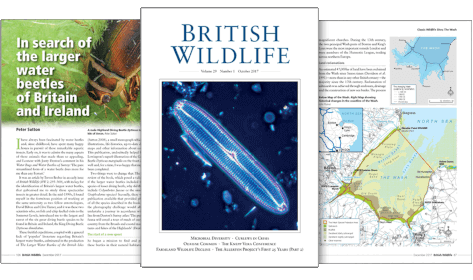
British Wildlife

8 issues per year 84 Seiten per Ausgabe Nur im Abonnement erhältlich

British Wildlife is the leading natural history magazine in the UK, providing essential reading for both enthusiast and professional naturalists and wildlife conservationists. Published eight times a year, British Wildlife bridges the gap between popular writing and scientific literature through a combination of long-form articles, regular columns and reports, book reviews and letters.

Abonnement ab £33 im Jahr

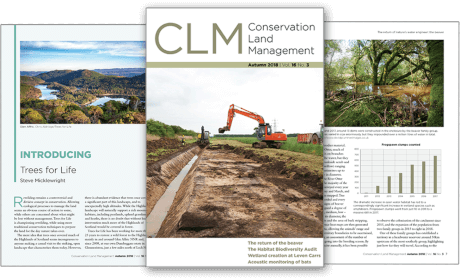
Conservation Land Management

4 Auflagen im Jahr 44 Seiten Nur im Abonnement erhältlich

Conservation Land Management (CLM) ist ein Mitgliedermagazin und erscheint viermal im Jahr. Das Magazin gilt allgemein als unverzichtbare Lektüre für alle Personen, die sich aktiv für das Landmanagement in Großbritannien einsetzen. CLM enthält Artikel in Langform, Veranstaltungslisten, Buchempfehlungen, neue Produktinformationen und Berichte über Konferenzen und Vorträge.

Subscriptions from £26 per year
Akademische und professionelle Bücher  Reptiles & Amphibians  Amphibians

Advances in Amphibian Research in the Former Soviet Union, Volume 10: The Amphibians of Belarus

By: SM Drobenkov, RV Novitsky, LV Kosova, KK Ryzhevich and MM Pikulik
168 pages, Graphs, tables, 14 colour plates
Advances in Amphibian Research in the Former Soviet Union, Volume 10: The Amphibians of Belarus
Click to have a closer look
  • Advances in Amphibian Research in the Former Soviet Union, Volume 10: The Amphibians of Belarus Paperback Dec 2006 In stock
    £56.99
    #160547
Price: £56.99
About this book Contents Customer reviews Related titles

About this book

This book summarizes the results of a long-term investigation of amphibian distribution, ecology and morphology in the Republic of Belarus. For all amphibian species, Triturus vulgaris, T. cristatus, Bombina bombina, Pelobates fuscus, Bufo bufo, B. viridis, B. calamita, Hyla arborea, Rana temporaria, R. arvalis, R. ridibunda, R. lessonae and Rana esculenta, geographical and habitat distribution, assemblage structure, feeding, activity, reproduction and development are described. Detailed analysis of morphological variation and the differentiation of dominant populations by landscape regions are given. Regional problems of anthropogenic pressure and methodology of species conservation are discussed. The book may be used by both specialists and amateurs.

Contents

Introduction, Chapter 1. Materials and Methods, Chapter 2. Physical and Geographical Characterization of Belarus, Chapter 3. Systematic Overview, Smooth Newt, Triturus vulgaris (Linnaeus, 1758), Great Crested Newt, Triturus cristatus (Laurenti, 1768), Fire-Bellied Toad, Bombina bombina (Linnaeus, 1761), Common Spadefood, Pelobates fuscus (Laurenti, 1768), Common Toad, Bufo bufo (Linnaeus, 1758), Green Toad, Bufo viridis Laurenti, 1768, Natterjack Toad, Bufo calamita Laurenti, 1768, Common Tree Frog, Hyla arborea (Linnaeus, 1758), Common Frog, Rana temporaria Linnaeus, 1758, Moor Frog, Rana arvalis Nilsson, 1842, Marsh Frog, Rana ridibunda Pallas, 1771, Pool Frog, Rana lessonae Camerano, 1882, Edible Frog, Rana esculenta Linnaeus, 1758, Chapter 4. Structure of Assemblages and Synecology, 4.1. Dynamics of Faunistic Complexes, 4.2. Structural Organization of Assemblages, 4.3. Habitat Distribution and Population Number, 4.4. Trophic Structure, Chapter 5. Phenotypic Variability of Populations, 5.1. Intraspecific Variability of Morphometric Characters of the Moor and the Common Frogs, 5.2. Interpopulation Variability of Morphometric Characters of the Moor and the Common Frogs, 5.3. Analysis of Variability of Phenetic Structures of Moor and Common Frog Populations, Chapter 6. Reproduction and Development, 6.1. Phenology of Reproduction, 6.2. Spawning, 6.3. Embryonic and Larval Development, Chapter 7. Anthropogenic Influences and Conservation, 7.1. Main Anthropogenic Factors, 7.2. Current State and Dynamics of Populations, 7.3. Conservation Measures, Conclusions, List of Sites and Structure of Amphibian Associations, References, Color Plates,

Customer Reviews

By: SM Drobenkov, RV Novitsky, LV Kosova, KK Ryzhevich and MM Pikulik
168 pages, Graphs, tables, 14 colour plates
Current promotions
Great GiftsNew and Forthcoming BooksBritish Wildlife Magazine SubscriptionField Guide Sale 2025