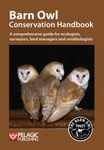
Handbook / Manual
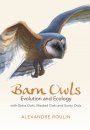
By: The Barn Owl Trust(Author), Graham R Martin(Foreword By)
395 pages, 32 plates with 46 colour photos & colour illustrations; b/w photos, b/w illustrations
"The definitive reference for those with an interest in Barn Owls" - Mike Toms, BTO

Click to have a closer look
About this book
Contents
Customer reviews
Biography
Related titles
Recommended titles
About this book
A comprehensive handbook covering all aspects of the conservation of Barn Owls. Written by the Barn Owl Trust, this book includes in-depth information on Barn Owl survey techniques, relevant ecology, Barn Owls and the law, mortality, habitat management, use of nest boxes and barn Owl rehabilitation. Essential reading for ecologists, planners, land managers and ornithologists.
Founded in 1988, the Barn Owl Trust is a small national charity working very hard to conserve one of the most beautiful birds on Earth. Anyone who has ever watched a wild Barn Owl hunting at dusk has surely been touched by the experience. Sadly, these magical birds have become increasingly rare – and the reasons are all man-made. Lack of food due to intensive farming, the loss of roost and nest sites, road mortality and rat poison, are the main factors to blame. The BOT is a small team of professional staff and volunteers, a grass-roots, non-profit organisation, based on the edge of Dartmoor in Devon. With nearly 30 years' experience in the field, they aim to be the experts on all aspects of UK Barn Owl conservation.
Contents
1. Introduction
2. Ecology
3. Legal issues
4. Surveys
5. Habitat
6. Nestboxes
7. Mortality
8. Planning
9. Rehabilitation
Customer Reviews
Biography
The Barn Owl Trust is a registered charity based in the southwest of England. Its main areas of work are practical conservation, education, research and the provison of information. The Trust is the main source of Barn Owl information in Britain dealing with over 5,000 conservation enquiries a year. The advice the Trust provides is based on 26 years of first-hand experience in practical and advisory conservation work on farms, over 20 years of research and educational work, plus 10 years first-hand experience in habitat creation and management on the Trusts own land.
County-wide Barn Owl Surveys, owl ringing, research into the effects of barn conversions and major road mortality and investigations into foraging behaviour and post-fledging dispersal using radio-tracking, the erection of over 1,500 nestboxes and the training of ecological consultants are all part of the broad base of experience. The Barn Owl Trust recently produced Natural England’s standing advice on Barn Owls and Rural Planning and is currently in consultation with the Highways Agency regarding the mitigation of road mortality. Since its foundation in 1988, the Barn Owl Trust has established an excellent reputation amongst conservation organisations. Despite being consulted by government and recognised in the Queens Birthday Honours List, the Barn Owl Trust is still a grass-roots organisation carrying out a huge amount of practical conservation work.
Handbook / Manual
By: The Barn Owl Trust(Author), Graham R Martin(Foreword By)
395 pages, 32 plates with 46 colour photos & colour illustrations; b/w photos, b/w illustrations
"The definitive reference for those with an interest in Barn Owls" - Mike Toms, BTO
"As its title suggests, this is very much a hands-on tome, aiming to provide practical advice to those working in the field, be they consultants surveying for breeding pairs, developers renovating properties or conservationists keen to improve environmental conditions for local populations. The Barn Owl Trust have offered this type of support via helplines and through their website since the charity was founded in 1988 and are therefore ideally placed to produce such a guide."
– David Leech, IBIS
"It contains a wealth of information of interest to its target audience and beyond. Perhaps also, despite the challenges that humans inadvertently put in the path of barn owl survival, like motorways, it is an uplifting tribute to the energy and commitment that so many people have devoted to the cause of this beautiful bird."
– James Robertson, Natur Cymru
"The Barn Owl Trust has produced an excellent guide for anyone involved in the conservation of barn owls. There are chapters on starting a survey, creating new habitat, providing nest boxes, mitigation and mortality."
– Nigel Middleton, The Peregrine
"How I wish this book had been on my shelves when I first began my study of Barn Owls 47 years ago. If it had been, countless hours of lost sleep and many millions of midge bites could have been avoided, for it answers virtually every question a Barn Owl researcher needs to ask. It is a magnificent work and must have taken a herculean effort to put together and verify the mass of data held within its 395 pages."
– Tony Warburton
"The most complete and concise catalogue of techniques, methods and practices used to protect the Barn Owl, both in captivity and in the wild [...] Anyone who has any interest and any capacity to assist in Barn Owl conservation should own this important book."
– Chris Packham
"Packed with well-researched information and drawing on over two decades of first-hand experience, the Barn Owl Trust's book looks set to become the definitive reference for those with an interest in Barn Owls, their ecology and conservation. Like the Trust, this book is upbeat and practical, delivering an optimistic approach to Barn Owl conservation that is accessible to readers from a wealth of backgrounds."
– Mike Toms, BTO, coordinator of the national Barn Owl survey: Project Barn Owl
"Here you will find guidance on all aspects of Barn Owl conservation, from the care of injured birds, the creation and conservation of suitable habitat for their maintenance and successful breeding, to thorny questions about the impact of major roads and secondary poisoning by rodenticides. It would be easy to write a book about Barn Owls that would be a classic in the genre of conservation gloom and doom. Barn Owls are under pressure from multiple sources which are well analysed and described here. But rather than throwing up our hands, we are invited by this guide to take a very positive approach"
– Graham Martin, Emeritus Professor Centre for Ornithology, School of Biosciences, University of Birmingham
"Covering everything from nestboxes to land surveys and planning issues, this comprehensive handbook is a vital reference for anyone involved in the conservation of this, one of our most cherished birds."
– Steve Gantlett, Birding World 25(11), December 2012
"The Barn Owl Trust has an excellent reputation for providing high-quality advice about this species, and their website is full of leaflets and information notes covering a wide range of subjects. This book brings together all that advice and guidance in one place, providing an invaluable resource for anyone involved in barn owl Tyto alba conservation. [...] This volume is the definitive guide for those involved in barn owl conservation but will hopefully help to achieve a great deal more besides."
– Ian Carter, British Birds, 15-10-2012