To see accurate pricing, please choose your delivery country.
 
 
United States
£ GBP
All Shops
Important Notice for US Customers

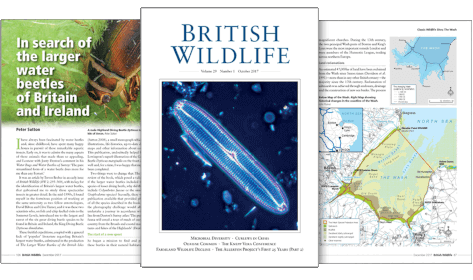
British Wildlife

8 issues per year 84 pages per issue Subscription only

British Wildlife is the leading natural history magazine in the UK, providing essential reading for both enthusiast and professional naturalists and wildlife conservationists. Published eight times a year, British Wildlife bridges the gap between popular writing and scientific literature through a combination of long-form articles, regular columns and reports, book reviews and letters.

Subscriptions from £33 per year

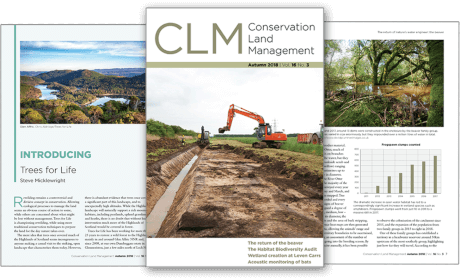
Conservation Land Management

4 issues per year 44 pages per issue Subscription only

Conservation Land Management (CLM) is a quarterly magazine that is widely regarded as essential reading for all who are involved in land management for nature conservation, across the British Isles. CLM includes long-form articles, events listings, publication reviews, new product information and updates, reports of conferences and letters.

Subscriptions from £26 per year
Field Guides & Natural History  Ornithology  Birds of Europe/Western Palaearctic

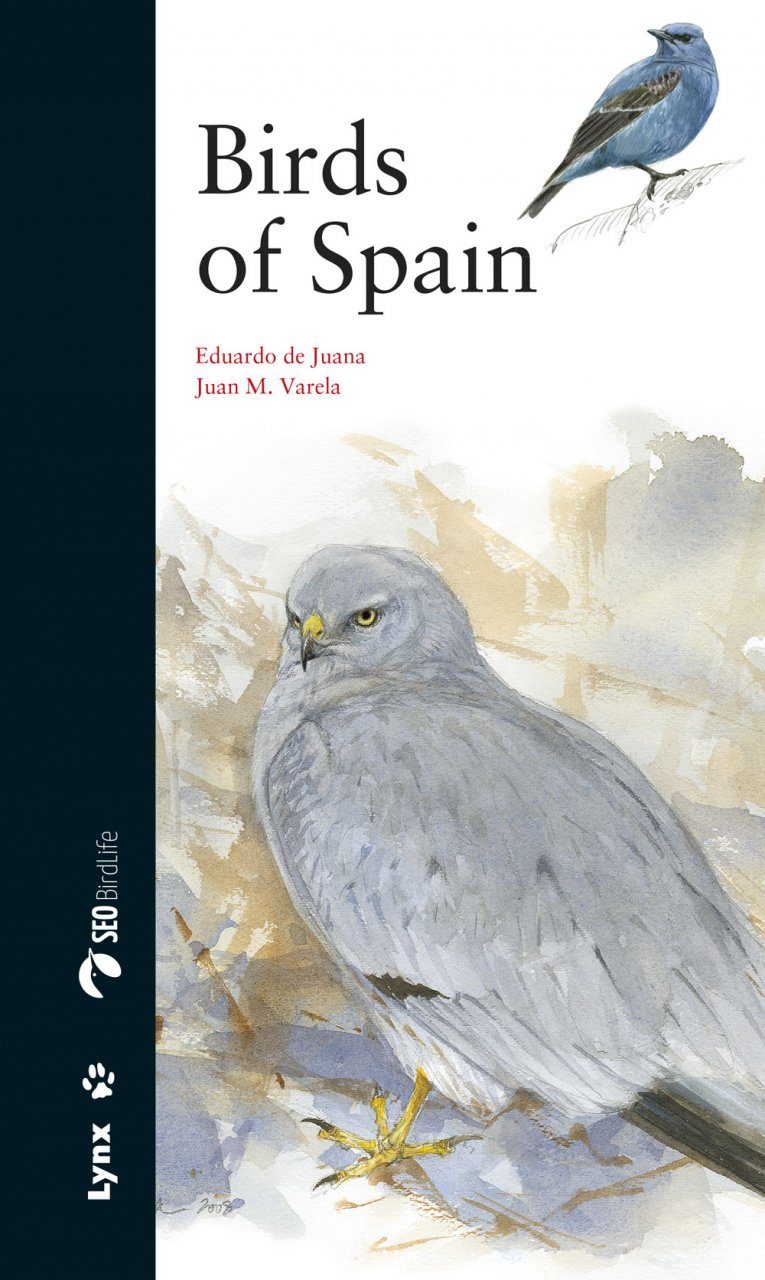
Birds of Spain

Field / Identification Guide
By: Eduardo de Juana Aranzana(Author), Juan M Varela Simó(Author), Ernest FJ García(Translated by), Mike Lockwood(Translated by)
286 pages, ~1000 colour illustrations, 300+ colour distribution maps
Publisher: Lynx Edicions
Birds of Spain
Click to have a closer look
Select version
Average customer review
  • Birds of Spain ISBN: 9788416728022 Edition: 1 Hardback Feb 2017 Not in stock: Usually dispatched within 4 days
    £27.99
    #234234
  • Birds of Spain ISBN: 9788416728732 Edition: 2 Paperback Jan 2025 In stock
    £34.99
    #265449
Selected version: £34.99
About this book Customer reviews Related titles
Images Additional images
Birds of SpainBirds of SpainBirds of SpainBirds of SpainBirds of Spain

About this book

Language: English

The second edition of Birds of Spain is based on the thoroughly revised and updated fourth edition of Aves de España, the most popular field guide to the identification of the birds of Spain. Recommended by SEO/Birdlife, this guide offers the most current information on all bird species found within Spanish territories, including Peninsular Spain, Ceuta, Melilla, and the Balearic and Canary Islands.

- Comprehensive Coverage: It includes detailed descriptions of 599 species, with 191 classified as occasional or accidental, and 5 noted as extinct.
- Illustrations: The guide features over a thousand colour illustrations, with 129 new additions in this edition, highlighting key identification details for each species.
- Maps: Contains over 300 maps showing the distribution and presence of species throughout the year.
- Multilingual Index: For ease of reference, bird names are provided in Spanish, Catalan, Basque, and Galician.
- Enhanced Digital Content: QR codes link to the SEO/BirdLife Guide to the Birds of Spain, providing access to supplementary texts, illustrations, videos, photographs, and audio recordings of bird songs and calls.
- Dual Purpose: It serves as both a field guide for birdwatchers and a concise reference for those seeking an up-to-date overview of Spanish avifauna.

This edition caters to a wide audience, from beginners in birdwatching to experienced ornithologists seeking a reliable and comprehensive reference on Spanish birds. A detailed references list is included, highlighting key recent publications on the Spanish avifauna, such as ornithological atlases, regional avifaunas, and bird reports, both print and online. This guide also recommends further identification resources and guides on where to observe birds in Spain.

Customer Reviews (2)

  • A great new version
    By Keith 27 May 2025 Written for Paperback
    The very first edition of this book appeared way back in 2000 as Aves de España and became an immense success with people in Spain, and I remember wishing there was an English version. That finally arrived in 2017 and dealt with 567 species. Now we have the second English edition which covers 599 species (which includes 191 vagrants and scarce migrants which are not all illustrated and are given a short text with status in an appendix).

    We are all used to the high quality of the illustrations in the Collins Bird Guide, and I think Juan Manuel Varela’s illustrations are just as good, facing right and with pointers to the main ID features. In total there are over 1000 colour illustrations, and 129 of these are new for this edition. New species include Moltoni’s Warbler (split from Western Subalpine Warbler and a summer visitor to Mallorca and Ibiza – and vagrant elsewhere), Gran Canaria Blue Chaffinch (split from the wider form that included birds on Tenerife), Red-billed Tropicbird (which now has a small breeding colony on Fuerteventura), Laughing Dove (now resident on most of the Canary Islands) and European Pygmy-owl (several pairs were recently discovered nesting in Catalonia).

    I particularly like the 300-plus colour distribution maps which show a map measuring 25 mm × 25 mm of Spain, with Portugal included and nearby parts of France and Morocco. For those species also found regularly in the Canary Islands there is a small map for that too.

    A useful feature is a QR code for each species which links to the SEO/BirdLife Guide to the Birds of Spain. This is in Spanish, so your phone will need to automatically translate. This told me that Jack Snipe was Little Snipe (!), but the main reason I used the link was to access sound recordings for immediate in-the-field comparisons. There is also a directory of 57 areas to visit (including 7 in the Canary Islands).

    This book is handy for use in the field (12 cm × 21 cm) and weighs 550 gm. Much as I love my Collins Guide, this is the book that will accompany me to Spain and Portugal.
    Was this helpful to you? Yes No
  • A compact, updated field guide to Spanish birds
    By Gehan de Silva Wijeyeratne 8 Oct 2025 Written for Paperback
    My spontaneous reaction to this book was an overarching impression of a book that seems clean and fresh and friendly to people whose birding is at a beginner or intermediate level. However, I should immediately add that the quality of the text and the structure of information is good enough to satisfy experienced birders. So why does this book seem like a ‘friendly’ book for newcomers.

    The answer seems to lie in the illustrations being much bigger, perhaps twice the size of other field guides. Plus, there is a pleasing painterly touch to the illustrations. This does not detract from the accuracy. The illustrations are life-like and have the accuracy of detail expected from an advanced field guide. But nevertheless, they are pleasing and an interesting departure from the photo-realism style that has become more normal. Also, it may actually help newcomers to birding to have a book where the illustrations are easier on the eye and not too busy with several illustrations of different age class or sub-species plumages.

    The identification aspect of the text is very good and reflects much of the recent advances in bird identification. In fact, as an ID guide, the book will work well anywhere in Europe for the regularly occurring species. The book is also compact and lighter than European gold standard, the Collins Bird Guide. For European birders flying into Spain for a short break and needing to carry everything in a day pack on a budget airline, this book is a good alternative. Especially so if you are a regular to Spain and are interested in the distribution text which is specific to Spain. However, the clear distribution maps cover the whole of the Iberian Peninsula, quite often extending to the North African coast as well. I would have been quite happy to have had this book on my last visit to Portugal because it would have been perfectly adequate as a field guide for Portugal as well.

    The text on distribution and abundance is Spain-centric. This book will serve well the many native English speakers who visit regularly or have a second home in Spain. But wherever you live in Europe, it is always to compare and contrast the relative abundance of some species of birds in your home country versus another you are visiting. Visiting birders may find this extra information of interest as field guides often omit that level of detail to remain compact. But this book manages to fit extra information in concisely and even in some cases information on subspecies or similar species whilst keeping the book relatively compact.

    The text facing the pages has clear distribution maps. As with other field guides by Lynx Nature Books there are QR codes as well, on the text page facing the plates. These take you to the SEO Birdlife’s Guía de Aves de España site in Spanish. What is most helpful is that you can then listen to the calls as well.

    The main section ends with abbreviated accounts of rarities some of which are illustrated. The end pages include a good bibliography, a checklist of species, links to regional bird reports and other internet resources. All in all, it's a field guide that has been put together well and will be a good role model for other country-level field guides which want to pack in a lot of information but nevertheless feel accessible those who have not crossed the line to being hardcore birders.
    Was this helpful to you? Yes No
Field / Identification Guide
By: Eduardo de Juana Aranzana(Author), Juan M Varela Simó(Author), Ernest FJ García(Translated by), Mike Lockwood(Translated by)
286 pages, ~1000 colour illustrations, 300+ colour distribution maps
Publisher: Lynx Edicions
Media reviews

"[...] One day it would be nice to see a field guide that covers the whole of the Iberian Peninsula, combining Spain and Portugal. However if I needed a bird field guide for Spain only, I would definitely consider buying this one. Both authors are very well known in their field and have authored many books previously. This publication represents a further improvement since the first edition."
– Diana de Palaci, BTO book reviews

"[...] I always used to recommended that British visitors to Spain should buy a copy of Aves de España even if their Spanish was, like mine, very limited so, despite my minor caveats, I have no hesitation in recommending this English language version. It is a convenient and reasonably priced source of information, in English, that can only be found in a far more expensive reference book – The Birds of the Iberian Peninsula (also by Eduardo de Juana and the translator here Ernest Garcia). Enthusiasts, of course, will want both one for the bookshelf and one for the field.  Although aimed at a novice or 'intermediate' birdwatcher, this is a superb little guide crammed with useful information which any Anglophone visitor to or resident in Spain would be foolish not to have with them. Very highly recommended."
– John Cantelo, Birding Cadiz Province blog

Current promotions
Great GiftsNew and Forthcoming BooksBritish Wildlife Magazine SubscriptionField Guide Sale 2025