

United States
£ GBP
Language: English
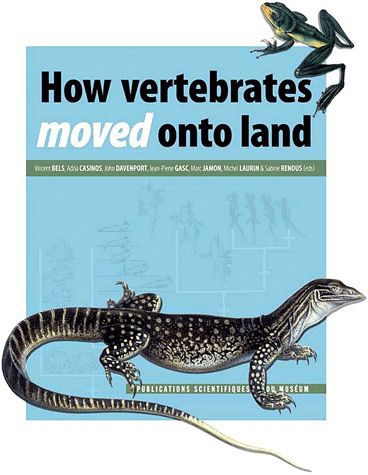
Among vertebrates, the evolutionary transition from an aquatic or amphibious to a fully terrestrial life seems to have occurred potentially more than once within the clade. These events probably occurred in the Carboniferous. Selective pressures faced by the first amphibious or terrestrial vertebrates due to environmental constraints in their new environments generated drastic changes in locomotor structures, performances and strategies in vertebrates. To explain "how vertebrates moved onto land", this volume presents a comparative investigation of locomotion, from structure to motor control, in fossil and living groups. The present volume provides an up-to-date integrative study on these, based on morphology, physiology, palaeontology, biomechanics, behavioral ecology, and neurobiology.
The first paper shows how the hypotheses about transition changed through time. The two following papers show how our knowledge of locomotor structures of vertebrates suggests a possible scenario explaining this evolutionary transition. However, locomotor performance and motor control in extinct taxa can be inferred only from extensive analysis of locomotor modes (i.e., walking, trotting, running, jumping, hopping) in recent organisms relevant to the evolutionary transition from water to land. In three other papers, locomotor performances are studied through comparative approaches in fully aquatic vertebrates, in vertebrates transitorily inhabiting terrestrial environments, and in vertebrates which have definitively passed through the transition to permanently terrestrial occupation.







![Le Lagerstätte de La Voulte: Un Environnement Bathyal au Jurassique [The Lagerstätte of La Voulte: A Bathyal Environment in the Jurassic]](http://mediacdn.nhbs.com/jackets/jackets_resizer_medium/18/183483.jpg?height=150&width=118)
![La Flore Fossile du Bassin Houiller de Saint-Etienne [The Fossil Flora of the Bassin Houiller of Saint-Etienne]](http://mediacdn.nhbs.com/jackets/jackets_resizer_medium/61/61163.jpg?height=150&width=120)





![Kame no Kōra wa Abarabone: Jintai de Arawasu Ugokumonozukan [Turtle Shells Have Ribs: A Picture Book of Animal Anatomy Represented by the Human Body]](http://mediacdn.nhbs.com/jackets/jackets_resizer_medium/24/249897.jpg?height=150&width=99)


![Atlas des Mammifères Sauvages de France, Volume 1: Mammifères Marins [Atlas of Wild Mammals of France, Volume 1: Marine Mammals]](http://mediacdn.nhbs.com/jackets/jackets_resizer_medium/23/233077.jpg?height=150&width=108)
![Antoine-Laurent de Jussieu (1748-1836): Fabrique d'une Science Botanique [Production of Botanical Science]](http://mediacdn.nhbs.com/jackets/jackets_resizer_medium/25/259747.jpg?height=150&width=103)


![Atlas des Mammifères Sauvages de France, Volume 2: Ongulés et Lagomorphes [Atlas of Wild Mammals of France, Volume 2: Ungulates and Lagomorphs]](http://mediacdn.nhbs.com/jackets/jackets_resizer_medium/25/252352.jpg?height=150&width=107)
![Atlas des Mammifères Sauvages de France, Volume 3: Carnivores et Primates [Atlas of Wild Mammals of France, Volume 3: Carnivores and Primates]](http://mediacdn.nhbs.com/jackets/jackets_resizer_medium/26/263780.jpg?height=150&width=106)
![Les îles Saint-Paul et Amsterdam (Océan Indien Sud): Environnement Marin et Pêcheries [Saint-Paul and Amsterdam Islands (South Indian Ocean): Marine Environment and Fisheries]](http://mediacdn.nhbs.com/jackets/jackets_resizer_medium/26/260268.jpg?height=150&width=107)

![Les Chauves-Souris de Guyane [The Bats of French Guiana]](http://mediacdn.nhbs.com/jackets/jackets_resizer_medium/13/134247.jpg?height=150&width=100)