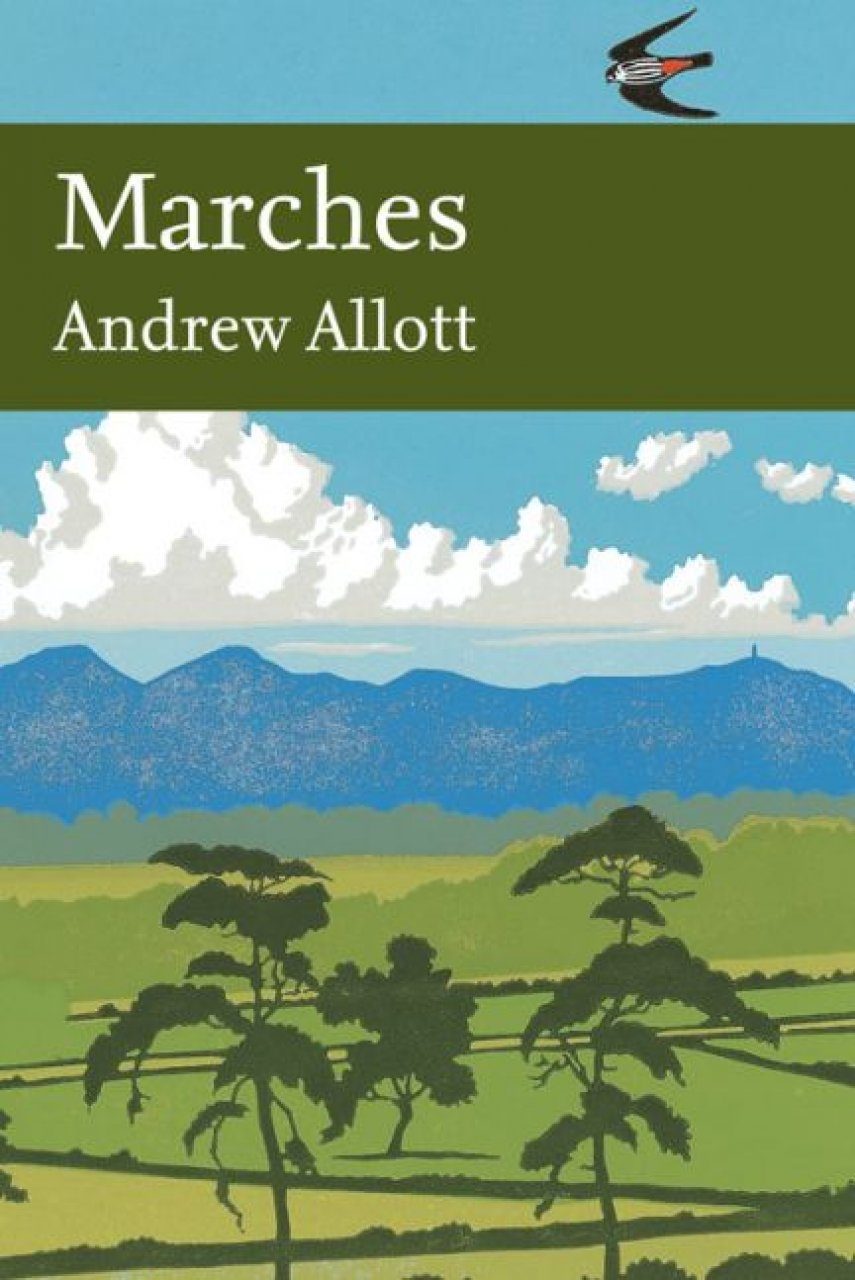
Marches
A complete natural history and the first large-scale survey of this unique part of the country. The borderland between England and Wales has long been a region of contention. Its distinctive geography, wedged roughly between Welsh mountains and English river beds has not only isolated this rural, sparsely-populated slice of land, but created a unique identity. Stretching along the bordering counties with England -- Cheshire, Shropshire, Herefordshire and Monmouthshire -- the Welsh Marches are made up of a mixture of mountains and moorlands, farms and wooded river valleys. The natural history of the region is like most parts of the British Isles -- inextricably linked to the activities of man across many thousands of years.
Andrew Allott brings together a wealth of material in the latest New Naturalist volume, much of which is published here for the first time. Presenting the first large-scale survey of this unique part of the country, he offers a complete natural history of the area, covering the hills, fossils, ice ages, meres, mosses, forests, streams and rivers, whilst also focusing on man's impact on the region, the changing wildlife, the impact of agriculture and the scars of past and present industrial activity.
Praise for the New Naturalist series:
"The series is an amazing achievement."
- The Times Literary Supplement
"The books are glorious to own."
- Independent
Customer reviews for this volume:
Magnificent Marches
by S.W.Mott in the United Kingdom
In the early 1980s, I lived and worked in Gloucester and undertook numerous outings to the Welsh Marches to walk and watch wildlife. So Andrew Allott's book "Marches" has been eagerly awaited. It is a superb, masterly addition to the NN series.
Here we have a comprehensive account of the region, which is meticulously researched and thoughtfully detailed. The text includes examples to illustrate the wider context and the themes of the chapters. Mr Allott makes very good use of local sources and resources for much of these, such as the charming reference to the work done by a local Primary School (p.75) and other local people, communities and wildlife groups. This is absolutely the right approach as it embeds the book in the region it describes.
The book is well structured; the first chapter invites us to take a "tour" of the region's main, distinctive topographical areas which serve as a scaffold for the following chapters, whose themes take the unique and chararcteristic features of the Border landscape arising within the topographical areas.
Mr Allott writes in an interesting and flowing style. It is well structured. His attention to detail is woven seamlessly into the overview, the carefully chosen examples serve as fascinating insights into the natural history of the region.
The chapters cover the expected themes but include up-to-date analysis ands review of nature conservation, farming, land-use changes and local development and management, and outlining lessons learned and issues for the future. I found myself thinking that the lessons learned in the Marches region could well be applied elsewhere too!
My only niggles are in the editing of the book. In trying to fit some of the Figures on to one page renders some of the detail too small to read, (make it almost meaningless) or makes the use of colour coding difficult to differentiate. There are inconsistencies too - why can Figs 16 or 104 for example be provided with a colour key, yet Figs 81 and 82 are not? For the latter, the reader has to wade through text which explains the colour.
On p41 we have an ambiguous paragraph which, on first reading, makes it seem that a new set of semi-natural squatters have returned to the Clee Hills. I suspect that the word "vegetation" has been omitted after the word "semi-natural"! Perhaps trying to publish 3 NN titles a year is having a negative effect on the editing.
These small niggles do not detract very much from this magnificent account of the varied, rich and very distinctive natural history of the Marches. To try to shoe-horn this into any descriptive framework is a challenge and one in which Mr Allott has succeeded - and succeeded triumphantly.

Andrew Allott studied botany at Pembroke College, Oxford and is currently Head of Biology at Shrewsbury School (Charles Darwin's former school). He has written a biology textbook for OUP, published in 2001. He lives in Shropshire and has an active interest in ecology
Other products you may be interested in:
- Bestselling
- New
- Offers
Vew all titles in Europe combined with Britain & British Isles (GEN)
View other products from the same publisher
Related organisations include:
- Avalon trekking
- Beds,Cambs,Northants & Peterborough Wildlife Trust
- Biosphere Expeditions
- Cornwall Wildlife Trust
- Joint Nature Conservation Committee
- Scottish Wildlife Trust