United States
£ GBP
The D-1000X is a specialist item that NHBS does not normally hold in stock. We are very happy to order a D-1000X for you on receipt of prepayment or an official purchase order in line with the credit terms on your account. Please note, there is often a 3 to 4 week lead time for this item, please contact customer services for information about current delivery times. Once an order for this item is confirmed it cannot be cancelled or returned unless the item is found to be faulty upon receipt.
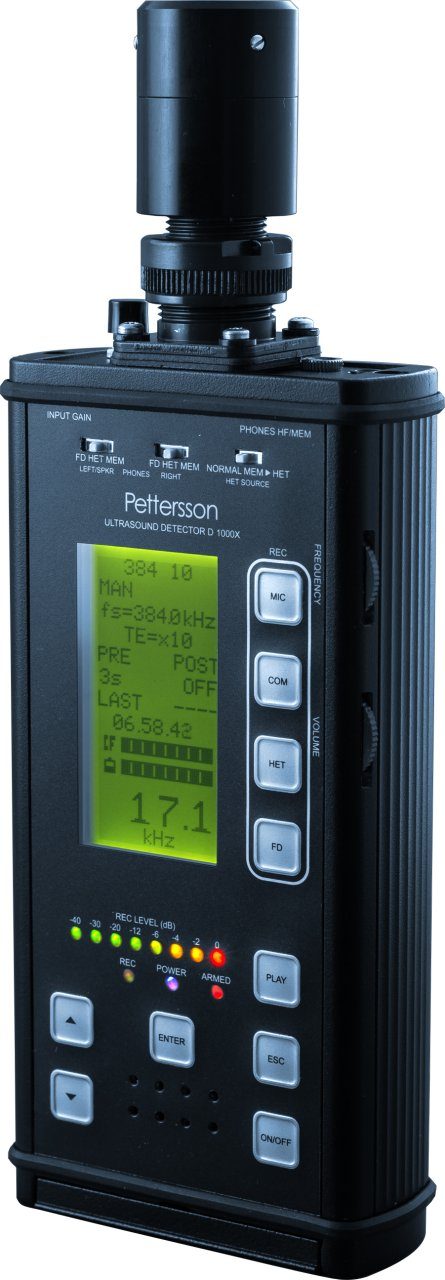
The D-1000X combines Time Expansion, Frequency Division and Heterodyne detection, it is the first bat detector with a built-in Compact Flash "tape recorder", relieving the user from the hassle of operating a separate recorder or laptop with connecting cables. It can be configured to work in a variety of operating modes, but thanks to the use of "Profiles", switching between different modes is made instantly. Each profile contains all the selectable settings such as sampling rate, triggering mode, time expansion factor and LED intensity and can be prepared in advance and saved in the detector.
At any time, either the direct ultrasonic signal, the heterodyne signal or the frequency division signal can be recorded onto the CF-card. Spoken comments can be recorded by speaking into the microphone while recording in the direct mode, or in a special comment recording mode (at a lower sampling rate). The recording time is limited only by the available space on the CF-card. Upon completion of a recording in the direct mode, the signal will be automatically replayed in Time Expansion form, if this function is enabled. Time expansion factors from 1 (original speed) to 30 can be chosen. The recordings can be made by manually starting and stopping the recording or through level-activated (and optional frequency selective) triggering. In the latter case, the detector can be set up for unattended capture of calls. Pre- and post-triggering modes with a variety of different settings can be used.
The .wav sound files on the CF-card are stamped with date and time and can be read directly on a PC, using a standard CF-card reader. The detector is equipped with Pettersson's well-known, high-quality capacitance microphone which has been further improved to give lower noise, wider dynamic range and lower distortion.
Heterodyne Heterodyne bat detection offers immediate identification of bats in the field. You select the ultrasonic frequency range to listen to just like tuning in radio. Heterodyne detectors typically have a headphone socket and line-out socket for recording calls.
Frequency Division Frequency Division detection is a `broadband' method as the entire ultrasonic range audible all the time (in contrast to a Heterodyne detector, which is sensitive only to a limited range of frequencies at each time). Calls are transformed in real time i.e. the calls are heard through the detector at the same time they were emitted by the bat. By listening to the full range of frequencies you won't miss a bat while tuned into the wrong frequency. Frequency Division can be used for sound analysis of recorded calls.
Time Expansion Time Expansion detection is a `broadband' method as the entire ultrasonic range audible all the time (in contrast to a Heterodyne detector, which is sensitive only to a limited range of frequencies at each time). Time Expansion detectors first stores a portion of the ultrasonic signal in its digital memory and then replays it at a slower speed, i.e. it is does not transform the calls in real time. The delay depends on the actual storage time, and if this is very short (up to around 100 msec), the replay is also made fairly quickly and the detector gives an "almost real time" response. Time expanded calls produce the highest quality sonograms.
Comparing Frequency Division and Time Expansion A Time Expansion detector actually stores the original signal (which is then stretched out in time), The output of such a detector provides the same information as that of the original signal. Hence, it is possible to make any type of analysis and obtain useful and accurate results. This includes spectral analysis of all types (e.g. spectrogram/sonagram).
In contrast a Frequency Division detector counts the number of cycles of the ultrasonic signal and generates an output cycle (pulse) for each N input cycles, where N is often 10. This effectively divides the frequency by N. A Frequency Division detector is only capable of tracking one frequency, consequently, it is not possible to perform any harmonic analysis from an Frequency Division signal. To do this, Time Expansion signals should be used.
This detector offers all three detection methods.
Accessories
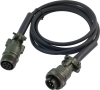
Microphone Extension Cable
Specifications:
* Type: Heterodyne, frequency division (x10), time expansion and direct recording
* Frequency range: 5 - 235 kHz (frequency division and heterodyne); 5 kHz – 0.4 x sampling frequency (time expansion and direct recording); Activating the high-pass filter results in a lower frequency limit of about 20 kHz.
* Heterodyne freq. resolution: 0.1kHz (f < 17.8kHz); 0.2 kHz (18-43 kHz); 0.5 kHz (43.5-107 kHz); 1 kHz (108-235 kHz)
* Headphones output: 3.5mm stereo jack, load impedance 32 ohms or greater
* HF/MEM output: 3.5mm stereo jack, load impedance 500 ohms or greater, ca 600 mVrms at 0 dB
* Batteries: 5 x AA size, Alkaline or NiMH recommended
* External DC supply: 7-10 V, 250 mA (average), 700 mA (peak)
* Size: 170 x 80 x 35mm, excluding microphone
* Weight: 600g including batteries
Recording/playback system:
* ADC resolution: 16 bits
* Anti-aliasing filter: Yes, adaptive
* Sampling rates: 32, 44.1, 48, 96, 100, 192, 200, 250, 300, 384, 400, 500, 750, 768 kHz
* Time expansion factors: 1, 2, 3, 5, 10, 20, 30
* DAC resolution: 12 bits