Due to changes at US Customs we will be only processing the shipping of orders through UPS. The purchase cost does not include any costs incurred from US Customs and the receiver will be liable for all import duties and taxes associated with their order. Should the order be returned undelivered, please note the refund will be processed minus the shipping costs.
Certain goods from specific countries are subject to higher tariffs and import restrictions. Ensure you check the regulations regarding the country of origin of your items to avoid unexpected charges or delays. Also ensure you select "business address" or "home address" when adding a new address to ensure your order is reported correctly
If you have any questions or need help with placing your order, please contact our Customer Services Team or select "Quotation" as the payment method online. Furthermore you can contact your local customs office for further information.
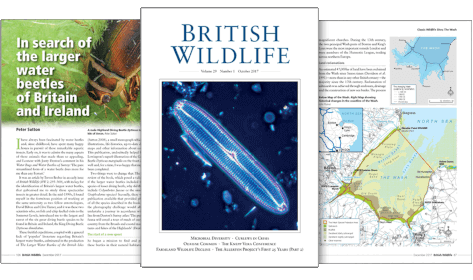
British Wildlife is the leading natural history magazine in the UK, providing essential reading for both enthusiast and professional naturalists and wildlife conservationists. Published eight times a year, British Wildlife bridges the gap between popular writing and scientific literature through a combination of long-form articles, regular columns and reports, book reviews and letters.
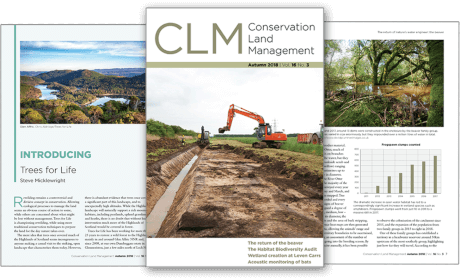
Conservation Land Management (CLM) is a quarterly magazine that is widely regarded as essential reading for all who are involved in land management for nature conservation, across the British Isles. CLM includes long-form articles, events listings, publication reviews, new product information and updates, reports of conferences and letters.
The goal of Critical Plant Studies is to initiate an interdisciplinary dialogue, whereby philosophy and literature would learn from each other to think about, imagine, and describe, vegetal life with critical awareness, conceptual rigour, and ethical sensitivity. Literary works featuring plant imagery may be analyzed with reference to philosophical frameworks, while philosophical discussions of the meanings of vegetal life may be enriched and supported with the tools of literary criticism. Another dialogic dimension of Critical Plant Studies entails a sustained engagement between Western and non-Western philosophies and religious traditions, representative of the human attitudes to plants. This "cross-pollination" of different fields of knowledge and experience will become possible thanks to the fundamental role plants play in human life, regardless of their backgrounding or neglect.
Ethically stated, the aim of Critical Plant Studies series is to encourage an incremental shift of cultural attitudes from a purely instrumental to a respectful approach to vegetal beings. This is particularly important at the current time of the global environmental crisis, when massive de-forestation, seed patenting, and profit-driven agriculture threaten the very future of life on the planet. Not only will works included in the series shed light on the being of plants, but they will also assist us in critically thinking through the crucial issues and challenges of the contemporary world. Bioethics and genetic engineering, of which plants were the first examples; the role of spirituality and holism in the techno-scientific age; the reliance of our imagination and creativity on elements of the "natural" world; global food shortages and sustainable agricultural practices; the roots of our thinking and writing in other-than-human, vegetal processes, such as growth and decay, germination and branching out, fecundation and fruition – books included in Critical Plant Studies will, in one way or another, touch upon these and related themes central to the philosophy, literature, and culture of the twenty-first century.