Um genaue Preise zu sehen, wählen Sie bitte Ihr Lieferland.
 
 
United States
£ GBP
Alle Kategorien
Important Notice for US Customers

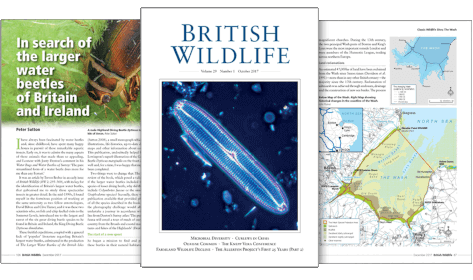
British Wildlife

8 issues per year 84 Seiten per Ausgabe Nur im Abonnement erhältlich

British Wildlife is the leading natural history magazine in the UK, providing essential reading for both enthusiast and professional naturalists and wildlife conservationists. Published eight times a year, British Wildlife bridges the gap between popular writing and scientific literature through a combination of long-form articles, regular columns and reports, book reviews and letters.

Abonnement ab £33 im Jahr

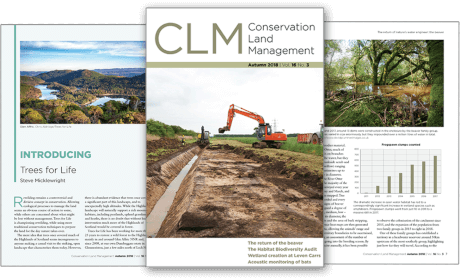
Conservation Land Management

4 Auflagen im Jahr 44 Seiten Nur im Abonnement erhältlich

Conservation Land Management (CLM) ist ein Mitgliedermagazin und erscheint viermal im Jahr. Das Magazin gilt allgemein als unverzichtbare Lektüre für alle Personen, die sich aktiv für das Landmanagement in Großbritannien einsetzen. CLM enthält Artikel in Langform, Veranstaltungslisten, Buchempfehlungen, neue Produktinformationen und Berichte über Konferenzen und Vorträge.

Subscriptions from £26 per year
Akademische und professionelle Bücher  Habitats & Ecosystems  Forests & Wetlands

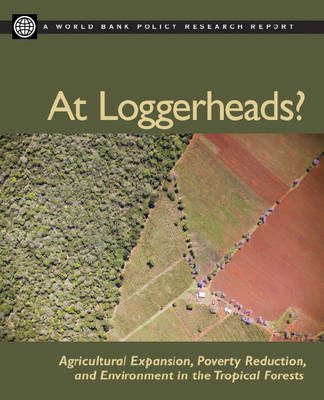
At Loggerheads Agricultural Expansion, Poverty Reduction and Environment in the Tropical Forests

By: Kenneth M Chomitz
284 pages, diagrams, colour illus, maps
NHBS
Important World Bank contribution on how to solve the problem of deforestation and carbon emissions
At Loggerheads
Click to have a closer look
  • At Loggerheads ISBN: 9780821367353 Paperback Nov 2006 Out of stock with supplier: order now to get this when available
    £23.99
    #163082
Price: £23.99
About this book Customer reviews Related titles

About this book

Despite the vast number of books and reports on tropical deforestation, there's confusion about the causes of forest loss and forest poverty, and the effectiveness of policy responses.

This book seeks to describe ways to reconcile pressures for agricultural expansion in the tropics with the urgent needs for both forest conservation and poverty alleviation. It diagnoses the causes and impacts of forest loss and the reasons for the association of forests with poverty. It looks at how policies - modulated by local conditions - act simultaneously on deforestation and poverty, creating tradeoffs or complementarities, depending on the situation.

In Latin America, dense tropical forest is often cleared to create pastures worth as little as $300 a hectare, while releasing large amounts of CO2. In Africa and Asia, some deforestation is equally unproductive. These forests may be worth five times more if left standing, providing carbon storage services, than if cleared and burned. If developing countries could tap this value, they could also stimulate more productive agriculture in degraded areas, while preserving the environmental services of forests.

But current carbon markets do not tap the potential benefits of forest carbon. The report reviews the obstacles impeding the use of global carbon finance to reduce deforestation, and offers workable solutions.

The report argues that with stronger financial incentives for avoiding cutting down trees, poor farmers in Madagascar and other forest countries could invest in sustainable agriculture in already-cleared fields, rather than cutting down more forest for paltry and often temporary gains.

Tropical deforestation accounts for about 20 percent of global CO2 emissions, so the report says global forest carbon finance could therefore be a tool for slowing global warming.

Customer Reviews

By: Kenneth M Chomitz
284 pages, diagrams, colour illus, maps
NHBS
Important World Bank contribution on how to solve the problem of deforestation and carbon emissions
Current promotions
Great GiftsNew and Forthcoming BooksBritish Wildlife Magazine SubscriptionField Guide Sale 2025