Due to changes at US Customs we will be only processing the shipping of orders through UPS. The purchase cost does not include any costs incurred from US Customs and the receiver will be liable for all import duties and taxes associated with their order. Should the order be returned undelivered, please note the refund will be processed minus the shipping costs.
Certain goods from specific countries are subject to higher tariffs and import restrictions. Ensure you check the regulations regarding the country of origin of your items to avoid unexpected charges or delays. Also ensure you select "business address" or "home address" when adding a new address to ensure your order is reported correctly
If you have any questions or need help with placing your order, please contact our Customer Services Team or select "Quotation" as the payment method online. Furthermore you can contact your local customs office for further information.
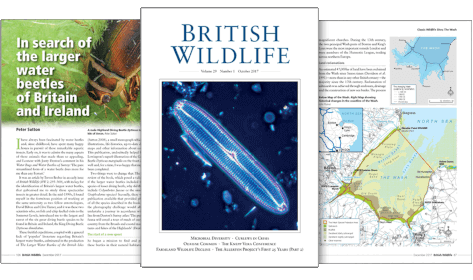
British Wildlife is the leading natural history magazine in the UK, providing essential reading for both enthusiast and professional naturalists and wildlife conservationists. Published eight times a year, British Wildlife bridges the gap between popular writing and scientific literature through a combination of long-form articles, regular columns and reports, book reviews and letters.
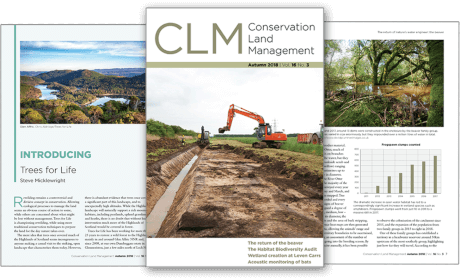
Conservation Land Management (CLM) is a quarterly magazine that is widely regarded as essential reading for all who are involved in land management for nature conservation, across the British Isles. CLM includes long-form articles, events listings, publication reviews, new product information and updates, reports of conferences and letters.
In proportion to its area Ecuador is the floristically richest country in South America. About 230 families of vascular plants are known and the number of species has been estimated at something between 16,000 and 18,000. The richness of the flora is largely due to the diverse ecological conditions created by the great altitudinal differences. The land rises from sea level to nearly 6,300 m altitude. The vegetation varies from xerophytic scrub to rain forest and high-Andean pramos.
The present Flora Of Ecuador is the first ever published. It comprises all vascular plants, including commonly cultivated and escaped species, of the Ecuadorean mainland. It describes families, genera and species, and provides keys to genera and species. Remarks on nomenclature, intraspecific variation, Ecuadorean distribution and total range are included. Synonyms and collections studied are listed. Illustrations are provided for many taxa and descriptions of a large number of new taxa are published for the first time.
The Flora is published family by family (or in the largest families as parts thereof). The volumes are issued at irregular intervals as typescripts become ready for printing. The sequence and circumscription of the families follow, with minor deviations, Engler's Syllabus der Pflanzenfamilien, ed. 12. Up to May 1996, 78 families have been published, some families (Polypodiaceae, Compositae, Rubiaceae, Orchidaceae) only partially so. Treatments of many families are in preparation by specialists from different parts of the world, mainly Europe and the Americas.
The Riksmuseum, Stockholm (S), and the herbaria at the Universities of Göteborg (GB) and Aarhus, Denmark (AAU) are presumed to harbour about half of the Ecuadorean plant collections now existing. The present Flora is based on material in these as well as other important herbaria of the world.