Um genaue Preise zu sehen, wählen Sie bitte Ihr Lieferland.
 
 
United States
£ GBP
Alle Kategorien
Important Notice for US Customers

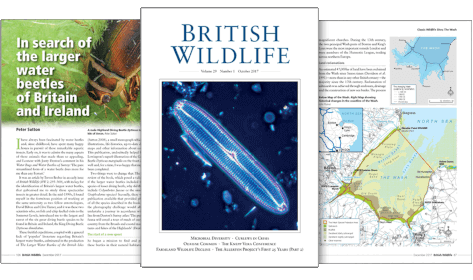
British Wildlife

8 issues per year 84 Seiten per Ausgabe Nur im Abonnement erhältlich

British Wildlife is the leading natural history magazine in the UK, providing essential reading for both enthusiast and professional naturalists and wildlife conservationists. Published eight times a year, British Wildlife bridges the gap between popular writing and scientific literature through a combination of long-form articles, regular columns and reports, book reviews and letters.

Abonnement ab £33 im Jahr

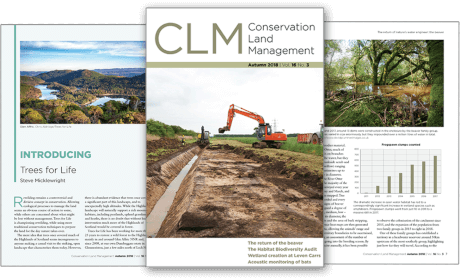
Conservation Land Management

4 Auflagen im Jahr 44 Seiten Nur im Abonnement erhältlich

Conservation Land Management (CLM) ist ein Mitgliedermagazin und erscheint viermal im Jahr. Das Magazin gilt allgemein als unverzichtbare Lektüre für alle Personen, die sich aktiv für das Landmanagement in Großbritannien einsetzen. CLM enthält Artikel in Langform, Veranstaltungslisten, Buchempfehlungen, neue Produktinformationen und Berichte über Konferenzen und Vorträge.

Subscriptions from £26 per year
Feldführer und Naturgeschichte  Ornithology  Birds of Asia-Pacific

Birds of Vietnam

Field / Identification Guide
By: Richard C Craik(Author), Lê Quý Minh(Author)
408 pages, 1970+ colour illustrations, 880+ colour distribution maps
Publisher: Lynx Edicions
Birds of Vietnam
Click to have a closer look
Select version
Average customer review
  • Birds of Vietnam ISBN: 9788416728107 Edition: 1 Flexibound Nov 2018 Not in stock: Usually dispatched within 4 days
    £49.99
    #243021
  • Birds of Vietnam ISBN: 9788416728138 Edition: 1 Hardback Nov 2018 Not in stock: Usually dispatched within 4 days
    £54.99
    #245040
  • Birds of Vietnam ISBN: 9788416728725 Edition: 2 Flexibound Mar 2025 In stock
    £55.00
    #264646
  • Birds of Vietnam ISBN: 9788416728718 Edition: 2 Hardback Mar 2025 In stock
    £55.00
    #264645
Selected version: £55.00
About this book Customer reviews Biography Related titles
Images Additional images
Birds of VietnamBirds of VietnamBirds of VietnamBirds of VietnamBirds of VietnamBirds of Vietnam

About this book

Vietnam, home to rare secretive pheasants, jewel-like pittas, spectacular laughingthrushes and enigmatic babblers, is Asia’s most exciting new birding destination. A global biodiversity hotspot, Vietnam boasts 16 endemic species and subspecies groups, and a further 42 near-endemic species and subspecies, the largest number of any country in mainland South-East Asia.

This modern field guide provides a comprehensive overview of Vietnam’s rich and diverse avifauna, describing all 931 species with detailed text, illustrations and distribution maps.

Key features:
- Comprehensive coverage of all 931 species with detailed texts addressing status, habitat and behaviour, age, sex, geographical variation, voice, and confusion species.
- Over 1,970 high-quality illustrations depicting all species and distinctive subspecies, including birds in flight, males, females, juveniles, and non-breeding plumages, where applicable.
- QR codes for every species, linking to complementary audiovisual material for deeper insights.
- More than 880 full-colour range maps for all regularly occurring species.
- Well-marked subspecies groups receive full accounts, with distributions of breeding subspecies clearly mapped.
- Local species names included for added accessibility.

What’s new in the second edition?
-  New Species Included: Incorporates 13 new bird species observed in Vietnam between 2018 and 2024, with detailed descriptions, updated conservation statuses, high-quality illustrations, distribution maps, and - QR codes linking to additional audiovisual resources
- Updated Nomenclature: All scientific and English names have been revised in accordance with the HBW and BirdLife International Digital Checklist of the Birds of the World (Version 9, 2024).
- Conservation Status: The global conservation status of all species has been updated to reflect the latest data from the IUCN Red List (2024).
- Improved Distribution Maps: Includes updated distribution maps for approximately 30 species, reflecting new observations made up to 2024.

This second edition represents a significant update to the first, incorporating the latest discoveries and research to provide the most accurate and up-to-date resource for birders and ornithologists exploring Vietnam’s extraordinary avian diversity.

Customer Reviews (2)

  • A real step forward for Vietnam
    By Keith 19 Jul 2019 Written for Flexibound
    This is the latest in a new series from Lynx entitled the BirdLife International Field Guides Collection. A field guide for Thailand was published last summer and soon to appear are guides to the West Indies and Japan. I was pleased to get my hands on this latest book just ahead of a recent trip to Vietnam.

    Vietnam is one of the best birding destinations in Asia and a three-week trip from north to south is likely to result in a pleasing haul of around 400 species. That said, the birds are often hard to find and it is only down to the ingenuity of local bird guides that you can actually see some of the shyer laughing thrushes from temporary hides set up at feeding stations. As a result of this, anyone who visited Vietnam a few years ago may now find that several species they only have glimpsed before are now easily available for much closer scrutiny.

    For almost two decades the standard bird book for Vietnam has been A Field Guide to the Birds of South-East Asia by Craig Robson (New Holland, 2000 and 2008 – now published by Bloomsbury), and although that is still a masterpiece it urgently needs updating. It lacks distribution maps, but where it is still invaluable is in illustrating a wide range of races across the region.

    By comparison, this new book sometimes only shows one race when several can be found in Vietnam, although it is very good at showing approximately where each race can be found. That criticism aside, this is the first field guide dedicated to Vietnam and is really welcome. It describes and illustrates all 911 species that have been recorded in the country with colour maps for all except vagrants, and always next to the illustration rather than the text – a useful move in my view.

    Texts of around 150 words per species cover status, habitat and behaviour, age, sex and geographical variation, voice, and always suggests confusion species. There are 180 colour plates with over 1900 illustrations taken from Handbook of the Birds of the World, and these include birds in flight for larger families such as waterfowl, waders and raptors, both sexes (where appropriate) and a selection of juvenile and non-breeding plumages. A total of 29 artists created these images but you would never think that because their styles have merged together very well. The layout has around six species per plate and this works well, although occasionally similar species have ended up split between two pages – for example, White-spectacled Warbler Phylloscopus intermedius which would have been better placed next to the Phylloscopus warblers that it actually looks like it rather than the ones that it does not.

    Like all of the books in this new series the taxonomy used is that of BirdLife/HBW and it recognises 10 endemics and a further 27 near-endemics for Vietnam. If you follow the IOC taxonomy then you will not recognise Tonkin Partridge Arborophila tonkinensis as a species (treated by IOC as a race of Green-legged Partridge Arborophila chloropus. However you will struggle to find two IOC endemics in this book - Dalat Bush-warbler Locustella idonea and Dalat Shrike-babbler Pteruthius annamensis which BirdLife/HBW lump into Russet Grasshopper-warbler Locustella mandelli and White-browed Shrike-babbler Pteruthius aeralatus. Of course, not everyone agrees on taxonomy, but much as travelling birders love HBW, an increasing number (perhaps most) are now using the IOC list as their checklist. So it can become confusing when around up to 5% of the species are described using different names or taxonomic relationships. In most cases, this guide makes it clear when other names are in common usage – but not always.

    In addition to the species pages, for those who like to seek additional information while travelling, there is a Quick Response (QR) code for each species linking to the HBW Internet Bird Collection gallery of photos, videos and sounds. There are also introductory pages outlining Vietnam’s habitats and key birding sites.

    Weighing in at around 1 kg this is a very portable book and added greatly to the enjoyment of my trip, although at £50 for the softback version it is relatively expensive when you can buy second-hand copies of Robson’s guide for under £20.
    6 of 6 found this helpful - Was this helpful to you? Yes No
  • Essential field guide for Vietnam
    By Gehan de Silva Wijeyeratne 8 Oct 2025 Written for Flexibound
    Field guides for birds in Asia have come a long way since I first began to bird watch in Asia. Growing up in Sri Lanka I got off to a good start with G. M. Henry’s A Guide to the Birds of Ceylon and Dillon Ripley and Salim Ali’s Handbook of the Birds of the Indian Subcontinent in 10 volumes. For travels further east into South-east Asia, I used A Field Guide to the Birds of South-East Asia by Ben King, Martin Woodcock and E.V. Dickinson. It took nearly another three decades before this was superseded by Craig Robson’s A Field Guide to the Birds of South-East Asia in the modern format with every species illustrated in colour on plates. However, the first edition and even the updated edition in 2008 still had the plates and text in separate parts of the book as was the old custom when full colour printing across the whole book was expensive.

    The Handbook of the Birds of the World (HBW) in 17 volumes resulted in the publisher now known as Lynx Nature books having a comprehensive suite of colour illustrations and text for every species of bird in the world. This has placed them in an ideal position to produce books which are country-specific. The field guides in this spin-off series mark an important step change in the development of bird field guides in the world and perhaps more so in part of Asia. Now for many countries we have thoroughly modern field guides with first-class illustrations with the species text on a facing page, covering the standard field guide topics on identification, distribution and behaviour. These guides are not only important as tools in the hands of scientists and conservationists but they also play an important part in the development of wildlife tourism which provides a further economic impetus to conserve the last remaining wildernesses.

    As this book makes clear, Vietnam is a special place for birding with 931 species, 16 endemics and 42 near endemics. Vietnam at one time suffered from the perception that its biodiversity had been largely lost due to human pressures with forests being replaced by agricultural land. In 2006, Vietnam: A Natural History by Eleanor Janes Sterling, Martha Maud Hurley and Le Duc Minh’ sought to dispel this myth by providing a fine all-round account of its natural history and outlining many of the exciting recent discoveries of new species not alone with its flora but even with vertebrate species. Nevertheless, Vietnam continues to be still under-appreciated as a birding destination despite the efforts of people like lead author Richard Craik who has been leading birding tours in the country. However, a second edition, 6 years after the first suggests that perceptions on Vietnam’s wildlife potential is changing for the better.

    The field guide follows the standard formula for field guides in the Lynx series with the text updated and supplemented by local experts, in this case Richard Craik and Lê Quý Minh. The QR codes take you to the eBird website for supplementary information, images and most usefully sound recordings from the Macaulay Library. The growth of citizen science and the wealth of information that is available now and is being continuously updated is phenomenal and is another essay in itself.

    The inner front cover shows Vietnam in relation to its South-east Asian neighbours and the inner back cover marks out 18 of the top birding sites in Vietnam. The first 19 pages of the preliminary sections include an overview of the country’s recent ornithological exploration history, a geographical overview, a summary of key habitat types and a synopsis of the important birding hotspots. There is also an important note on avoiding harm to birds from tape playback and the dangers of baiting at feeding stations and photographic hides resulting in local extinction due to the illegal activity of bird trappers. Conservation in Asia is never easy and even wildlife tourism which is generally a good thing can have unintended consequences.

    29 artists are credited with the illustrations, many of which first appeared in HBW. Many of the artists are household names to keen birders who know them for producing some of the finest field guide illustrations in the world. Combine that with first-class text, clear distribution maps and QR codes and you are left with an absolutely superb book. The species accounts have the families separated by a shaded header with brief details of the number of extant species in the family and that in the region. The text in addition to describing the bird’s status in Vietnam briefly outlines any subspecies in the region, followed by typical habitat, identification-oriented text, voice and also describes similar species. This is a functional book intended for field use (the flexi-cover option has a water-resistant cover). Nevertheless, I find the quality of the overall production and beauty of the artwork also lends the book a certain aesthetic appeal. But then, I enjoy the company of ornithological books and I still have in my collection the books by Ali and Ripley, King, Robson and many more from the Asian region.

    Despite multiple visits to some countries in Asia and several natural history book titles on Vietnam in my book collection, I have not yet birded in Vietnam. But with this essential field guide to the birds of Vietnam on my shelf, I think it will not be long before I go to Vietnam.
    Was this helpful to you? Yes No

Biography

Founder of Vietnam Birding, Richard C. Craik has worked in tourism development in Vietnam since the early 1990s and has travelled and watched birds extensively throughout the country and the wider region during this time. He has contributed to travel guides, journals and other media on ecotourism, conservation and birds in Vietnam for more than 30 years.

A well-known figure in the conservation community in Vietnam and one of the most experienced birding guides in the region, Lê Quý Minh has been head guide at Vietnam Birding since 2007. He previously worked at Bach Ma National Park in central Vietnam for 12 years, heading the ecotourism and environmental education departments.

Field / Identification Guide
By: Richard C Craik(Author), Lê Quý Minh(Author)
408 pages, 1970+ colour illustrations, 880+ colour distribution maps
Publisher: Lynx Edicions
Media reviews

"[...] This superb field guide to the country identifies 18 birding hotspots, each with notes on possible species and ideas for travel and local accommodation. One is the infamous Mekong Delta where the really lucky visitor might spot a Spoon‐billed Sandpiper. The illustrations are among the best I have seen, each species having breeding, non‐breeding and sub‐species plumages and excellent maps. At 400 pages and measuring 24 × 16 cms this is a chunky book, but is both essential to get the best out of a trip and as fine a memento of the visit as will be found. Thoroughly recommended."
– Ian Richards, Ibis 162(1), January 2020

"[...] Overall, this is a wonderful field guide to the birds of Vietnam. A great layout, largely excellent illustrations and adequate text make it a must for any visiting (or even resident!) birder to Vietnam. Lynx and the authors should be congratulated for producing such a guide so quickly."
– James Eaton, BirdGuides.com

"[...] Overall, this is an impressive and very welcome field guide, and the authors and those who helped “prepare” the text (Alex Berryman, Chris Bradshaw, Guy Kirwan, Tim Marlow, and Chris Sharpe) should be congratulated on getting this book out in record time. I am certainly looking forward to testing this guide out on my next visit to Vietnam. Whilst it does not have such detailed text as that in Robson’s guide, it does have the advantage of good maps, and if you are only going to Vietnam, you will not be confused by all the other species that are crowded onto the plates in Robson’s book."
– Frank Lambert (05-05-2019), read the full review at The Birder's Library

"For me, a good foreign bird guide is one that doesn’t just inform you of the many species you might see on your travels, but also takes the time to introduce you to the area and habitats you will be visiting when in a new country. The Birds of Vietnam by Craik and Minh is one of these, with clear and distinguishable illustrations prefaced by a good introduction to the country and help on how to plan your trip. [...] Each species is nicely detailed, mapped and illustrated across well-spaced pages with neatly highlighted sections. I enjoyed the high-quality artwork and thought that the identifying features were clear but not over-emphasised with easy comparisons between ages, morphs and related species. [...] As someone who’s keen on making a trip out to that region of the world, I feel that this is a book I would choose to take with me and make space for in my bag. On the outside the plasticised cover is sturdy and, being a little wider than the pages, gives me confidence that I can take this outside without feeling it’s going to end up to crumpled or water damaged. I’d be happy to take it round with me and their suggestions of places and tours to take I have found very useful when considering which areas to prioritise visits to. In all I’d recommend getting this book to help both your identification and planning of a birding trip to Vietnam."
– Katharine Bowgen, BTO book reviews


Current promotions
Great GiftsNew and Forthcoming BooksBritish Wildlife Magazine SubscriptionField Guide Sale 2025