Um genaue Preise zu sehen, wählen Sie bitte Ihr Lieferland.
 
 
United States
£ GBP
Alle Kategorien
Important Notice for US Customers

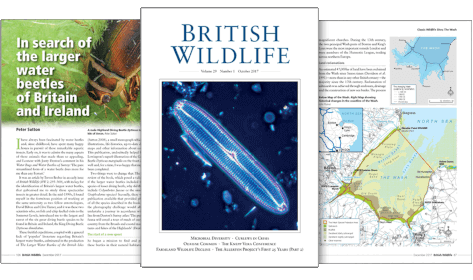
British Wildlife

8 issues per year 84 Seiten per Ausgabe Nur im Abonnement erhältlich

British Wildlife is the leading natural history magazine in the UK, providing essential reading for both enthusiast and professional naturalists and wildlife conservationists. Published eight times a year, British Wildlife bridges the gap between popular writing and scientific literature through a combination of long-form articles, regular columns and reports, book reviews and letters.

Abonnement ab £33 im Jahr

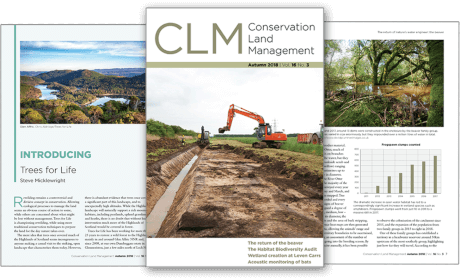
Conservation Land Management

4 Auflagen im Jahr 44 Seiten Nur im Abonnement erhältlich

Conservation Land Management (CLM) ist ein Mitgliedermagazin und erscheint viermal im Jahr. Das Magazin gilt allgemein als unverzichtbare Lektüre für alle Personen, die sich aktiv für das Landmanagement in Großbritannien einsetzen. CLM enthält Artikel in Langform, Veranstaltungslisten, Buchempfehlungen, neue Produktinformationen und Berichte über Konferenzen und Vorträge.

Subscriptions from £26 per year
Akademische und professionelle Bücher  Marine & Freshwater Biology  Fishes  Bony Fishes

Conservation Aquaculture An Evolution-Based Approach for the Production of Fish for Aquaculture-assisted Fisheries Programs

By: Douglas Tave(Author)
168 pages, 14 colour & 2 b/w illustrations
Publisher: Springer Nature
Conservation Aquaculture
Click to have a closer look
  • Conservation Aquaculture ISBN: 9783031719776 Hardback Feb 2025 Expected delivery 16th March - 19th March
    £110.00
    #270039 | Stock: 0
Price: £110.00
About this book Contents Customer reviews Biography Related titles

About this book

Stocking hatchery-produced fish has been a standard component of fisheries management for over 100 years. This book discusses the production of hatchery fish used in aquaculture-assisted fisheries programs to help stabilise and recover endangered species. For the most part, these programs have been unsuccessful, and a reason why is that the traditional approach to fish culture produces fish that are genetically and behaviorally ill-suited to help recover an imperilled species. The hatchery environment and management used to culture the fish make them sub-viable in the wild. Even if most of the augmented fish die, survivors that mate with wild fish lower the fitness of the endangered population, making the conservation program counterproductive.

Since traditional aquaculture programs have been shown to produce fish that are ill-suited to help recovery, a new way of producing fish is needed. That new way is conservation aquaculture. In conservation aquaculture, fish are raised in naturalised mesocosms that mimic the environment in which the endangered species lives. Management is naturalised, so domestication does not produce genetic changes, and so fish develop a full and effective suite of behaviours that enable them to forage efficiently and detect and avoid predators when stocked.

The conservation aquaculture management techniques described in the book can also be used to improve commercial and recreational fish stocking programs.

Contents

- Aquaculture-assisted Fisheries
- Defining Conservation Aquaculture
- Captive Conservation Genetic Management
- Domestication
- Epigenetics
- Behavior
- Conservation Aquaculture Programs

Customer Reviews

Biography

Douglas Tave received a PhD in aquaculture from Auburn University and was a professor of aquaculture, professor of aquaculture genetics, aquaculture extension specialist, research scientist, and a fish hatchery manager. Now retired, he was a principal designer of and subsequently manager for 14 years of the world's first purpose-built large-scale conservation aquaculture hatchery, where he and his colleagues turned the basic ideas about conservation aquaculture into reality. He is the author of several books about the genetic aspects of fish hatchery management: Genetics for Fish Hatchery Managers; Inbreeding and Brood Stock Management; Selective Breeding Programs for Medium-Sized Fish Farms. He is co-editor of Strategies and Tactics for Management of Fertilized Hatchery Ponds, founded the peer-reviewed Journal of Applied Aquaculture, and was the genetics columnist for Aquaculture Magazine for 9 years.

By: Douglas Tave(Author)
168 pages, 14 colour & 2 b/w illustrations
Publisher: Springer Nature
Current promotions
New and Forthcoming BooksBritish Wildlife Magazine SubscriptionField Guide Sale 2025