Um genaue Preise zu sehen, wählen Sie bitte Ihr Lieferland.
 
 
United States
£ GBP
Alle Kategorien
Important Notice for US Customers

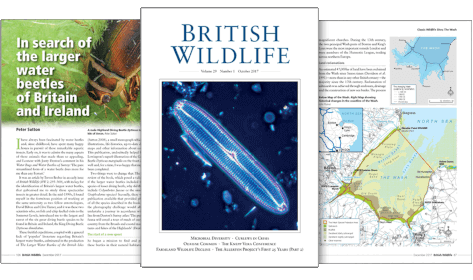
British Wildlife

8 issues per year 84 Seiten per Ausgabe Nur im Abonnement erhältlich

British Wildlife is the leading natural history magazine in the UK, providing essential reading for both enthusiast and professional naturalists and wildlife conservationists. Published eight times a year, British Wildlife bridges the gap between popular writing and scientific literature through a combination of long-form articles, regular columns and reports, book reviews and letters.

Abonnement ab £33 im Jahr

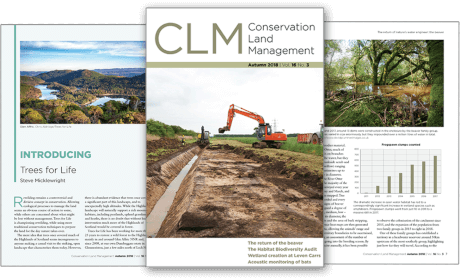
Conservation Land Management

4 Auflagen im Jahr 44 Seiten Nur im Abonnement erhältlich

Conservation Land Management (CLM) ist ein Mitgliedermagazin und erscheint viermal im Jahr. Das Magazin gilt allgemein als unverzichtbare Lektüre für alle Personen, die sich aktiv für das Landmanagement in Großbritannien einsetzen. CLM enthält Artikel in Langform, Veranstaltungslisten, Buchempfehlungen, neue Produktinformationen und Berichte über Konferenzen und Vorträge.

Subscriptions from £26 per year
Akademische und professionelle Bücher  Insects & other Invertebrates  Insects  Flies (Diptera)

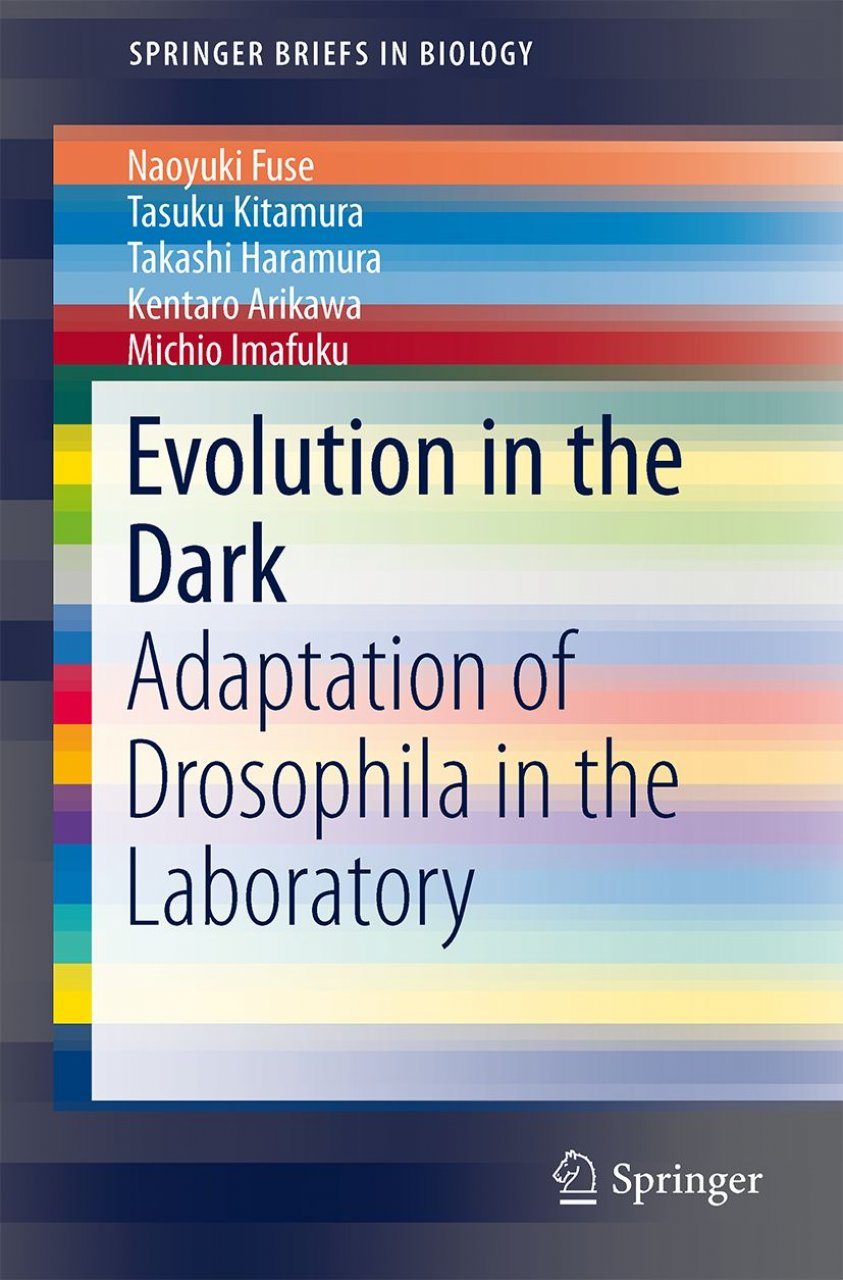
Evolution in the Dark Adaptation of Drosophila in the Laboratory

By: Naoyuki Fuse(Author), T Kitamura(Author), T Haramura(Author), K Arikawa(Author), M Imafuku(Author)
60 pages, 9 colour & 18 b/w illustrations, 7 tables
Publisher: Springer Nature
Evolution in the Dark
Click to have a closer look
  • Evolution in the Dark ISBN: 9784431541462 Paperback Sep 2013 Not in stock: Usually dispatched within 1-2 weeks
    £44.99
    #201911
Price: £44.99
About this book Contents Customer reviews Related titles

About this book

How organisms come to possess adaptive traits is a fundamental question for evolutionary biology. Although it is almost impossible to demonstrate evolution in the laboratory, this issue can be approached by using an unusual organism, "Dark-fly": Drosophila melanogaster kept in complete darkness for 57 years through 1400 generations, which corresponds to 28,000 years in terms of human generations. Has Dark-fly adapted to an environment of total darkness? If so, what is the molecular nature of the adaptation? In Evolution in the Dark, the remarkable findings from the Dark-fly project performed at Kyoto University are presented.

It was found that Dark-fly did not have poor eyesight, but rather exhibited higher phototaxis ability and displayed lengthened bristles on the head that function as tactile receptors. Circadian rhythms were weakened but still retained in Dark-fly. With recent progress in genome science enabling researchers to perform whole genome sequencing for Dark-fly, a large number of mutations were identified including genes encoding a light receptor, olfactory receptors, and enzymes involved in neural development. The Dark-fly project is a simple but very long-term experiment. Combined with advanced techniques in genetics and genomics, it is a valuable tool for understanding the molecular nature of adaptive evolution.

Contents

Foreword by Kiyokazu Agata

1. History of the "Dark-fly" project (Tasuku Kitamura, Takashi Haramura, Michio Imafuku)
2. Circadian rhythms of Dark-fly (Takashi Haramura, Michio Imafuku)
3. Compound eyes of Dark-fly (Michio Imafuku and Kentaro Arikawa)
4. Genome features of Dark-fly (Naoyuki Fuse)

Customer Reviews

By: Naoyuki Fuse(Author), T Kitamura(Author), T Haramura(Author), K Arikawa(Author), M Imafuku(Author)
60 pages, 9 colour & 18 b/w illustrations, 7 tables
Publisher: Springer Nature
Current promotions
Great GiftsNew and Forthcoming BooksBritish Wildlife Magazine SubscriptionField Guide Sale 2025