Um genaue Preise zu sehen, wählen Sie bitte Ihr Lieferland.
 
 
United States
£ GBP
Alle Kategorien
Important Notice for US Customers

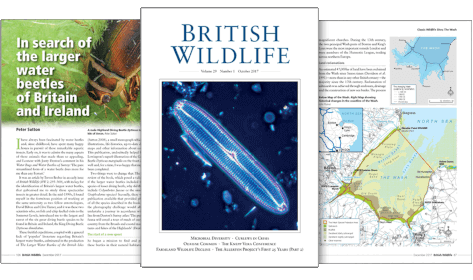
British Wildlife

8 issues per year 84 Seiten per Ausgabe Nur im Abonnement erhältlich

British Wildlife is the leading natural history magazine in the UK, providing essential reading for both enthusiast and professional naturalists and wildlife conservationists. Published eight times a year, British Wildlife bridges the gap between popular writing and scientific literature through a combination of long-form articles, regular columns and reports, book reviews and letters.

Abonnement ab £33 im Jahr

Conservation Land Management

4 Auflagen im Jahr 44 Seiten Nur im Abonnement erhältlich

Conservation Land Management (CLM) ist ein Mitgliedermagazin und erscheint viermal im Jahr. Das Magazin gilt allgemein als unverzichtbare Lektüre für alle Personen, die sich aktiv für das Landmanagement in Großbritannien einsetzen. CLM enthält Artikel in Langform, Veranstaltungslisten, Buchempfehlungen, neue Produktinformationen und Berichte über Konferenzen und Vorträge.

Subscriptions from £26 per year
Akademische und professionelle Bücher  Earth System Sciences  Hydrosphere  Water Resources & Management  Marine Resources & Management

Fish Population Dynamics, Monitoring, and Management Sustainable Fisheries in the Eternal Ocean

By: Ichiro Aoki(Editor), Takashi Yamakawa(Editor), Akinori Takasuka(Editor)
245 pages, 51 colour & b/w illustrations, tables
Publisher: Springer Nature
Fish Population Dynamics, Monitoring, and Management
Click to have a closer look
  • Fish Population Dynamics, Monitoring, and Management ISBN: 9784431566199 Hardback Jun 2018 Not in stock: Usually dispatched within 1-2 weeks
    £139.99
    #241081
Price: £139.99
About this book Contents Customer reviews Related titles

About this book

Fish Population Dynamics, Monitoring, and Management explores how we can solve the urgent problem of optimizing the use of variable, uncertain but finite fisheries resources while maintaining sustainability from a marine-ecosystem conservation perspective. It offers readers a broad understanding of the current methods and theory for sustainable exploitation of fisheries resources, and introduces recent findings and technological developments. Fish Population Dynamics, Monitoring, and Management is divided into three parts: Part I discusses fish stock dynamics, and illustrates how ecological processes affecting life cycles and biological interactions in marine environments lead to fish stock variability in space and time in major fish groups; small pelagic fish, demersal fish and large predatory fish. These insights shed light on the mechanisms underlying the variability in fish stocks and form the essential biological basis for fisheries management. Part II addresses the technologies and systems that monitor changes in fisheries resources and marine ecosystems using two approaches: fishery-dependent and fishery-independent data. It also describes acoustic surveys and biological sampling, as well as stock assessment methods. Part III examines management models for effectively assessing the natural variability in fisheries resources. The authors explore ways of determining the allowable catch in response to changes in stock abundance and how to incorporate ecological processes and monitoring procedures into management models. Fish Population Dynamics, Monitoring, and Management offers readers a broad understanding of sustainable exploitation as well as insights into fisheries management for the next generation.

Contents

1 Introduction

Part I Dynamics of fish stocks in marine ecosystems
2 Part I Description
3 Biological mechanisms underlying climate impacts on population dynamics of small pelagic fish
4 Population dynamics of demersal fish focusing on walleye pollock (Gadus chalcogrammus)
5 Significance of sex-specific ecological and life history traits on the sustainable exploitation of sharks

Part II Monitoring systems
6 Part II Description
7 Biological monitoring: fish eggs, fish larvae and zooplankton
8 Acoustic survey
9 Fisheries stock assessment

Part III Management models
10. Part III Description
11 Harvest control rules
12 Ecosystem model in data-poor situations
13 Perspectives

Customer Reviews

By: Ichiro Aoki(Editor), Takashi Yamakawa(Editor), Akinori Takasuka(Editor)
245 pages, 51 colour & b/w illustrations, tables
Publisher: Springer Nature
Current promotions
Great GiftsNew and Forthcoming BooksBritish Wildlife Magazine SubscriptionField Guide Sale 2025