Um genaue Preise zu sehen, wählen Sie bitte Ihr Lieferland.
 
 
United States
£ GBP
Alle Kategorien
Important Notice for US Customers

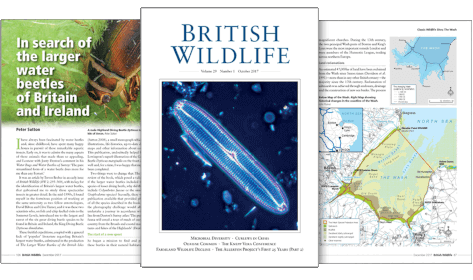
British Wildlife

8 issues per year 84 Seiten per Ausgabe Nur im Abonnement erhältlich

British Wildlife is the leading natural history magazine in the UK, providing essential reading for both enthusiast and professional naturalists and wildlife conservationists. Published eight times a year, British Wildlife bridges the gap between popular writing and scientific literature through a combination of long-form articles, regular columns and reports, book reviews and letters.

Abonnement ab £33 im Jahr

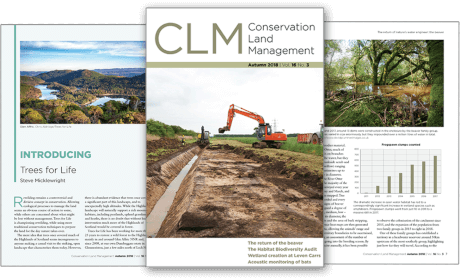
Conservation Land Management

4 Auflagen im Jahr 44 Seiten Nur im Abonnement erhältlich

Conservation Land Management (CLM) ist ein Mitgliedermagazin und erscheint viermal im Jahr. Das Magazin gilt allgemein als unverzichtbare Lektüre für alle Personen, die sich aktiv für das Landmanagement in Großbritannien einsetzen. CLM enthält Artikel in Langform, Veranstaltungslisten, Buchempfehlungen, neue Produktinformationen und Berichte über Konferenzen und Vorträge.

Subscriptions from £26 per year
Akademische und professionelle Bücher  Organismal to Molecular Biology  Biochemistry & Molecular Biology

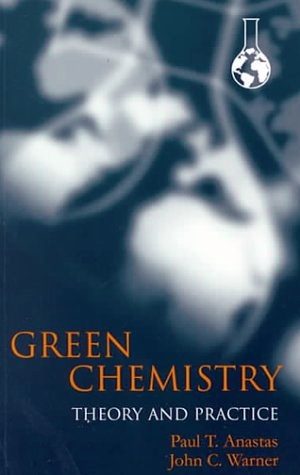
Green Chemistry Theory and Practice

By: Paul Anastas and John Warner
144 pages, Illus
Green Chemistry
Click to have a closer look
  • Green Chemistry ISBN: 9780198506980 Paperback Mar 2000 Not in stock: Usually dispatched within 6 days
    £31.49
    #103189
Price: £31.49
About this book Contents Customer reviews Related titles

About this book

This book aims to introduce the reader to the design, development, and evaluation processes of new Green Chemistry methodologies. A comprehensive introductory text, it takes a broad view of the subject and integrates a wide variety of topics. Topics covered include: alternative feedstocks, environmentally benign synthetic methodologies, designing safer chemical products, new reaction conditions, alternative solvents and catalyst development, and the use of biosynthesis and biomimetic principles. The reader is introduced to the new evaluation process that encompasses the health and environmental impact of a synthetic pathway from choice of starting materials through to target molecule. Throughout the text, comparisons and contrasts with classical methodologies are offered as illustrative examples. This accessible text is aimed at all those involved with the design, manufacture, use and disposal of chemicals and their products - especially synthetic chemicals at the graduate and professional level, process development chemists and environmental scientists.From reviews of the hardback: 'An excellent introduction into the fast growing field and the fascinating science of green chemistry. ..Should be consulted by anyone who wants to know about environmentally benign chemistry and, especially, by scientists who contemplate adopting its principles in their own research or teaching efforts.' Science

Contents

1. Introduction; 2. What is Green Chemistry?; 3. Tools of Green Chemistry; 4. Principles of Green Chemistry; 5. Evaluating the Impacts of Chemistry; 6. Evaluating Feedstocks and Starting Materials; 7. Evaluating Reaction Types; 8. Evaluation of Methods to Design Safer Chemicals; 10. Future Trends in Green Chemistry

Customer Reviews

By: Paul Anastas and John Warner
144 pages, Illus
Media reviews


"What is green chemistry? In Green Chemistry: Theory and Practice, Paul T. Anastas and John C. Warner provide a concise and comprehensive answer: 'Green chemistry is the utilization of a set of principles that reduces or eliminates the use or generation of hazardous substances in the design, manufacture and application of chemical products.' . . . Measure by measure, [Anastas] and Warner fill this abstract and fairly broad definition with life. Their short book provides a framework for the pursuit of environmentally compatible chemistry. This introductory text is intended to provide a basis for teaching and includes a collection of exercises for the topics of each chapter. . . . [This book] should be consulted by anyone who wants to know about environmentally benign chemistry and, especially, by scientists who contemplate adopting its principles in their own research or teaching efforts."--Science
"Historically, as Paul Anastas and John Warner point out in Green Chemistry: Theor

Current promotions
Great GiftsNew and Forthcoming BooksBritish Wildlife Magazine SubscriptionField Guide Sale 2025