Um genaue Preise zu sehen, wählen Sie bitte Ihr Lieferland.
 
 
United States
£ GBP
Alle Kategorien
Important Notice for US Customers

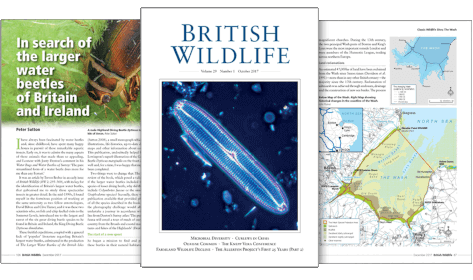
British Wildlife

8 issues per year 84 Seiten per Ausgabe Nur im Abonnement erhältlich

British Wildlife is the leading natural history magazine in the UK, providing essential reading for both enthusiast and professional naturalists and wildlife conservationists. Published eight times a year, British Wildlife bridges the gap between popular writing and scientific literature through a combination of long-form articles, regular columns and reports, book reviews and letters.

Abonnement ab £33 im Jahr

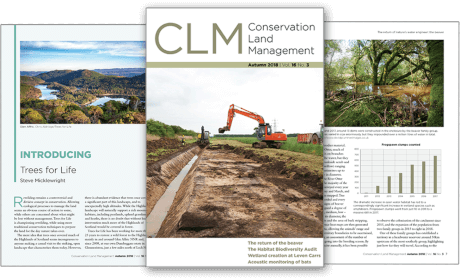
Conservation Land Management

4 Auflagen im Jahr 44 Seiten Nur im Abonnement erhältlich

Conservation Land Management (CLM) ist ein Mitgliedermagazin und erscheint viermal im Jahr. Das Magazin gilt allgemein als unverzichtbare Lektüre für alle Personen, die sich aktiv für das Landmanagement in Großbritannien einsetzen. CLM enthält Artikel in Langform, Veranstaltungslisten, Buchempfehlungen, neue Produktinformationen und Berichte über Konferenzen und Vorträge.

Subscriptions from £26 per year
Feldführer und Naturgeschichte  Habitats & Ecosystems  Habitats & Ecosystems: General

Habitats of Africa A Field Guide for Birders, Naturalists, and Ecologists

Field / Identification Guide
By: Ken Behrens(Author), Keith Barnes(Author), Iain D Campbell(Author)
448 pages, colour photos, colour illustrations, colour distribution maps
Habitats of Africa
Click to have a closer look
Average customer review
  • Habitats of Africa ISBN: 9780691244761 Flexibound Feb 2025 In stock
    £30.00
    #265847
Price: £30.00
About this book Customer reviews Biography Related titles
Images Additional images
Habitats of AfricaHabitats of AfricaHabitats of AfricaHabitats of AfricaHabitats of AfricaHabitats of AfricaHabitats of AfricaHabitats of AfricaHabitats of AfricaHabitats of AfricaHabitats of AfricaHabitats of AfricaHabitats of AfricaHabitats of AfricaHabitats of AfricaHabitats of AfricaHabitats of AfricaHabitats of Africa

About this book

With breathtaking wildlife and stunningly beautiful locales, Africa is a premier destination for birders, conservationists, ecotourists, and ecologists. This compact, easy-to-use guide provides an unparalleled treatment of the continent's wonderfully diverse habitats. Incisive and up-to-date descriptions cover the unique features of each habitat, from geology and climate to soil and hydrology, and require no scientific background. Knowing the surrounding environment is essential to getting the most out of your travel experiences. Habitats of Africa offers quick and reliable information for anyone who wants a deeper understanding and appreciation of the habitats around them.

- Covers 85 major African habitats, including oceanic habitats
- Features hundreds of colour photos of habitats and their wildlife, a wealth of helpful diagrams and illustrations, and a detailed distribution map for each land habitat
- Concise text provides all the information you need to identify and understand habitats anywhere in Africa quickly and accurately
- Discusses iconic and indicator species of birds, mammals, and plants
- Includes an in-depth section on habitat classification-invaluable for ecologists
- Representative habitat accounts include a feature describing what you can expect to see and experience there
- Formatted like a field guide for easy reference

Customer Reviews (3)

  • Invaluable companion to any naturalist and enthusiast interested in African ecology.
    By Liam 16 Mar 2025 Written for Flexibound
    Having experienced some of the lesser travelled parts of Africa and realised the gap in mainstream scientific knowledge to some of these areas, I would say that this field guide comprehensively covers many of the ecological nuances that exist on this tremendously diverse continent. Beautifully laid out and comfortably compact, this guide has sufficient scientific detail, yet approachable format, indexes and text.
    This is a field guide that has a firm place in any keen naturalist’s library who is interested in African wildlife, birds and ecology.
    Very well done to the authors for having pulled this wonderful resource together!
    1 of 1 found this helpful - Was this helpful to you? Yes No
  • Essential lecture to prepare a trip and to understand distribution of the avifauna of Africa
    By Tom 30 Mar 2025 Written for Flexibound
    Let me review this book from the eyes of a birder with general interest in nature, the subtitle of the book being A Field Guide for Birders, Naturalists and Ecologists.

    It’s a handy book with a beautiful cover, both from the paper material used and the cover illustration. As an experienced birder you normally skip the introduction of any new identification guide on birds, knowing you will not really learn something new in that section. You should not do it with this book as you will learn already quite interesting stuff on the first 3 pages. You will even find some similarities to the birding world, such as there are several lists of ecosystems of the world. Some including wildlife as does the HotW Habitats of the World, none being really easy to use for birders. So, the authors had to take their own decisions as what they consider as distinct habitats, distinct for non-professional ecologists, birders and naturalists with only basic knowledge of geology, climate and botany. Two main criteria were retained: their visual distinctiveness with species of vegetation present, e.g. grass versus trees, that even the most narrow-sighted birder will recognize and their assemblage of wildlife, primarily mammals and birds. Spoiler alert, it’s working very well!

    The area covered is all continental Africa from the pine forest of Morocco to the fynbos of South Africa, Madagascar and all the islands of Macaronesia, Gulf of Guinea islands, the remote islands off the South Atlantic and all the western Indian Ocean islands.

    Before entering the chapters of the book, you have to study just 5 more pages of the introduction about canopy leaf types (just look at the nice figure), climate descriptions (3 letters easily explained in the Köppen climate paragraph) and very nice and easy to understand climate graphs.

    And here we go to the first larger chapter called ‘Regional Introductions’ for NE Africa, East Africa, Central and North-Central Africa, Indian Ocean, Greater Southern Africa, N Africa and W Africa with beautiful coloured maps of the habitats and a list including the 3-letter code explained in the introduction.

    Next you will get to the core of the book with the 13 categories of habitats described by the authors, naming just a few like Conifers, Deserts and arid lands, Savannas or Anthropogenic habitat and their different sub-habitats.
    Every single habitat is introduced by a map, a climate diagram, and a beautiful b&w illustration showing the vegetation and including a human for scale. The habitat is then described in a way that even a birder will understand, including numerous very high-quality photographs of the habitat, mammals and birds present and characteristics of the place with a special chapter explaining why these species of mammals and birds are present.

    Not to forget the numerous sidebars presenting great information about various topics.

    But why is this book so interesting for birders. Let me explain with one single example, the distribution of Eastern Chanting-Goshawk. So, you travel to Tanzania, maybe even the first time, and you want to know where you will see the Eastern and where the Dark Chanting-Goshawk. First look will obviously be in your field guide studying the tiny maps, and when back home you may have noticed that even the most recent map for Eastern Chanting-Goshawk is completely wrong for Tanzania even though an almost perfect distribution map could be found at the Tanzania Bird Atlas website. But as an owner of the Habitats of Africa you simply have a look at either page 37 at the East Africa chapter or at page 227 in the Savannas chapter, and knowing that Eastern Chanting-Goshawk is a Northern Dry Thorn Savanna bird, you will have a perfect map of distribution of this habitat and its species in Tanzania. The habitat as defined by the authors is clearly working!

    And this is true for hundreds of bird species throughout Africa, be it for Miombo or any other habitat specialists.
    Thus, this book is perfect for planning your trip, learning much more than you will ever get out of a field guide, putting your observations in a broader ecological context and by the sheer fact that you will start to understand African biogeography in birds and mammals, your trip will be even more fun.

    Is it a field guide too? Yes, once on location, you will have plenty of time spending your evenings with a cold beer, a bird guide and the habitats guide to have a broader view of the African natural wonders.

    What else makes the book so appealing: a wealth of information not readily available elsewhere, written for birders and naturalists, explained by first class diagrams and maps and filled with hundreds of first-class (!) photographs.

    So, from my point of view as a keen birder interested both in African birds and mammals, this is essential lecture to prepare a trip and to understand distribution of the avifauna of Africa. It will be even more fun with complimentary knowledge about a topic not readily available for birders until now. Every serious birder needs this book!
    Was this helpful to you? Yes No
  • Great coverage of all habitats
    By Keith 23 Oct 2025 Written for Flexibound
    I have been lucky enough to visit quite a bit of Africa for birding, so on receiving this (the latest in the Habitats of the World series), I set myself the challenge to write down how many habitats I could think of. I like to think I am imaginative, but I could only come up with twelve. To my shame, I then saw that the authors have covered 85 major African habitats in this book. These are not just landscapes; they extend to marine habitats too. Some of these habitats are immense, but importantly, others are quite restricted, and they often contain the most endangered birds.

    So having been to north-west Zambia a while back, I decided to look at a really restricted habitat: the tall, dry woodland which is known locally as Mavunda. There are five pages devoted to this great birding habitat (home to Margaret’s Batis and Perrin’s Bush-Shrike, to mention just two species).

    The layout for each habitat is the same with concise sections such as “In a Nutshell” to tell you in fewer than 20 words what it is. Then there is a list of other habitats that have affinities with the one you are reading about. A more detailed description of the habitat follows, but importantly, this is written in an engaging way, minimising complex terminology. A section on Conservation outlines the many challenges that face this habitat, and if protection is in place it is explained. A section on Wildlife covers the main taxa, and includes a decent amount of bird information. Finally, there is a section on Distribution so you can work out how to see this habitat, and a list of key sites such as national parks.

    A book with this title could be dull, but each page has several photographs and there are many useful diagrams and maps too. Personally, I hope that at some point Princeton will look at publishing this book (and others in the Habitats of the World series) as larger format books with more space for larger images and text. To me, this is a book I want to work on before a trip, and I do not see it as a field guide.

    Introductory pages explain more generally the structure of Africa and its climate, taking each of the regions in turn. The subsequent habitat descriptions are grouped by main habitat type rather than region, which makes perfect sense. So, my Mavunda habitat is one of ten considered within a grouping called “Warm Humid Broadleaf Forests”.

    Probably the most important thing that this book does is make you aware of habitats that do not get mentioned in regular conversation. Without this kind of input, we would all simply talk about the twelve habitats that I could remember!
    Was this helpful to you? Yes No

Biography

Ken Behrens is a professional nature guide whose books include (with Iain Campbell, Charley Hesse, and Phil Chaon) Habitats of the World (Princeton).

Keith Barnes is a bird tour leader for Tropical Birding whose books include (with Ken Behrens) Wildlife of Madagascar (Princeton WILDGuides).

Iain Campbell is a professional nature guide and habitat ecologist whose books include (with Phil Chaon and Ben Knoot) Habitats of North America (Princeton) and multiple bird guides.

Field / Identification Guide
By: Ken Behrens(Author), Keith Barnes(Author), Iain D Campbell(Author)
448 pages, colour photos, colour illustrations, colour distribution maps
Media reviews

"This book does a magnificent job in presenting African habitat in all its head-spinning diversity."
– David M. Gascoigne, Travels with Birds

Current promotions
Great GiftsNew and Forthcoming BooksBritish Wildlife Magazine SubscriptionField Guide Sale 2025