Um genaue Preise zu sehen, wählen Sie bitte Ihr Lieferland.
 
 
United States
£ GBP
Alle Kategorien
Important Notice for US Customers

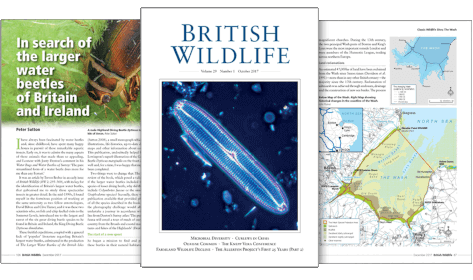
British Wildlife

8 issues per year 84 Seiten per Ausgabe Nur im Abonnement erhältlich

British Wildlife is the leading natural history magazine in the UK, providing essential reading for both enthusiast and professional naturalists and wildlife conservationists. Published eight times a year, British Wildlife bridges the gap between popular writing and scientific literature through a combination of long-form articles, regular columns and reports, book reviews and letters.

Abonnement ab £33 im Jahr

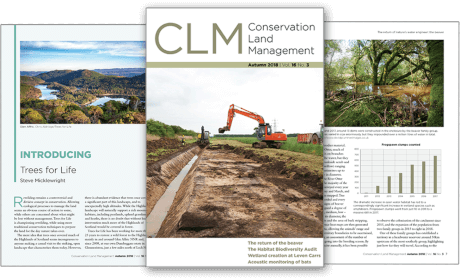
Conservation Land Management

4 Auflagen im Jahr 44 Seiten Nur im Abonnement erhältlich

Conservation Land Management (CLM) ist ein Mitgliedermagazin und erscheint viermal im Jahr. Das Magazin gilt allgemein als unverzichtbare Lektüre für alle Personen, die sich aktiv für das Landmanagement in Großbritannien einsetzen. CLM enthält Artikel in Langform, Veranstaltungslisten, Buchempfehlungen, neue Produktinformationen und Berichte über Konferenzen und Vorträge.

Subscriptions from £26 per year
Akademische und professionelle Bücher  Environmental & Social Studies  Economics, Politics & Policy  Health & Health Care

Infectious Diseases: A Geographical Analysis Emergence and Re-emergence

By: AD Cliff
560 pages, Figs, tabs
Infectious Diseases: A Geographical Analysis
Click to have a closer look
  • Infectious Diseases: A Geographical Analysis ISBN: 9780199244737 Hardback Jul 2009 Not in stock: Usually dispatched within 2-3 weeks
    £252.50
    #181233
Price: £252.50
About this book Customer reviews Related titles

About this book

The last four decades of human history have seen the emergence of an unprecedented number of 'new' infectious diseases: the familiar roll call includes AIDS, Ebola, H5N1 influenza, hantavirus, hepatitis E, Lassa fever, legionnaires' and Lyme diseases, Marburg fever, Rift Valley fever, SARS, and West Nile. The outbreaks range in scale from global pandemics that have brought death and misery to millions, through to self-limiting outbreaks of mainly local impact. Some outbreaks have erupted explosively but have already faded away; some grumble along or continue to devastate as now persistent features in the medical lexicon; in others, a huge potential threat hangs uncertainly and worryingly in the air. Some outbreaks are merely local, others are worldwide.

This book looks at the epidemiological and geographical conditions which underpin disease emergence. What are the processes which lead to emergence? Why now in human history? Where do such diseases emerge and how do they spread or fail to spread around the globe? What is the armoury of surveillance and control measures that may curb the impact of such diseases? But, uniquely, it sets these questions on the modern period of disease emergence in an historical context. First, it uses the historical record to set recent events against a much broader temporal canvas, finding emergence to be a constant theme in disease history rather than one confined to recent decades. It concludes that it is the quantitative pace of emergence, rather than its intrinsic nature, that separates the present period from earlier centuries. Second, it looks at the spatial and ecological setting of emergence, using hundreds of specially-drawn maps to chart the source areas of new diseases and the pathways of their spread. The book is divided into three main sections: Part 1 looks at early disease emergence, Part 2 at the processes of disease emergence, and Part 3 at the future for emergent diseases.

Customer Reviews

By: AD Cliff
560 pages, Figs, tabs
Current promotions
Great GiftsNew and Forthcoming BooksBritish Wildlife Magazine SubscriptionField Guide Sale 2025