Click to have a closer look
About this book
Contents
Customer reviews
Biography
Related titles
About this book
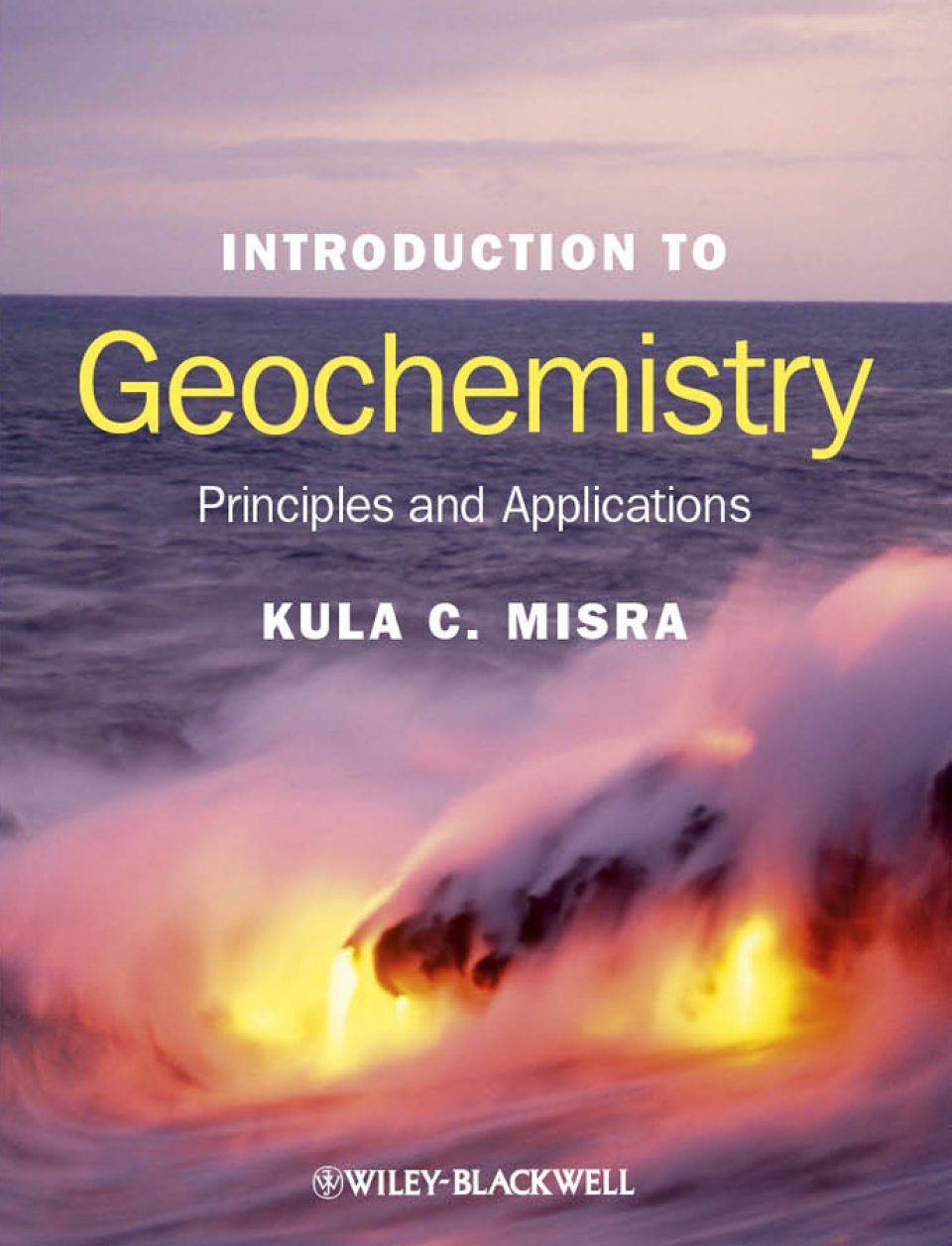
This unique guide covers a broad range of topics on the distribution and abundance of elements and isotopes in geologic systems as a result of chemical and isotopic reactions. Chapters develop relevant geochemical principles in a logical sequence and with an appropriate balance between qualitative reasoning and quantitative rigor. With an emphasis on practical applications, this text helps undergraduates develop sound problem-solving techniques through worked-out examples and challenging end-of-chapter problem sets. Students also learn how to construct and interpret phase diagrams suitable to the problem being considered.
Contents
Outline of the Proposed Book. Principles and applications of chemical and isotopic reactions that control the distribution and abundance of elements and isotopes in geologic systems at different scales constitute the central theme of the proposed book. The strategy adopted here is to start with interactions at the smallest scale (atoms and molecules), then deal with multi-phase, mesoscale systems (e.g., mineral assemblages), and finally apply the accumulated wisdom to the understanding of macroscale/megascale systems (e.g., mantle-crust; crust-hydrosphere-atmosphere). This is a logical structure because the total response of a geologic system can normally be rationalized on the basis of what happens (or is likely to happen) on smaller scales within the system. As can be seen from the outline (attached), the book consists of 13 chapters, which (excluding Chapter 1 - Introduction) are divided into four parts as summarized below:. Part I - Crystal Chemistry. This part contains a brief review of atomic structure of the elements (Ch. 2) and chemical bonds that hold atoms together in compounds (Ch. 3).. Part II - Chemical Reactions. This part starts with a discussion of the basic concepts of equilibrium thermodynamics for closed systems comprised of pure phases (Ch. 4) and then introduces the concept of chemical potential (Ch. 5) that is required to handle more complex, multi-component systems. The next three chapters explore applications of the thermodynamic principles to selected categories of chemical reactions that are of particular interest to earth scientists: geothermometry and geobarometry (Ch. 6); reactions involving aqueous solutions (Ch. 7), with emphasis on dissolution/precipitation of carbonate minerals and chemical weathering of silicate minerals; and oxidation-reduction reactions, especially at the near-surface environment (Ch. 8). The last chapter of this part (Ch. 9) briefly discusses the kinetics of chemical reactions, which constrain the progress of thermodynamically viable reactions. Part III - Isotope Geochemistry. The first chapter in this part (Ch. 10) deals with radiogenic isotopes, with focus on their application to age-dating of minerals and rocks. Fractionation of stable isotopes (oxygen, hydrogen, sulfur, and carbon) and their geologic applications (geothermometry, source issues, interpretation of paleoclimate, etc.) are discussed in the next chapter (Ch. 11).. Part IV - Geochemical Systems. Application of the principles developed in earlier chapters to understand geochemical interactions among mantle, crust, hydrosphere, and atmosphere is the subject matter of this part the book. This part is divided into two chapters. The first one, the mantle-crust system (Ch 12), begins with an overview of the solar system and origin of the earth. The main focus of the chapter, the mantle-crust interaction, is dominated by two themes: (a) magma generation by partial melting in the upper mantle and magma crystallization into igneous rocks that have formed the oceanic crust and much of the continental crust; and (b) evolution of the crust through geologic time based on the framework of plate tectonics. The last chapter of the book (Ch 13) reviews the compositions of the atmosphere and the oceans, discusses biogeochemical cycles, and ends with a discussion of the interactions that have shaped the evolution of the crust, oceans, and atmosphere through geologic time.
Customer Reviews
Biography
Kula C. Misra is a Professor of Geology (Emeritus) at the University of Tennessee where he has taught geochemistry, economic geology, and environmental geology for more than 30 years. He received a M.Tech degree in Applied Geology from the Indian Institute of Technology (Kharagpur) and, after working for about ten years as a field geologist, a Ph.D. degree in Geology from the University of Western Ontario (Canada). His research papers have been published in several professional journals, and he is the author of the textbook Understanding Mineral Deposits published in the year 2000. He is a member of several professional organizations and has served as a consultant to corporations and government agencies on subjects related to mineral deposits and environmental geochemistry.