Um genaue Preise zu sehen, wählen Sie bitte Ihr Lieferland.
 
 
United States
£ GBP
Alle Kategorien
Important Notice for US Customers

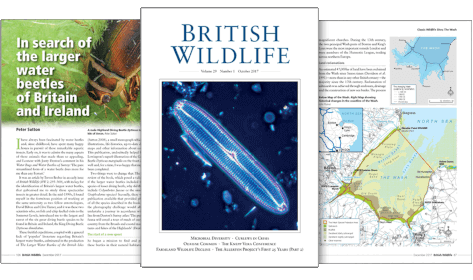
British Wildlife

8 issues per year 84 Seiten per Ausgabe Nur im Abonnement erhältlich

British Wildlife is the leading natural history magazine in the UK, providing essential reading for both enthusiast and professional naturalists and wildlife conservationists. Published eight times a year, British Wildlife bridges the gap between popular writing and scientific literature through a combination of long-form articles, regular columns and reports, book reviews and letters.

Abonnement ab £33 im Jahr

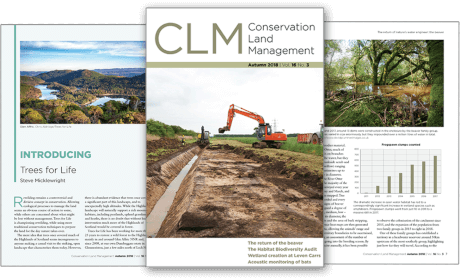
Conservation Land Management

4 Auflagen im Jahr 44 Seiten Nur im Abonnement erhältlich

Conservation Land Management (CLM) ist ein Mitgliedermagazin und erscheint viermal im Jahr. Das Magazin gilt allgemein als unverzichtbare Lektüre für alle Personen, die sich aktiv für das Landmanagement in Großbritannien einsetzen. CLM enthält Artikel in Langform, Veranstaltungslisten, Buchempfehlungen, neue Produktinformationen und Berichte über Konferenzen und Vorträge.

Subscriptions from £26 per year
Akademische und professionelle Bücher  Reference  Data Analysis & Modelling  Cartography, Remote Sensing, Image Analysis & GIS

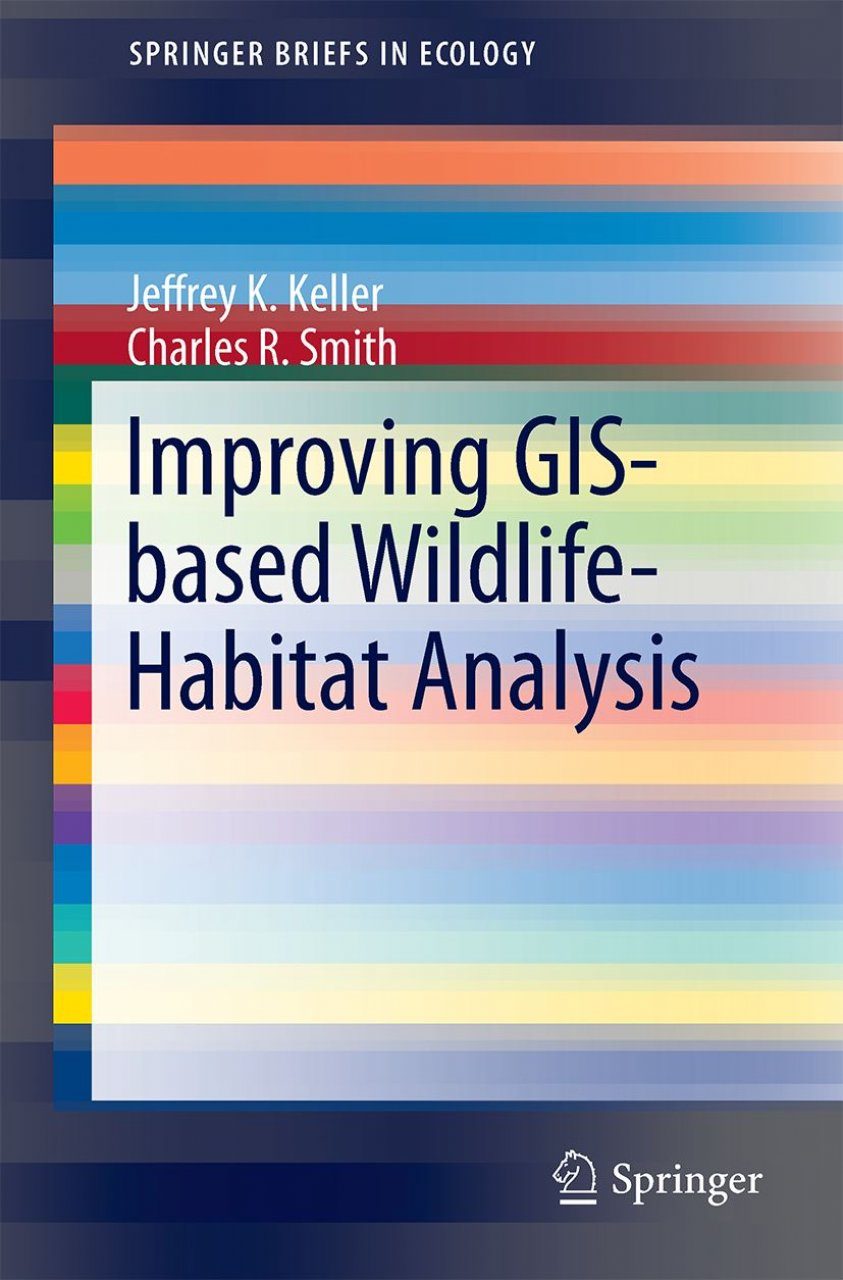
Improving GIS-based Wildlife-Habitat Analysis

By: Jeffrey K Keller(Author), Charles R Smith(Author)
132 pages, 6 colour & 8 b/w illustrations, 10 tables
Publisher: Springer Nature
Improving GIS-based Wildlife-Habitat Analysis
Click to have a closer look
  • Improving GIS-based Wildlife-Habitat Analysis ISBN: 9783319096070 Paperback Oct 2014 In stock
    £44.99
    #217470
Price: £44.99
About this book Contents Customer reviews Biography Related titles

About this book

Geographic Information Systems (GIS) provide a powerful tool for the investigation of species-habitat relationships and the development of wildlife management and conservation programs. However, the relative ease of data manipulation and analysis using GIS, associated landscape metrics packages, and sophisticated statistical tests may sometimes cause investigators to overlook important species-habitat functional relationships. Additionally, underlying assumptions of the study design or technology may have unrecognized consequences.

Improving GIS-based Wildlife-Habitat Analysis examines how initial researcher choices of image resolution, scale(s) of analysis, response and explanatory variables, and location and area of samples can influence analysis results, interpretation, predictive capability, and study-derived management prescriptions. Overall, most studies in this realm employ relatively low resolution imagery that allows neither identification nor accurate classification of habitat components. Additionally, the landscape metrics typically employed do not adequately quantify component spatial arrangement associated with species occupation. To address this latter issue, the authors introduce two novel landscape metrics that measure the functional size and location in the landscape of taxon-specific 'solid' and 'edge' habitat types.

Keller and Smith conclude that investigators conducting GIS-based analyses of species-habitat relationships should more carefully 1) match the resolution of remotely sensed imagery to the scale of habitat functional relationships of the focal taxon, 2) identify attributes (explanatory variables) of habitat architecture, size, configuration, quality, and context that reflect the way the focal taxon uses the subset of the landscape it occupies, and 3) match the location and scale of habitat samples, whether GIS- or ground-based, to corresponding species' detection locations and scales of habitat use.

Contents

Chapter 1. Working Definitions
Chapter 2. Image Resolution vs. Habitat Selection Scale in a Remote Sensing Context
Chapter 3. Explanatory Variables
Chapter 4. Landscape Sampling Area vs. Actual Location of Taxonomic Survey
Chapter 5. Refining Habitat Specificity
Chapter 6. Example Using High-resolution Imagery and Taxon-specific Variables

Customer Reviews

Biography

Jeffrey K. Keller is a professional restoration ecologist.

Charles R. Smith is a senior research associate with Cornell's Department of Natural Resources. He also holds an adjunct associate professorship in the graduate program in biodiversity, conservation, and policy in the Department of Biological Sciences at the State University of New York at Albany.

By: Jeffrey K Keller(Author), Charles R Smith(Author)
132 pages, 6 colour & 8 b/w illustrations, 10 tables
Publisher: Springer Nature
Current promotions
Great GiftsNew and Forthcoming BooksBritish Wildlife Magazine SubscriptionField Guide Sale 2025