Um genaue Preise zu sehen, wählen Sie bitte Ihr Lieferland.
 
 
United States
£ GBP
Alle Kategorien
Important Notice for US Customers

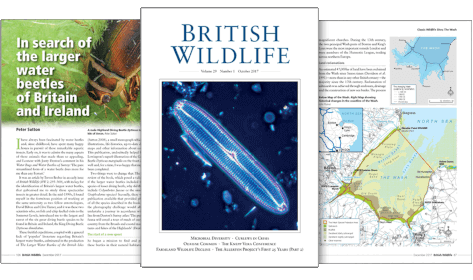
British Wildlife

8 issues per year 84 Seiten per Ausgabe Nur im Abonnement erhältlich

British Wildlife is the leading natural history magazine in the UK, providing essential reading for both enthusiast and professional naturalists and wildlife conservationists. Published eight times a year, British Wildlife bridges the gap between popular writing and scientific literature through a combination of long-form articles, regular columns and reports, book reviews and letters.

Abonnement ab £33 im Jahr

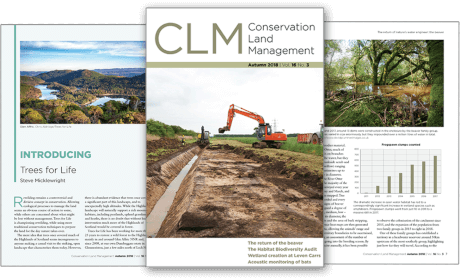
Conservation Land Management

4 Auflagen im Jahr 44 Seiten Nur im Abonnement erhältlich

Conservation Land Management (CLM) ist ein Mitgliedermagazin und erscheint viermal im Jahr. Das Magazin gilt allgemein als unverzichtbare Lektüre für alle Personen, die sich aktiv für das Landmanagement in Großbritannien einsetzen. CLM enthält Artikel in Langform, Veranstaltungslisten, Buchempfehlungen, neue Produktinformationen und Berichte über Konferenzen und Vorträge.

Subscriptions from £26 per year
Akademische und professionelle Bücher  Organismal to Molecular Biology  Biochemistry & Molecular Biology

Stable Isotope Techniques in the Study of Biological Processes and Functioning of Ecosystems

Handbook / Manual
By: Murray Unkovich(Editor), John S Pate(Editor), Ann McNeill(Editor), D Jane Gibbs(Editor)
289 pages, b/w illustrations, tables
Publisher: Springer Nature
Stable Isotope Techniques in the Study of Biological Processes and Functioning of Ecosystems
Click to have a closer look
  • Stable Isotope Techniques in the Study of Biological Processes and Functioning of Ecosystems ISBN: 9780792370789 Hardback Jul 2001 Not in stock: Usually dispatched within 2-3 weeks
    £129.99
    #126888
Price: £129.99
About this book Contents Customer reviews Related titles

About this book

Stable Isotope Techniques in the Study of Biological Processes and Functioning of Ecosystems has a very strong practical orientation, telling readers what methodologies are available using stable isotopes, how studies should be designed and executed to maximise effectiveness and incisiveness in terms of data obtained and outcomes in terms of understanding events and processes in plant and ecosystem functioning.

The readership is very much aimed toward postgraduates with good knowledge of general biological principles and underlying chemical and physical processes. Pre-existing knowledge of or experience in application and assay of stable isotopes is not required. The stable isotope research field is one of the most rapidly growing areas of ecophysiology and techniques using stable isotopes comprise an ever increasing component of research programs of university postgraduates and a wide range of agencies conducting environmental monitoring and rehabilitation programs. Stable Isotope Techniques in the Study of Biological Processes and Functioning of Ecosystems is tailor-made for such an audience.

Contents

1. Fundamentals of Stable Isotope Chemistry and Measurement; T.E. Dawson, P.D. Brooks
2. Carbon Isotope Discrimination and Plant Water-Use Efficiency: Case Scenarios for C3 Plants; J.S. Pate
3. Extraction and Analysis of Plant Water for Deuterium Isotope Measurement and Application to Field Experiments; J.V. Turner, et al
4. The Use of Stable Isotopes of Water for Determining Sources of Water for Plant Transpiration; G. Walker, et al
5. What do δ15N Signatures tell Us about Nitrogen Relations in Natural Ecosystems? G. Stewart
6. Assessing N2 Fixation in Annual Legumes using 15N Natural Abundance; M. Unkovich, J.S. Pate
7. The Use of 15N to study Biological Nitrogen Fixation by Perennial Legumes; M.B. Peoples, et al
8. Source/Sink Interactions in Crop Plants: Application of 13CO2 and Urea-15N Techniques in Quantitative Analysis; J.A. Palta
9. Use of Enriched 15N Sources to study Soil N Transformations; I.R.P. Fillery, S. Recous
10. Stable Isotope Techniques using Enriched 15N and 13C for Studies of Soil Organic Matter Accumulation and Decomposition in Agricultural Systems; A. McNeill
11. Source Identification in Marine Ecosystems: Food Web Studies using δ13C and δ15N; A.J. Smit
12. δ13C as an Indicator of Palaeoenvironments: A Molecular Approach; K. Grice
Index

Customer Reviews

Handbook / Manual
By: Murray Unkovich(Editor), John S Pate(Editor), Ann McNeill(Editor), D Jane Gibbs(Editor)
289 pages, b/w illustrations, tables
Publisher: Springer Nature
Current promotions
Great GiftsNew and Forthcoming BooksBritish Wildlife Magazine SubscriptionField Guide Sale 2025