Um genaue Preise zu sehen, wählen Sie bitte Ihr Lieferland.
 
 
United States
£ GBP
Alle Kategorien
Important Notice for US Customers

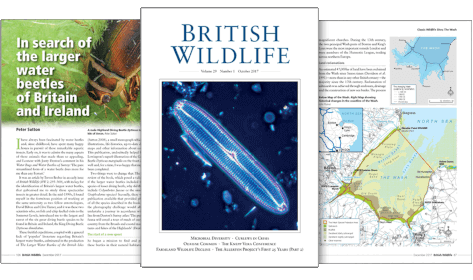
British Wildlife

8 issues per year 84 Seiten per Ausgabe Nur im Abonnement erhältlich

British Wildlife is the leading natural history magazine in the UK, providing essential reading for both enthusiast and professional naturalists and wildlife conservationists. Published eight times a year, British Wildlife bridges the gap between popular writing and scientific literature through a combination of long-form articles, regular columns and reports, book reviews and letters.

Abonnement ab £33 im Jahr

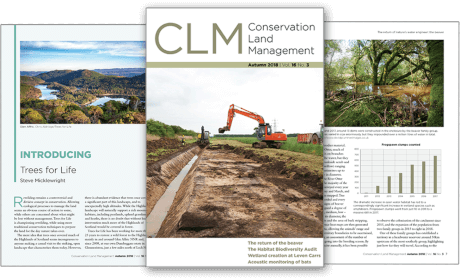
Conservation Land Management

4 Auflagen im Jahr 44 Seiten Nur im Abonnement erhältlich

Conservation Land Management (CLM) ist ein Mitgliedermagazin und erscheint viermal im Jahr. Das Magazin gilt allgemein als unverzichtbare Lektüre für alle Personen, die sich aktiv für das Landmanagement in Großbritannien einsetzen. CLM enthält Artikel in Langform, Veranstaltungslisten, Buchempfehlungen, neue Produktinformationen und Berichte über Konferenzen und Vorträge.

Subscriptions from £26 per year
Akademische und professionelle Bücher  Environmental & Social Studies  Pollution & Remediation  Waste Management & Remediation

Treatment Wetlands for Environmental Pollution Control

By: Hanna Obarska-Pempkowiak(Author), Magdalena Gajewska(Author), Ewa Wojciechowska(Author), Janusz Pempkowiak(Author)
207 pages, 8 colour & 52 b/w illustrations
Publisher: Springer Nature
Treatment Wetlands for Environmental Pollution Control
Click to have a closer look
  • Treatment Wetlands for Environmental Pollution Control ISBN: 9783319137933 Hardback Jan 2015 Expected delivery 3rd April - 6th April
    £89.99
    #220973 | Stock: 0
Price: £89.99
About this book Contents Customer reviews Related titles

About this book

The aim of Treatment Wetlands for Environmental Pollution Control is to present an overview of the state of the art with regard to the function, application and design of TWSs in order to better protect surface water from contamination. Accordingly, it also presents applications of constructed wetlands with regard to climatic and cultural aspects. The use of artificial and natural treatment wetland systems (TWSs) for wastewater treatment is an approach that has been developed over the last thirty years.

Europe is currently home to roughly 10 000 constructed wetland treatment systems (CWTSs), which simulate the aquatic habitat conditions of natural marsh ecosystems; roughly 3 500 systems are in operation in Germany alone. TWSs can also be found in many other European countries, for example 200 – 400 in Denmark, 400 – 600 in Great Britain, and ca. 1 000 in Poland. Most of the existing systems serve as local or individual household treatment systems. CWTSs are easy to operate and do not require specialized maintenance; further, no biological sewage sludge is formed during treatment processes. As TWSs are resistant to fluctuations in hydraulic loads, they are primarily used in rural areas as well as in urbanized areas with dispersed habitats, where conventional sewer systems and central conventional wastewater treatment plants (WWTPs) cannot be applied due to the high costs they would entail.

TWSs are usually applied at the 2nd stage of domestic wastewater treatment, after mechanical treatment, and/or at the 3rd stage of treatment in order to ensure purification of effluent from conventional biological reactors and re-naturalization. New applications of TWSs include rainwater treatment as well as industrial and landfill leachate treatment. TWSs are well suited to these fields, as they can potentially remove not only organic matter and nitrogen compounds but also trace metals and traces of persistent organic pollutants and pathogens. Based on the practical experience gathered to date, and on new research regarding the processes and mechanisms of pollutant removal and advances in the systems properties and design, TWSs continue to evolve.

Contents

- Introduction
- Characteristic of hydrophytes method
- Type of treatment wetlands
- Domestic wastewater treatment
- The quality of the outflow from conventional WWTPs and treatment wetlands systems
- Storm water treatment in TWs
- Landfill leachate treatment
- Reject water from digested sludge centrifugation in HTWs
- Sewage sludge stabilization

Customer Reviews

By: Hanna Obarska-Pempkowiak(Author), Magdalena Gajewska(Author), Ewa Wojciechowska(Author), Janusz Pempkowiak(Author)
207 pages, 8 colour & 52 b/w illustrations
Publisher: Springer Nature
Current promotions
Field Guide Sale 2025New and Forthcoming BooksBritish Wildlife Magazine Subscription