Um genaue Preise zu sehen, wählen Sie bitte Ihr Lieferland.
 
 
United States
£ GBP
Alle Kategorien
Important Notice for US Customers

British Wildlife

8 issues per year 84 Seiten per Ausgabe Nur im Abonnement erhältlich

British Wildlife is the leading natural history magazine in the UK, providing essential reading for both enthusiast and professional naturalists and wildlife conservationists. Published eight times a year, British Wildlife bridges the gap between popular writing and scientific literature through a combination of long-form articles, regular columns and reports, book reviews and letters.

Abonnement ab £33 im Jahr

Conservation Land Management

4 Auflagen im Jahr 44 Seiten Nur im Abonnement erhältlich

Conservation Land Management (CLM) ist ein Mitgliedermagazin und erscheint viermal im Jahr. Das Magazin gilt allgemein als unverzichtbare Lektüre für alle Personen, die sich aktiv für das Landmanagement in Großbritannien einsetzen. CLM enthält Artikel in Langform, Veranstaltungslisten, Buchempfehlungen, neue Produktinformationen und Berichte über Konferenzen und Vorträge.

Subscriptions from £26 per year
Akademische und professionelle Bücher  Botany  Plants & Botany: General

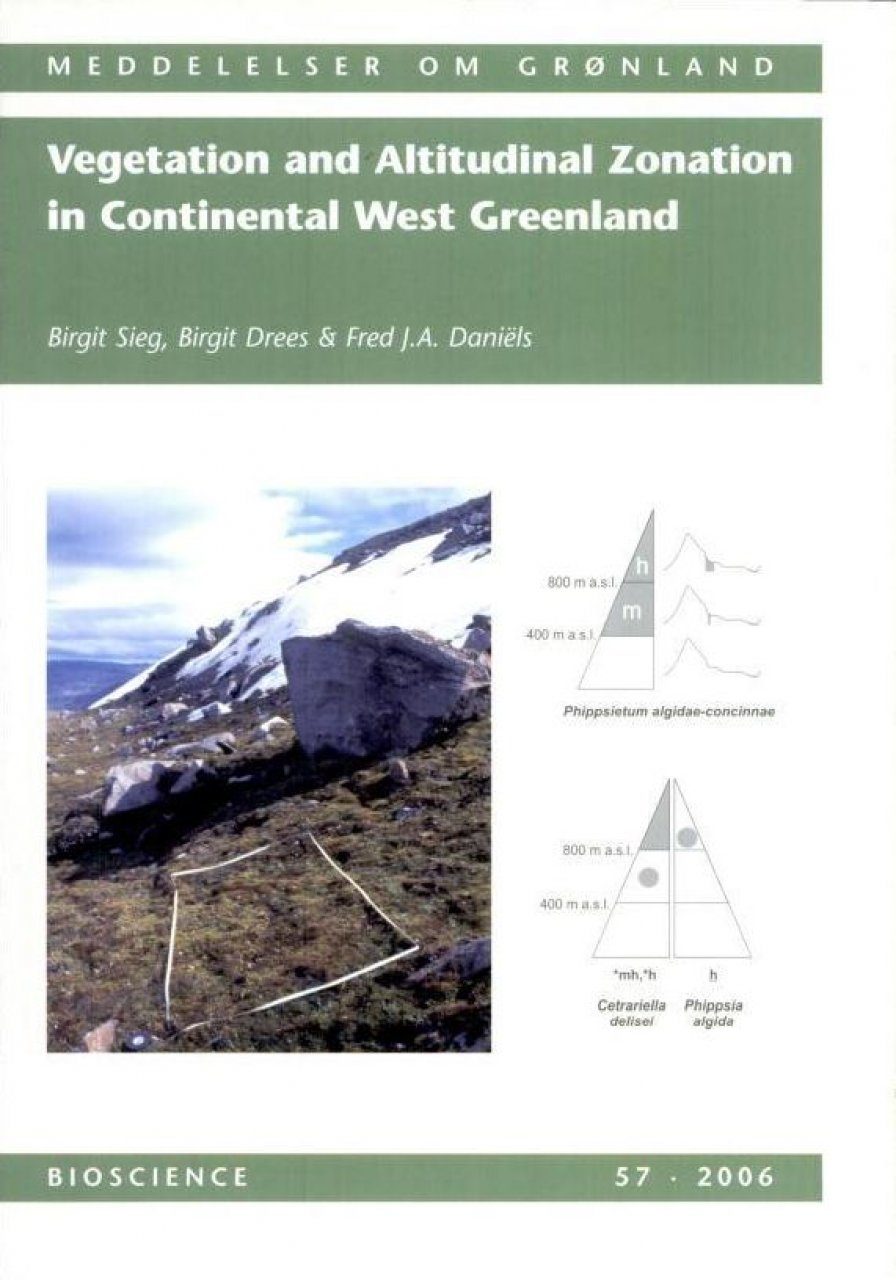
Vegetation and Altitudinal Zonation in Continental West Greenland

Monograph
By: Birgit Sieg(Author), Birgit Drees(Author), Fred JA Daniëls(Author)
93 pages, 9 colour photos and b/w illustrations, tables
Vegetation and Altitudinal Zonation in Continental West Greenland
Click to have a closer look
  • Vegetation and Altitudinal Zonation in Continental West Greenland ISBN: 9788763512756 Paperback Jan 2006 Not in stock: Usually dispatched within 1-2 weeks
    £34.99
    #211509
Price: £34.99
About this book Customer reviews Related titles

About this book

Following the principles of the Braun-Blanquet approach in Vegetation and Altitudinal Zonation in Continental West Greenland a detailed investigation of the vegetation types of mountains in continental West Greenland is presented. The vegetation types are analysed regarding their subdivision into subassociations, variants and elevation forms, as well as the prevailing environmental conditions of their habitats. 

Special attention is paid to bryophytes and lichens as these play an important role in arctic plant communities and ecosystems. Based on 394 relevés the following communities are dealt with: Calamagrostio lapponicae-Salicetum glaucae ass. nov., Hylocomio splendentis-Cassiopetum tetragonae, Empetro hermaphroditi-Betuletum nanae, Ledo decumbentis-Betuletum nanae (all Loiseleurio-Vaccinietea), Carici nardinae-Dryadetum integrifoliae, Thuidio abietini-Kobresietum myosuroides ass. nov., Rhododendro lapponici-Vaccinietum microphylli, Tortello arcticae-Caricetum rupestris ass. nov., Saxifrago nathorstii-Kobresietum simpliciusculae (all Carici-Kobresietea), Plagiomnio elliptici-Salicetum glaucae ass. nov. (Salicetea purpureae), Cerastium arcticum-Poa community, Pediculari flammeae-Caricetum bigelowii ass. nov. (both Salicetea herbaceae), Caricetum saxatilis, Caricetum rariflorae (both Scheuchzerio-Caricetea) and Racomitrium lanuginosum community (Thlaspietea rotundifolii). 

Moreover, the importance of all vegetation types in the study area (incl. Phippsietum algidaeconcinnae, Cassiopetum hypnoidis, a.o.) regarding the characterization and delimitation of altitudinal vegetation belts is assessed. For this purpose, their altitudinal distribution, elevation forms, change in habitat-type preferences and the substitution of communities along the altitudinal gradient as well as altitudinal indicator values of selected species are discussed. It resulted that the existence of three altitudinal belts with boundaries at 400 and 800 m a.s.l. can be confirmed and that a variety of the considered criteria is necessary for a comprehensive distinction of these vegetation belts. 

Furthermore, it was shown that differences between vegetation in mid and high altitudes are more pronounced than between low and mid altitudes. The lowlands and mid altitudes are dominated by erect dwarf-shrub heath vegetation. The associations Rhododendro-Vaccinietum and Ledo-Betuletum are mainly restricted to these altitudes. Mid altitudes are differentiated from the lowlands by elevation forms and change in habitat-type preferences of vegetation types as well as by occurrence of snowbed communities and absence of shrub vegetation. High altitudes are dominated by graminoid and prostrate dwarf-shrub vegetation of the classes Salicetea herbaceae and Carici-Kobresietea. They are differentiated from mid altitudes not only by elevation forms and change in habitat-type preferences of plant communities, but also by substitution of vegetation types. Tortello-Caricetum, Pediculari-Caricetum and Racomitrium lanuginosum community are restricted to these altitudes.

Customer Reviews

Monograph
By: Birgit Sieg(Author), Birgit Drees(Author), Fred JA Daniëls(Author)
93 pages, 9 colour photos and b/w illustrations, tables
Current promotions
January SaleNew and Forthcoming BooksBritish Wildlife Magazine SubscriptionField Guide Sale 2025

