Um genaue Preise zu sehen, wählen Sie bitte Ihr Lieferland.
 
 
United States
£ GBP
Alle Kategorien
Important Notice for US Customers

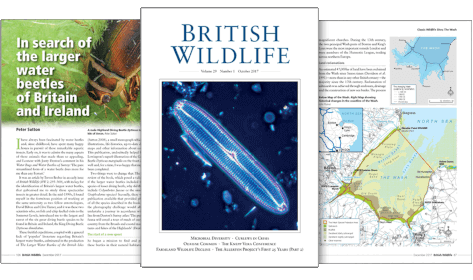
British Wildlife

8 issues per year 84 Seiten per Ausgabe Nur im Abonnement erhältlich

British Wildlife is the leading natural history magazine in the UK, providing essential reading for both enthusiast and professional naturalists and wildlife conservationists. Published eight times a year, British Wildlife bridges the gap between popular writing and scientific literature through a combination of long-form articles, regular columns and reports, book reviews and letters.

Abonnement ab £33 im Jahr

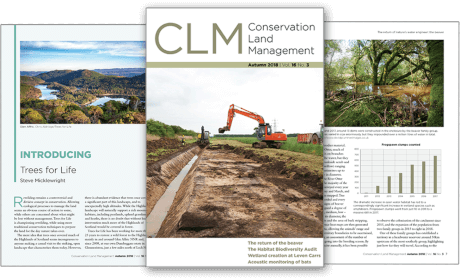
Conservation Land Management

4 Auflagen im Jahr 44 Seiten Nur im Abonnement erhältlich

Conservation Land Management (CLM) ist ein Mitgliedermagazin und erscheint viermal im Jahr. Das Magazin gilt allgemein als unverzichtbare Lektüre für alle Personen, die sich aktiv für das Landmanagement in Großbritannien einsetzen. CLM enthält Artikel in Langform, Veranstaltungslisten, Buchempfehlungen, neue Produktinformationen und Berichte über Konferenzen und Vorträge.

Subscriptions from £26 per year
Akademische und professionelle Bücher  Botany  Economic Botany & Ethnobotany

Viticulture, Volume 1 Resources

Series: Viticulture Volume: 1
By: Peter R Dry(Editor), Bryan G Coombe(Editor)
255 pages, colour & b/w photos, b/w illustrations, colour maps, tables
Publisher: Winetitles
Viticulture, Volume 1
Click to have a closer look
  • Viticulture, Volume 1 ISBN: 9780975685006 Edition: 2 Paperback Dec 2008 Not in stock: Usually dispatched within 2-4 weeks
    £115.00
    #182396
Price: £115.00
About this book Customer reviews Related titles

About this book

This book is a second edition of Viticulture, Volume I: Resources, which was published in 1988. The companion book. Viticulture, Volume II: Practices, appeared in 1992.

This edition of Volume I is about 50 per cent longer than the first. The authors have searched the literature widely, covering earlier classical works and modern scientific publications; hence, Viticulture Volume 1: Resources lists are lengthy. Much of the increase, however, is new material within those chapters that were also in the first edition – especially in the sections on regions, soils and climate. In addition, there is an entirely new chapter on berry development and grape quality. The increases in the number of researchers and in research funds and facilities have fuelled the changes.

A wide array of basic science is used in scientific studies concerning viticultural problems. Two in particular are prominent: a) Plant Physiology, now augmented by molecular methods, has helped explain problems of the plant itself; and b) Organic Chemistry has been an important tool for physiologists and for research on the transformation of the grape crop into its marketed products. A recent account of Faraday's early work to purify by distillation the exceptionally stable benzene molecule illustrates how a whole new discipline crucial to the study of all branches of biology – Organic Chemistry – can emerge as a result of a specific endeavour. This new edition of Viticulture, Volume I: Resources documents the evolution of viticultural science since the publication of the first edition through the specific endeavours of a burgeoning range of researchers. It also demonstrates the wide-reaching potential for viticultural science to influence, and be influenced by, developments in other areas of science, including new helds.

Customer Reviews

Series: Viticulture Volume: 1
By: Peter R Dry(Editor), Bryan G Coombe(Editor)
255 pages, colour & b/w photos, b/w illustrations, colour maps, tables
Publisher: Winetitles
Current promotions
Great GiftsNew and Forthcoming BooksBritish Wildlife Magazine SubscriptionField Guide Sale 2025