Um genaue Preise zu sehen, wählen Sie bitte Ihr Lieferland.
 
 
United States
£ GBP
Alle Kategorien
Important Notice for US Customers

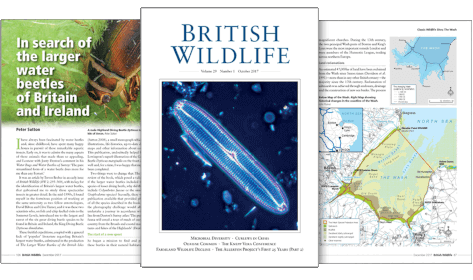
British Wildlife

8 issues per year 84 Seiten per Ausgabe Nur im Abonnement erhältlich

British Wildlife is the leading natural history magazine in the UK, providing essential reading for both enthusiast and professional naturalists and wildlife conservationists. Published eight times a year, British Wildlife bridges the gap between popular writing and scientific literature through a combination of long-form articles, regular columns and reports, book reviews and letters.

Abonnement ab £33 im Jahr

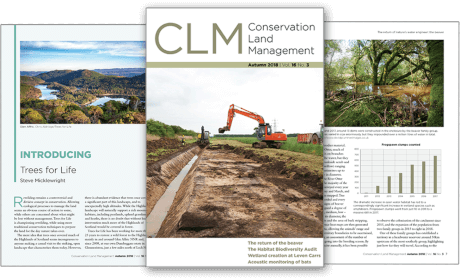
Conservation Land Management

4 Auflagen im Jahr 44 Seiten Nur im Abonnement erhältlich

Conservation Land Management (CLM) ist ein Mitgliedermagazin und erscheint viermal im Jahr. Das Magazin gilt allgemein als unverzichtbare Lektüre für alle Personen, die sich aktiv für das Landmanagement in Großbritannien einsetzen. CLM enthält Artikel in Langform, Veranstaltungslisten, Buchempfehlungen, neue Produktinformationen und Berichte über Konferenzen und Vorträge.

Subscriptions from £26 per year
Akademische und professionelle Bücher  Botany  Floras & Botanical Field Guides  Botany of Australasia

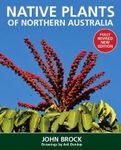
Flora of Australia, Volume 39: Alismatales to Arales

Flora / Fauna Identification Key
Series: Flora of Australia Volume: 39
301 pages, colour plates, b/w line drawings, distribution maps
Flora of Australia, Volume 39: Alismatales to Arales
Click to have a closer look
  • Flora of Australia, Volume 39: Alismatales to Arales ISBN: 9780643104235 Hardback Jul 2011 Not in stock: Usually dispatched within 5 days
    £105.00
    #122441
Price: £105.00
About this book Contents Customer reviews Related titles

About this book

Volume 39 of the Flora of Australia describes 17 families of monocots in 76 genera and 256 species. Most of the families are aquatic, and include the sea-grasses, pond weeds, and some major agricultural weed species. Four families are entirely or mostly terrestrial.

The aquatic families are all small in number of species, and two, Juncaginaceae and Posidoniaceae, have their greatest diversity in Australia. Lemnaceae contains the world's smallest and most reduced flowering plants, some as tiny as 1 mm long.

Of the terrestrial families, all are predominantly tropical, with their greatest diversity outside Australia. Arecaceae (palms) and Pandanaceae are often large trees, and include species of economic importance as food and oil crops, fibre, timber and other construction materials, as well as many horticultural species. Araceae are mostly climbers but also arborescent to aquatic herbs, with several important food species, and many horticultural species and cultivars.

Thirty authors, illustrators and photographers have contributed to this volume.

Contents

Contributors to Volume 39
Illustrators
Photographers
Introduction

Limnocharitaceae (S.W.L. Jacobs & K.A. McColl)
Alismataceae (S.W.L. Jacobs)
Hydrocharitaceae (S.W.L. Jacobs, K.A. McColl & J. Kuo)
Aponogetonaceae (C.B. Hellquist & S.W.L. Jacobs)
Juncaginaceae (H. Aston)
Potamogetonaceae (S.E. Papassotiriou, S.W.L. Jacobs & C.B. Hellquist)
Ruppiaceae (S.W.L. Jacobs & M.A. Brock)
Najadaceae (S.W.L. Jacobs & K.A. McColl)
Zannichelliaceae (S.W.L. Jacobs & K.A. McColl)
Posidoniaceae (J. Kuo)
Cymodoceaceae (J. Kuo)
Zosteraceae (J. Kuo)
Triuridaceae (K.J. Nicholls)
Arecaceae (J.L. Dowe & D.L. Jones)
Pandanaceae (A.J.G. Wilson)
Araceae (A. Hay)
Lemnaceae (E. Landolt)

Appendix: new taxa and recombinations
Supplementary Glossary
Abbreviations & Contractions
Publication date of previous volumes
Index

Customer Reviews

Flora / Fauna Identification Key
Series: Flora of Australia Volume: 39
301 pages, colour plates, b/w line drawings, distribution maps
Current promotions
Great GiftsNew and Forthcoming BooksBritish Wildlife Magazine SubscriptionField Guide Sale 2025