Um genaue Preise zu sehen, wählen Sie bitte Ihr Lieferland.
 
 
United States
£ GBP
Alle Kategorien
Important Notice for US Customers

British Wildlife

8 issues per year 84 Seiten per Ausgabe Nur im Abonnement erhältlich

British Wildlife is the leading natural history magazine in the UK, providing essential reading for both enthusiast and professional naturalists and wildlife conservationists. Published eight times a year, British Wildlife bridges the gap between popular writing and scientific literature through a combination of long-form articles, regular columns and reports, book reviews and letters.

Abonnement ab £33 im Jahr

Conservation Land Management

4 Auflagen im Jahr 44 Seiten Nur im Abonnement erhältlich

Conservation Land Management (CLM) ist ein Mitgliedermagazin und erscheint viermal im Jahr. Das Magazin gilt allgemein als unverzichtbare Lektüre für alle Personen, die sich aktiv für das Landmanagement in Großbritannien einsetzen. CLM enthält Artikel in Langform, Veranstaltungslisten, Buchempfehlungen, neue Produktinformationen und Berichte über Konferenzen und Vorträge.

Subscriptions from £26 per year
Akademische und professionelle Bücher  History & Other Humanities  History of Science & Nature

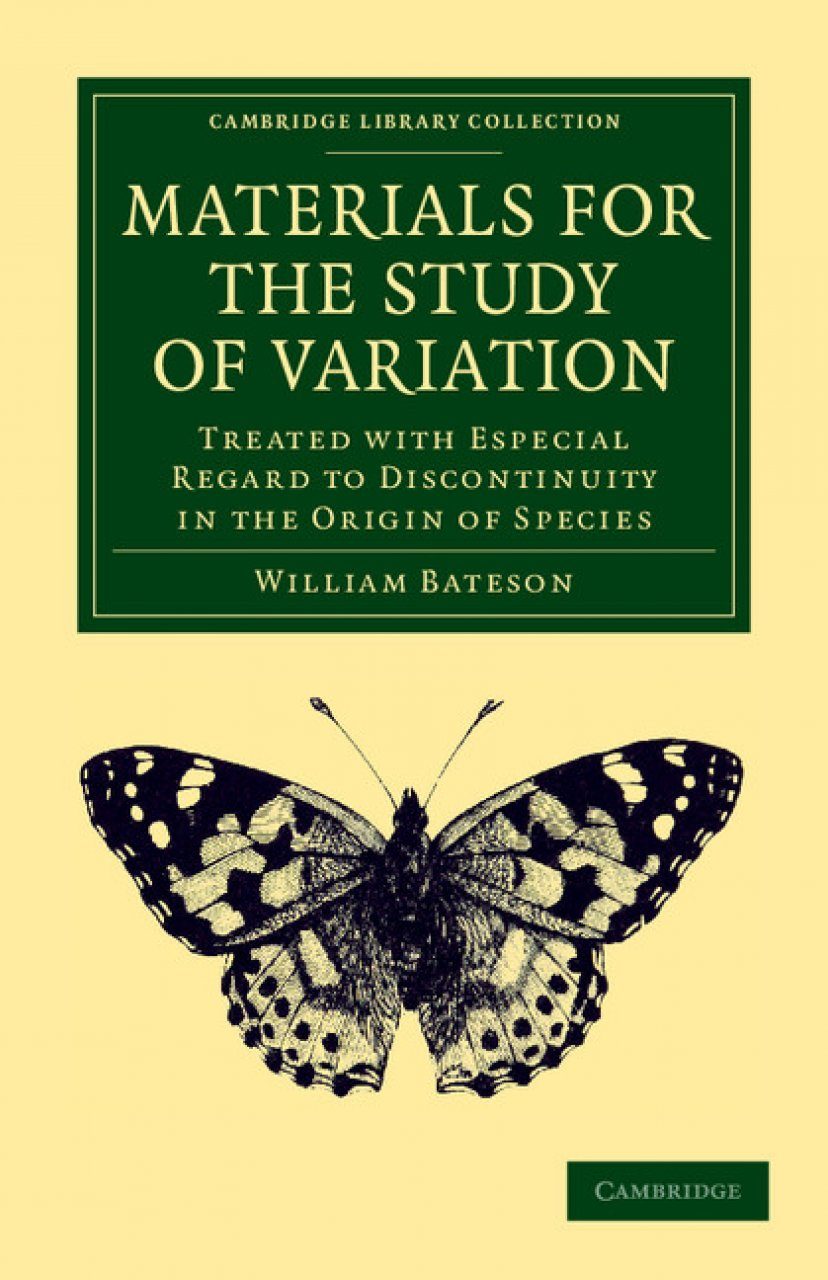
Materials for the Study of Variation Treated with Especial Regard to Discontinuity in the Origin of Species

By: William Bateson(Author)
620 pages, 209 b/w illustrations
Materials for the Study of Variation
Click to have a closer look
  • Materials for the Study of Variation ISBN: 9781108053129 Paperback Aug 2012 Not in stock: Usually dispatched within 1-2 weeks
    £51.00
    #199383
Price: £51.00
About this book Contents Customer reviews Related titles

About this book

A reprint of a classical work in the Cambridge Library Collection.

Building on the work of Darwin and Mendel, the biologist William Bateson (1861–1926) was the first scientist to combine the study of variation, heredity and evolution, and to use the term 'genetics'. This book was first published in 1894 after many years of experimental and theoretical work – particularly in the embryology of the acorn worm genus Balanoglossus – which had been guided by the principle that embryonic developmental stages replay the evolutionary transitions of adult forms of an organism's ancestors. Bateson was the first to challenge this theory, which made him unpopular among the scientific establishment of the time, but he was proved right. Organising his material by anatomical sections, Bateson explores speciation, phylogeny and discontinuous and continuous variation among a wide range of species, including vertebrates, invertebrates and plants. This pioneering work offers great insight into how the study of genetics and inheritance itself evolved.

Contents

Preface
Introduction

Part I. Meristic Variation
1. Arrangement of evidence
2. Segments of arthropoda
3. Vertebrae and ribs
4. Spinal nerves
5. Variation in arthropoda
6. Chaetopoda, hirundinea and cestoda
7. Branchial openings of chordata and structures in connexion with them
8. Mammae
9. Teeth
10. Teeth (recapitulation)
11. Miscellaneous examples
12. Colour-markings
13. Minor symmetries: digits
14. Digits (recapitulation)
15. Minor symmetries: segments in appendages
16. Radial series
17. Radial series: echinodermata
18. Bilateral series
19. Further illustrations of the relationship between right and left sides
20. Supernumary appendages in secondary symmetry
21. Appendages in secondary symmetry
22. Duplicity of appendages in arthropoda
23. Secondary symmetry in vertebrates
24. Double monsters
25. Concluding reflexions

Index of subjects
Index of persons

Customer Reviews

By: William Bateson(Author)
620 pages, 209 b/w illustrations
Current promotions
Great GiftsNew and Forthcoming BooksBritish Wildlife Magazine SubscriptionField Guide Sale 2025