By: Ivan R Schwab(Author), Russell Fernald(Foreword By)
306 pages, colour & b/w photos, b/w illustrations
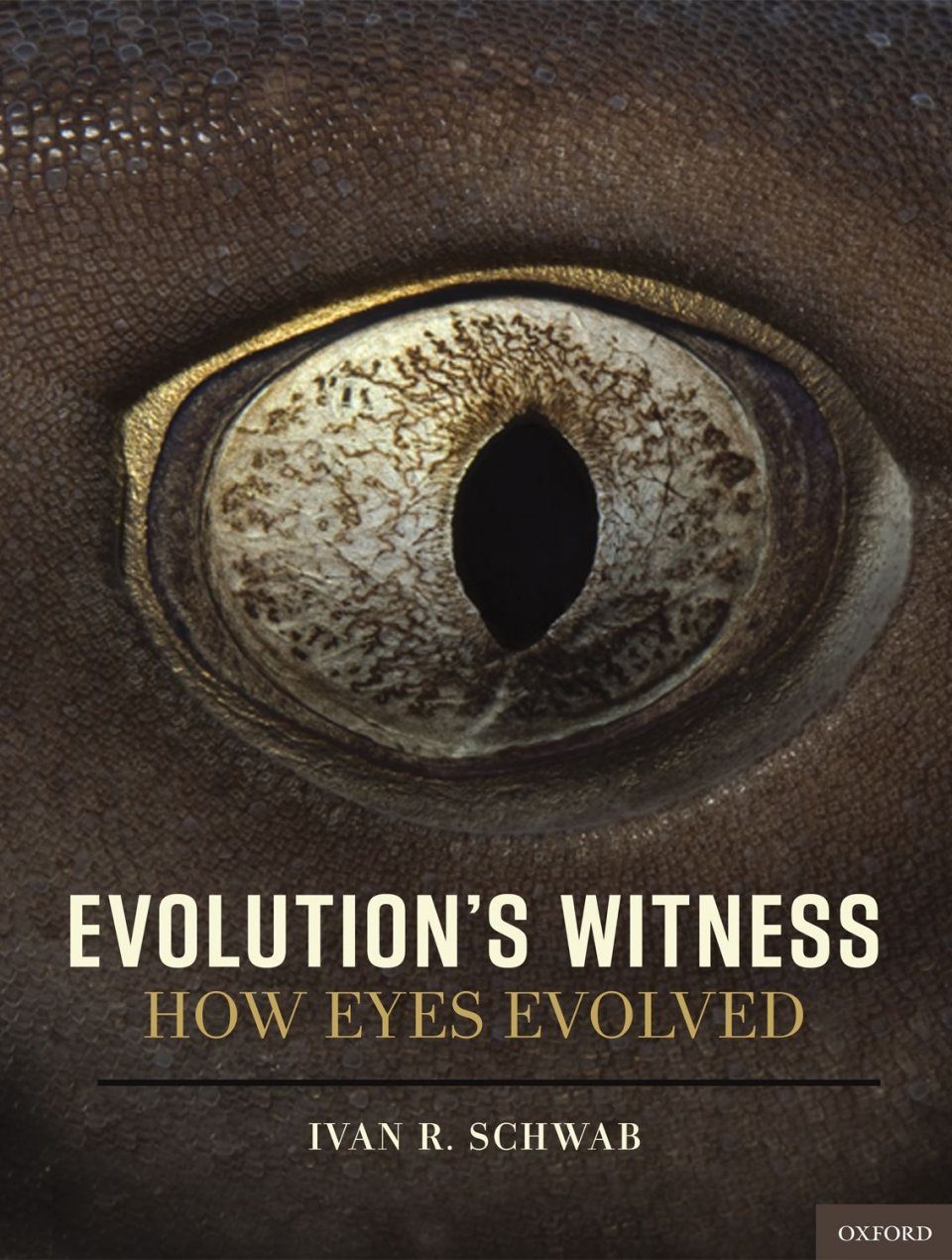
Evolution's greatest gift and its greatest triumph: this is the story of the evolution of the eye

Click to have a closer look
About this book
Contents
Customer reviews
Biography
Related titles
Recommended titles
About this book
With predation and carnivory as catalysts, the first known eye appeared in a trilobite during the Cambrian explosion approximately 543 million years ago. This period was a crucible of evolution and teemed with anatomical creativity, although the journey to formed vision actually began billions of years before that.
The Cambrian period, however, spawned nearly all morphological forms of the eye, followed by descent over hundreds of millions of years, providing an unimaginable variety of eyes with at least ten different designs. Some eyes display spectacular creativity with mirror, scanning or telephoto optics. Some of these ocular designs are merely curiosities, while others offer the finest visual potential packed into a small space, limited only by the laws of diffraction or physiological optics.
For example, some spiders developed tiny, well-formed eyes with scanning optics and three visual pigments; scallops have 40-100 eyes circling their mantle, each of which has mirror optics and contains two separate retinae per eye; deep ocean fish have eyes shaped like tubes containing yellow lenses to break camouflage; and some birds have vision five times better than ours; but this is only part of the story. Each animal alive today has an eye that fits its niche perfectly, demonstrating the intimacy of the evolutionary process as no other organ could. The evolution of the eye is one of the best examples of Darwinian principles.
Although few eyes fossilize in any significant manner, many details of this evolution are known and understood. From initial photoreception 3.75 billion years ago to early spatial recognition in the first cupped eyespot in Euglena to fully formed camera style eyes the size of beach balls in ichthyosaurs, animals have processed light to compete and survive in their respective niches.
Contents
Foreword / Russell Fernald
Acknowledgments
Introduction
Prologue
1. The age of first cellular life
2. The age of complex cellular life
3. Eukaryotes organize and metazoans arise
4. Early animals prepare the ground
5. Vision's big bang blazes the trail
6. The age of Arthropods: A major phylum begins
7. Vertebrates gain a foothold
8. Shelly fauna rule the sea
9. The piscine eye develops
10.The piscine eye matures
11. Insects arise to fly
12. Stealth, Speed and Predation
13. The age of Tetrapods and Terrestrials
14.Terrestrial life flourishes
15. Reptiles push the ocular envelope
16. March of the Archosaurs
17. Dinosaurs and their companions
18. Cephalopods change direction
19. Snakes arise from the ground
20. The Age of Birds - The eye is taken to great heights
21. Pollinators Co-Evolve
22. Mammalia diversifies
23. The Age of Mammals
24. Planktonic soup evolves
25. Mammals return to the sea
26. The visual witness and a conscious brain
Appendices
A. The human eye - a camera style eye
B. Extraocular muscles
C. Retinal Vascularization
D. Evolution of the cornea and ocular coats
E. Accommodation
F. Crystalline lens
G. Photoreceptor cells
H. Neurologic evolution in birds
References by Chapter
Glossary
Index
Customer Reviews
Biography
Ivan R. Schwab M.D. is currently a professor at the University of California, Davis where he has worked as an Ophthalmologist for over twenty years, and was on the faculty at West Virginia University for seven years before coming to UCD. His strong interest in biology and natural history has led him to investigate a diverse range of topics including ocular stem cells, bioengineered tissues for the eye and comparative optics and physiology. He has published extensively in these fields, with three previous books to his credit, and he was the winner of the 2006 IgNobel for Ornithology. He has combined those interests with one in evolution to produce this text on the evolution of the eye.
By: Ivan R Schwab(Author), Russell Fernald(Foreword By)
306 pages, colour & b/w photos, b/w illustrations
Evolution's greatest gift and its greatest triumph: this is the story of the evolution of the eye
"I found myself being drawn further into it the more I read."
– Eye News, June 2012
"Amazing color photos on nearly every page ensure a vivid trek through evolution of the eye [...] Evolution's Witness in whole or part, is an essential mainstay for multiple disciplines, irreplaceable for vision scientists and eye care professionals."
– Jeff Rabin, Optometry and Vision Science, May 2013
"Ivan Schwab's landmark new book, Evolution's Witness, which charts the development of eyes in all major taxa, comes at a propitious time [...] it is a comprehensive reference but also a source of inspiration and ideas for new ways to study myriad aspects of vision."
– Daniel Graham, Perception, 2012
"In Evolution's Witness: How Eyes Evolved, Ivan R. Schwab ventures back nearly 4,000 million years to witness the key events that have shaped the ability to form an image and trace the evolution of an organ that was considered by Charles Darwin to be almost perfect [...] Any person interested in comparative neurobiology will find this book a must and will marvel at how natural selection has driven adaptational change [...] this comprehensive and beautifully illustrated text should sit on the shelves of all students, graduates and academics with an interest in evolution, adaptation, neural plasticity and natural history. For those more intimately working in the field of visual neuroscience (including optometrists and ophthalmologists), it provides a unique and holistic perspective that provides the context in which we are all working."
– Shaun P. Collin, Clinical and Experimental Optometry, July 2013












![Kame no Kōra wa Abarabone: Jintai de Arawasu Ugokumonozukan [Turtle Shells Have Ribs: A Picture Book of Animal Anatomy Represented by the Human Body]](http://mediacdn.nhbs.com/jackets/jackets_resizer_medium/24/249897.jpg?height=150&width=99)


