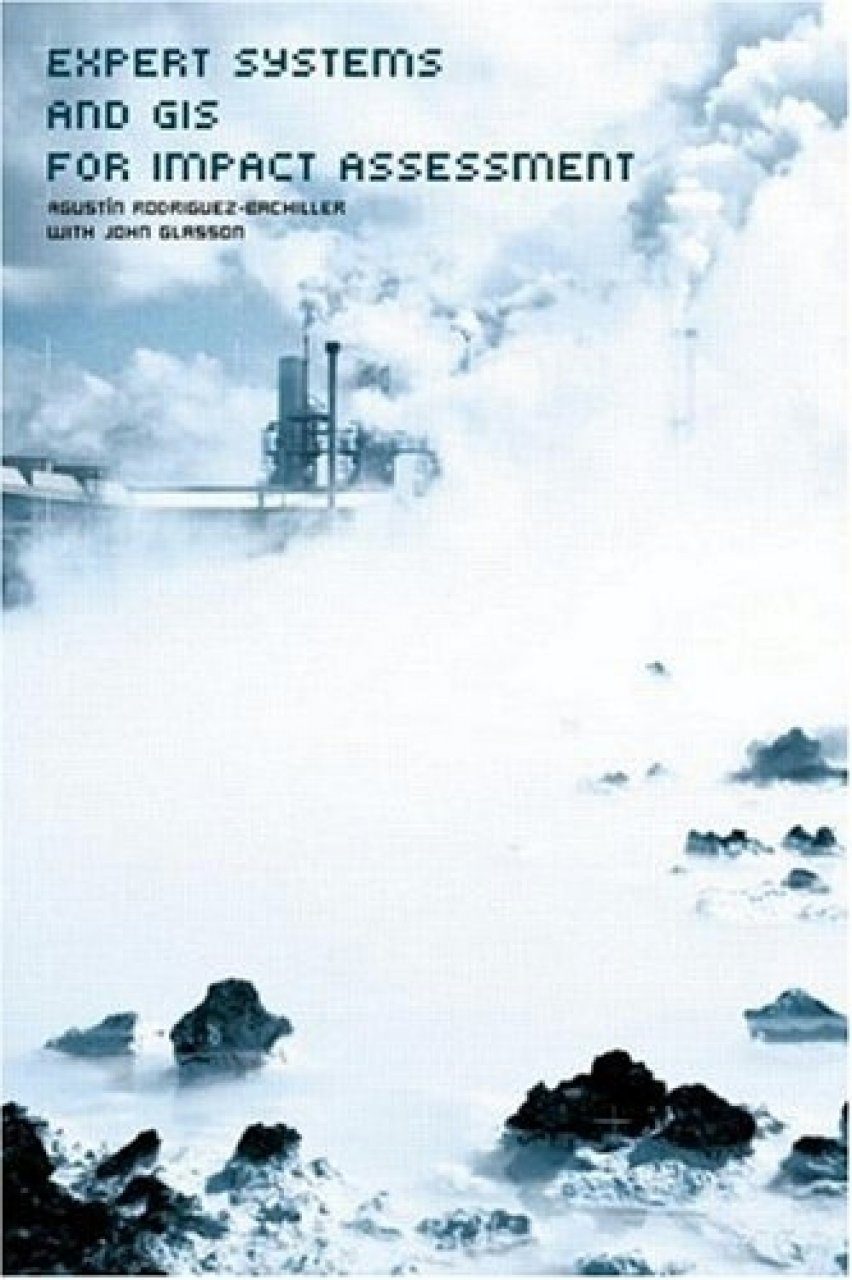
By: Agustin Rodriguez-Bachiller and John Glasson
384 pages, 50 illus, 15 b/w photos

Click to have a closer look
About this book
Contents
Customer reviews
Biography
Related titles
About this book
This book is aimed at professionals working with Environmental Impact Assessment, GIS and expert-systems professionals and students in these areas.
Contents
PART ONE Chapter 1 1. Introduction 2. Expert Systems: what about space? 3. Geographical Information Systems: more than display tools? 4. GIS problems and potential 5. Impact Assessment: ripe for automation? 6. The IA process 7. Environmental Statements 8. Integration: the way ahead? REFERENCES Chapter 2 1. Introduction 2. Expert Systems and Artificial Intelligence 2.1.The classical period 2.2.The romantic period 2.3.The modern period 2. Expert systems: structure and design 3. The promise of Expert Systems? 4. From Expert Systems to Decision Support Systems 5. Conclusions: expert systems are dead, long live expert systems? REFERENCES Chapter 3 1. Introduction 2. Impact Assessment and Environmental Management 3. The role of GIS 4. GIS for Impact Assessment 4.1. GIS mapping for Impact Assessment 4.2. GIS linked to external models for IA 4.3. Using GIS' own functionality for IA 4.4. Multi-purpose GIS systems 5. Conclusions REFERENCES Chapter 4 1. Introduction 2. GIS for environmental mapping and management 3. GIS linked to external models for environmental management 3.1.Water modeling 3.2.GIS and other environmental modeling 3.3.GIS for model design and development 3.4.GIS and other modeling approaches 4. Using GIS' own functionality for environmental management 4.1.Pre-programmed GIS applications 5. General-purpose environmental management systems 6. Conclusions REFERENCES Chapter 5 1. Introduction 2. Expert Systems without GIS for Environmental Assessment 2.1.Expert Systems without GIS for Impact Assessment 2.2.Expert Systems without GIS for environmental management 3. Expert Systems with GIS 3.1.GIS and Expert Systems: methodological issues 3.1.1.Methodological issues: visualization 3.1.2.Methodological issues: classification 3.2.GIS and Expert Systems in the Regional Research Laboratories 3.2.1.The RRLs Research Agenda 3.2.2.RRL-related work and publications 3.3.3.GIS and AI in the RRLs: conclusions 3.3.ES and GIS for Impact Assessment 3.4.ES and GIS for Environmental Management 4. Decision Support Systems (and ES) with GIS 4.1.GIS and DSS for Impact Assessment 4.2.GIS and DSS for Environmental Management 5. Conclusions REFERENCES PART TWO Chapter 6 1. Introduction 2. The logic of Project Screening 3. The SCREEN Expert System at Oxford Brookes University 4. Scoping 5. The SCOPE Expert System at Oxford Brookes University 6. Adding GIS to the SCREEN-SCOPE suite at Oxford Brookes 6.1.Procedures linking ES and GIS 6.2.Evaluating the GIS links 7. Conclusions REFERENCES Chapter 7 1. Introduction 2. Air Pollution 2.1.Project design and location 2.2.Baseline assessment 2.3.Impact prediction and assessment 2.3.1.Variations in the modeling approach 2.3.2.Model output and ac
Customer Reviews
Biography
Agustin Rodreguez-Bachiller is a senior lecturer in quantitative methods in the School of Planning. His research and teaching interests involve information technology, expert systems, applied statistics, GIS / spatial analysis, and planning methods and theory. Professor John Glasson is Head of the School of Planning at Oxford Brookes University and is the Research Director of the Impact Assessment Unit. He is also a member of various national professional and academic committees, including the ESRC Global Environmental Change Committee.
By: Agustin Rodriguez-Bachiller and John Glasson
384 pages, 50 illus, 15 b/w photos