To see accurate pricing, please choose your delivery country.
 
 
United States
£ GBP
All Shops
Important Notice for US Customers

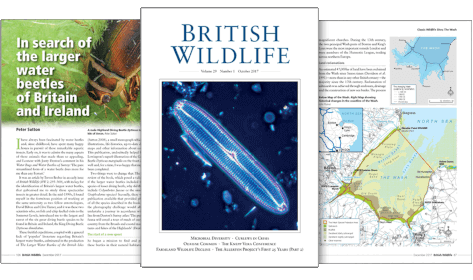
British Wildlife

8 issues per year 84 pages per issue Subscription only

British Wildlife is the leading natural history magazine in the UK, providing essential reading for both enthusiast and professional naturalists and wildlife conservationists. Published eight times a year, British Wildlife bridges the gap between popular writing and scientific literature through a combination of long-form articles, regular columns and reports, book reviews and letters.

Subscriptions from £33 per year

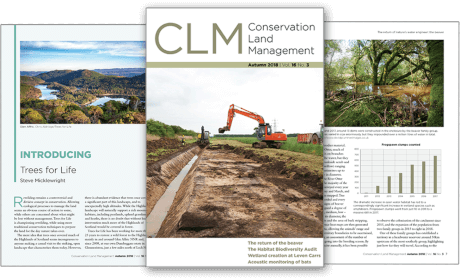
Conservation Land Management

4 issues per year 44 pages per issue Subscription only

Conservation Land Management (CLM) is a quarterly magazine that is widely regarded as essential reading for all who are involved in land management for nature conservation, across the British Isles. CLM includes long-form articles, events listings, publication reviews, new product information and updates, reports of conferences and letters.

Subscriptions from £26 per year
Academic & Professional Books  Insects & other Invertebrates  Insects  Butterflies & Moths (Lepidoptera)

Australian Moths A Natural History

Coming Soon
By: Roger L Kitching(Editor)
572 pages, colour photos
Publisher: CABI Publishing
Australian Moths
Click to have a closer look
  • Australian Moths ISBN: 9781800627666 Hardback 27 Feb 2026 Not yet published
    £175.00
    #269259 | Stock: 0
Price: £175.00
About this book Contents Customer reviews Biography Related titles

About this book

The insect Order Lepidoptera is one of the four megadiverse groups of insects globally. The vast majority of the Order are moths, and the unique Australian fauna has long been of interest to scientists and other enthusiasts.

Australian Moths: A Natural History presents a synthesis of much of the research work that has occurred over the last 30 years on the Australian moth fauna, focusing on the ecology, evolution and natural history of this key Order of insects. All the chapters are authored by experts currently active in the field. Following introductory material, the chapters fall into three broad categories. Seven chapters present general accounts of the fauna, ranging from the history of its discovery (including Indigenous knowledge), through origin and evolution, community ecology, to conservation. A central block of chapters describes key groups of Australian moths which have radiated extensively in Australia, followed by chapters summarising knowledge on key species. These species are of particular economic, social or conservation significance. The book closes with a chapter on key knowledge gaps as a challenge to future researchers and naturalists.

The work is essential reading for research students, senior scientists, conservationists, pest managers and amateur entomologists. It aims to promote moths as exciting and productive subjects for further study, enthusiasm and admiration.

Contents

1. Introduction: Moths and the Australian fauna

Part 1: History, evolution & ecology
2. Discovery and history
3. Origins and evolution
4. Biogeography
5. Life histories and feeding ecology
6. Natural enemies: challenges and responses
7. Dispersal and migration
8. The community ecology of Australian moths
9. Moth conservation in Australia

Part 2: Taxon accounts
10. The Hepialidae: the ghost moths
11. The Heliozelidae: the shield-bearers
12. The Oecophoridae: the mallee or concealer moths
13. The Xylorictidae: the timber moths
14. The Psychidae: the bagworm moths
15. The Cossoidea: wood-borers, sun moths, clearwing moths and their relatives
16. The Limacodidae: the Australian cup-moths
17. The Pyraloidea: the snout and grass moths
18. The Geometridae: waves, emeralds, carpets and their relatives
19. The Sphingidae: the hawkmoths
20. Noctuoidea - an overview
21. The Arctiinae: the tiger, lichen and wasp moths
22. The day-moths (Agaristinae)

Part 3: Species of economic importance
23. Moths as pests in Australia
24. The Jarrah leafminer: Perthida glyphopa
25. The diamondback moths; Plutella xylostella and Plutella australiana
26. The giant wood moth: Endoxyla cinereus
27. Tortricid pests: codling moth, light-brown apple moth and their relatives
28. Moths of stored products
29. Processionary caterpillars: Ochrogaster lunifer - a cryptic species complex
30. The fruit-piercing moths: Eudocima species - identities, distribution, ecology and pest status
31. The gumleaf skeletonizer moth: Uraba lugens
32. The earworms, bollworms and budworms: Helicoverpa spp.

Part 4: Species of special interest and conservation concern
33. Moths of special significance
34. Scribbly gum moths: Osmograptis spp.
35. The golden sun-moth: Synemon plana
36. The southern pink underwing, (Phyllodes imperialis smithersi) - a flagship species
37. The bogong moths, Agrotis infusa
38. Knowledge gaps and opportunities: a future for moth studies in Australia

Customer Reviews

Biography

Roger Kitching is Emeritus Professor of Ecology at Griffith University, Brisbane, Australia. In addition to being the author and editor of nine books, he has published over 280 research papers and articles.

Coming Soon
By: Roger L Kitching(Editor)
572 pages, colour photos
Publisher: CABI Publishing
Current promotions
New and Forthcoming BooksBritish Wildlife Magazine SubscriptionField Guide Sale 2025