To see accurate pricing, please choose your delivery country.
 
 
United States
£ GBP
All Shops
Important Notice for US Customers

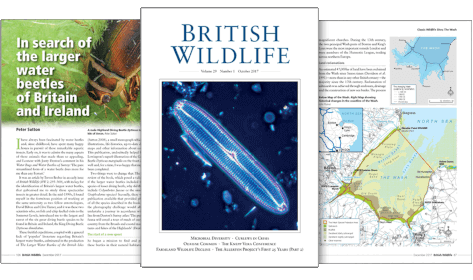
British Wildlife

8 issues per year 84 pages per issue Subscription only

British Wildlife is the leading natural history magazine in the UK, providing essential reading for both enthusiast and professional naturalists and wildlife conservationists. Published eight times a year, British Wildlife bridges the gap between popular writing and scientific literature through a combination of long-form articles, regular columns and reports, book reviews and letters.

Subscriptions from £33 per year

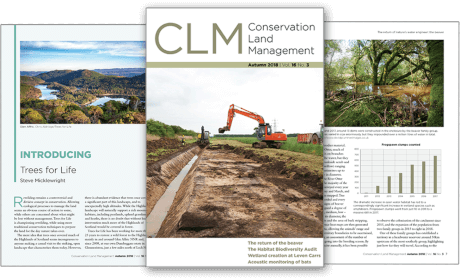
Conservation Land Management

4 issues per year 44 pages per issue Subscription only

Conservation Land Management (CLM) is a quarterly magazine that is widely regarded as essential reading for all who are involved in land management for nature conservation, across the British Isles. CLM includes long-form articles, events listings, publication reviews, new product information and updates, reports of conferences and letters.

Subscriptions from £26 per year
Academic & Professional Books  Reptiles & Amphibians  Reptiles

Conservation Status of the Reptiles of South Africa, Eswatini, and Lesotho

Series: Suricata Volume: 10
By: Krystal A Tolley(Editor), Werner Conradie(Editor), Darren W Pietersen(Editor), Joshua Weeber(Editor), Marius Burger(Editor), Graham J Alexander(Editor)
colour photos
Conservation Status of the Reptiles of South Africa, Eswatini, and Lesotho
Click to have a closer look
  • Conservation Status of the Reptiles of South Africa, Eswatini, and Lesotho ISBN: 9781928224631 Hardback Dec 2023 Not in stock: Usually dispatched within 1-2 months
    £125.00
    #264657
Price: £125.00
About this book Customer reviews Related titles

About this book

Reptiles across South Africa, Eswatini, and Lesotho face increasing threats to their survival, including habitat loss, climate change, and exploitation for the pet trade. However, amidst these challenges, there is a growing recognition of the importance of conservation efforts to protect these invaluable species.

A team of herpetologists, including Krystal Tolley from the South African National Biodiversity Institute and Graham Alexander from the University of the Witwatersrand, have collaborated on this book, Conservation Status of the Reptiles of South Africa, Eswatini, and Lesotho. Published as part of the Suricata series, this comprehensive publication delves into the conservation status of all 401 indigenous terrestrial reptiles in the region. The authors estimate that the proportion of species threatened with extinction in this region has almost doubled since 1990, underscoring the evolving challenges faced by these animals. Of particular note is the decline of the lizard Scelotes inornatus over the last 50 years, emphasizing the importance of timely conservation interventions.

The book represents a significant milestone in ongoing efforts to assess and conserve biodiversity, providing a meticulous evaluation of the extinction risk faced by reptiles in South Africa, Eswatini, and Lesotho. The International Union for the Conservation of Nature’s (IUCN) Red List of Threatened Species serves as the framework for these assessments, ensuring a rigorous and standardised approach. Biodiversity loss, one of the most significant challenges that faces South Africa, and the world, needs action. The Red List is a vital tool designed to evaluate a species’ risk of extinction, utilising the best available data at the time of assessment. Updating the list of threatened species is crucial due to the dynamic threat landscape; evolution in understanding due to advancements in taxonomy, data quality, and analytical tools; and conservation relevance. Outdated assessments can misallocate resources, directing attention to threats that are no longer significant or neglecting emerging threats, thus affecting the conservation of these species.

Reptiles, often overlooked, play a crucial role in ecosystems, with more than 12,000 species globally that contribute significantly to biodiversity. However, recent global reviews have highlighted alarming declines, with over 20% of reptile species at risk of extinction. The book identifies species in various threat categories, including Extinct, Critically Endangered, Endangered, and Vulnerable. The assessments reveal that 7.6% of the region’s reptile species are at risk of extinction, with an additional 5.6% considered Near Threatened. Despite these concerning statistics, not all news is bad. Against a global backdrop, South Africa has fewer threatened reptile species than other regions, suggesting that current declines due to habitat loss have not yet passed the point of no return for threatened species. The book represents a valuable resource for researchers, conservationists, and anyone passionate about preserving the richness of the reptile species.

Customer Reviews

Series: Suricata Volume: 10
By: Krystal A Tolley(Editor), Werner Conradie(Editor), Darren W Pietersen(Editor), Joshua Weeber(Editor), Marius Burger(Editor), Graham J Alexander(Editor)
colour photos
Current promotions
Great GiftsNew and Forthcoming BooksBritish Wildlife Magazine SubscriptionField Guide Sale 2025