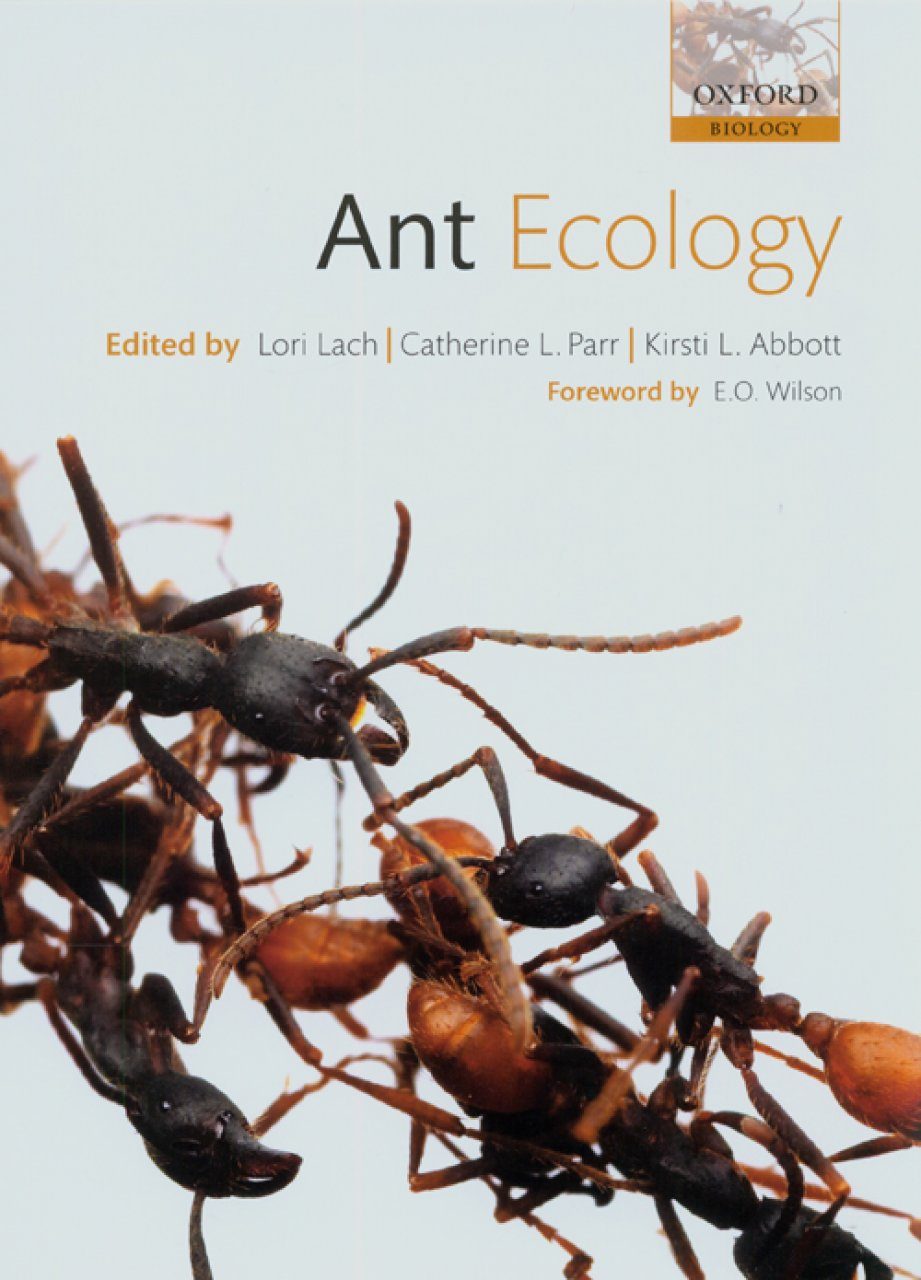
Comprising a substantial part of living biomass on earth, ants are integral to the functioning of terrestrial ecosystems. More than 12,000 species have been described to date, and it is estimated that perhaps as many still await classification.
Ant Ecology explores key ecological issues and new developments in myrmecology across a range of scales. The book begins with a global perspective on species diversity in time and space and explores interactions at the community level before describing the population ecology of these social insects. The final section covers the recent ecological phenomenon of invasive ants: how they move across the globe, invade, affect ecosystems, and are managed by humans. Each chapter links ant ecology to broader ecological principles, provides a succinct summary, and discusses future research directions. Practical aspects of myrmecology, applications of ant ecology, debates, and novel discoveries are highlighted in text boxes throughout the volume.
The book concludes with a synthesis of the current state of the field and a look at exciting future research directions. The extensive reference list and full glossary are invaluable for researchers, and those new to the field.
Foreword / E.O. Wilson
Preface / Lori Lach, Catherine Parr & Kirsti Abbott
Part 1 - Global Ant Diversity and Conservation
1. Taxonomy, Phylogenetics, and Evolution / Philip Ward
2. Biogeography / Brian Fisher
3. Geographic Gradients / Rob Dunn, Benoit Guénard, Michael Weiser & Nathan Sanders
4. Ant Conservation: Current Status and Call to Action / Leeanne Alonso
Part 2 - Community Dynamics
5. Competition and the Role of Dominant Ants / Catherine Parr & Heloise Gibb
6. Ants as Mutualists / Joshua Ness, Kailen Mooney & Lori Lach
7. Food and Shelter: How Resources Influence Ant Ecology / Nico Blüthgen & Heike Feldhaar
8. Ant Biodiversity and Function in Disturbed and Changing Habitats / Stacy Philpott, Ivette Perfecto, Inge Armbrecht & Catherine Parr
Part 3 - Population Ecology
9. Colonial Reproduction and Life Histories / Christian Peeters & Mathieu Molet
10. Colony Structure / Florian M. Steiner, Ross H. Crozier & Birgit C. Schlick-Steiner
11. Nestmate Recognition / Patrizia D'Ettorre & Alain Lenoir
12. Foraging and Defence Strategies in Ants / Anna Dornhaus & Scott Powell
Part 4 - Invasive Ants
13. Biogeographic and Taxonomic Patterns of Introduced Ants / Andrew Suarez, Terry McGlynn & Neil Tsutsui
14. Invasion Processes and Causes of Success / Paul Krushelnycky, David Holway & Edward LeBrun
15. Consequences of Ant Invasions / Lori Lach & Linda Hooper-Bui
16. Invasive Ant Management / Ben Hoffmann, Kirsti Abbott & Peter Davis
17. Synthesis and Perspectives / Lori Lach, Catherine Parr & Kirsti Abbott
Glossary
References
Index
Dr Lori Lach is a Research Fellow in the Ecosystems Restoration Laboratory at Murdoch University. She has conducted myrmecological research in many parts of the globe. Her current research interests include ant-plant and mutualistic interactions, and the consequences of biological invasions on these interactions. She is also interested in restoring native ant communities following ant invasion, and the development of restoration practices that facilitate invertebrate conservation.
Dr Catherine Parr is the present Trapnell Fellow is African Ecology at the University of Oxford. She is a community ecologist with broad research interests encapsulating species coexistence and biodiversity conservation. Much of her research focuses on ant communities in the savannas of southern Africa and northern Australia. Current projects involve investigating the importance of habitat complexity in mediating competition.
Dr Kirsti Abbott is an Assistant Lecturer and invasion ecologist at Monash University, with specific expertise in ants on islands, mutualisms, and management of invasive ants for biodiversity conservation. She is affiliated with isolated oceanic islands through advisory panels that help battle invasive ants, and has a passion for science communication and debate in the public arena. She currently teaches undergraduate students the importance of the practice and application of science in the hope they appreciate its contribution to the sustainability of the world we live in.
"Ant Ecology is a well-written and comprehensive summary of the diversity, community ecology, and population dynamics of ant communities. It is an effective synthesis of more than 50 years of literature, integrating topics ranging from behavioural ecology to conservation biology [...] The structure of the book enables the next generation of researchers to access relevant literature and identify current areas of interest. Ant Ecology is thus an important addition to the literature; it will rest on the bookshelves of mymecologists next to their beloved copy of The Ants, destined to become equally dog-eared, sticky with Tanglefoot, and streaked with Fluon, the badges of honour of a well-used and invaluable resourse on ant biology."
– Amy L. Mertl and James F. A. Traniello, American Entomologist
"Ant Ecology is probably the most complete summary of what is known about the ecology of ants to date. It is a must-read for first-year graduate students either planning to use ants as a model system or interested in various aspects of ant ecology. Ant Ecology will serve as a reference for cutting-edge ecological research on ants by among the most up-and-coming myrmecologists around."
– Ecology
"The editors have successfully woven together pieces from a wide range of contributors to create an enjoyable volume that provides both a comprehensive overview for those new to the field, and a useful reference volume for experienced myrmecologists."
– TREE
"The book as a whole has been extremely well written, in a simple and clear style which makes most of the contents appealing to a wide range of readers, even those without a strong background in biology. The book also incorporates 15 superb colour plates depicting a selection from the vast array of fascinating antlife."
– Animal Behaviour