Um genaue Preise zu sehen, wählen Sie bitte Ihr Lieferland.
 
 
United States
£ GBP
Alle Kategorien
Important Notice for US Customers

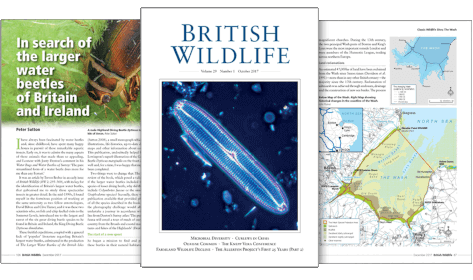
British Wildlife

8 issues per year 84 Seiten per Ausgabe Nur im Abonnement erhältlich

British Wildlife is the leading natural history magazine in the UK, providing essential reading for both enthusiast and professional naturalists and wildlife conservationists. Published eight times a year, British Wildlife bridges the gap between popular writing and scientific literature through a combination of long-form articles, regular columns and reports, book reviews and letters.

Abonnement ab £33 im Jahr

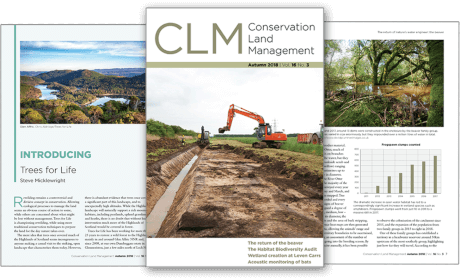
Conservation Land Management

4 Auflagen im Jahr 44 Seiten Nur im Abonnement erhältlich

Conservation Land Management (CLM) ist ein Mitgliedermagazin und erscheint viermal im Jahr. Das Magazin gilt allgemein als unverzichtbare Lektüre für alle Personen, die sich aktiv für das Landmanagement in Großbritannien einsetzen. CLM enthält Artikel in Langform, Veranstaltungslisten, Buchempfehlungen, neue Produktinformationen und Berichte über Konferenzen und Vorträge.

Subscriptions from £26 per year
Akademische und professionelle Bücher  History & Other Humanities  Philosophy, Ethics & Religion

Ecology without Nature Rethinking Environmental Aesthetics

By: Timothy Morton
258 pages
Ecology without Nature
Click to have a closer look
  • Ecology without Nature ISBN: 9780674034853 Paperback Oct 2009 Not in stock: Usually dispatched within 1 week
    £26.95
    #181341
Price: £26.95
About this book Contents Customer reviews Biography Related titles

About this book

In Ecology without Nature, Timothy Morton argues that the chief stumbling block to environmental thinking is the image of nature that most writers on the topic promote: they propose a new worldview, but their very zeal to preserve the natural world leads them away from the "nature" they revere. The problem is a symptom of a far deeper situation--of accepting the idea of "ecology without nature." That is, to have a properly ecological view, we must relinquish, once and for all, the idea of nature.

Developing a fresh vocabulary for reading "environmentality" in both content and form, Morton shows that representations of nature inevitably become metaphysical. Ranging widely in eighteenth- through twentieth-century literature, philosophy, culture, and the arts, Morton explores the value of art in imagining environmental conditions for the future. In short, the idea of nature has served much the same function in the modern period as the aesthetic has--that of healing what society has damaged; but as a result, unrealistic expectations have developed. Morton investigates our ecological assumptions in a way that is provocative and deeply engaging.

Contents

* Introduction: Toward a Theory of Ecological Criticism * The Art of Environmental Language: "I Can't Believe It Isn't Nature!" * Romanticism and the Environmental Subject * Imagining Ecology without Nature * Notes * Index

Customer Reviews

Biography

Timothy Morton is Professor of Literature and Environment, University of California, Davis.
By: Timothy Morton
258 pages
Media reviews
Morton demonstrates that because most ecocriticism assumes nature/environment as a concept, most ecocritics perpetuate the assumptions of the literature that they purport to critique. He argues that nature is an arbitrary rhetorical concept whose modern origins can be traced to Romantics writing during the Industrial Revolution--essentially, that ecocriticism fetishizes "nature." He contends that a "really deep ecology" would let go of the idea of nature because it marks the difference between "us" and "it." Drawing on writers from Adorno to Zizek, and considering literature and art from the 18th century to the present, Morton offers a complex, important, and often playful argument that lays the groundwork for new directions in ecocriticism. -- G. D. MacDonald Choice 20071001 We're in the sh . We have to face it and learn to live with it. That's a basic idea in dark ecology, which Timothy Morton outlines in his book Ecology Without Nature...Dark ecology has a realistic take on the human state without resorting to false optimism or fatalistic tones of apocalypse. It also requires people to take control, and not lay down in the mud with blind faith of staying above the surface without ever drowning. When we realise our connection to the rest of the world, we understand that our actions reflect all life on the planet...Dark ecology has the potential to be the punk rock or experimental pop of ecological thinking. Or even the death metal, since it shares a goth sensibility that focuses on the dark. Kasino A4 20071201 Ecology Without Nature offers original and important critiques of ecocritical theory, in particular through its analysis of the legacy of Romanticism and the paradox of dualism that pervades much ecological writing. Its occasionally irreverent style and embrace of kitsch make it an enjoyable read, even when the associationist organization and technical terminology require the reader to slow down. However, this slowing down is exactly what Morton recommends for ecocritics as we enter the twenty-first century and the increasingly urgent demands of "this poisoned ground" where Morton calls us to stand. -- Janet Fiskio Environmental Philosophy 20080401
Current promotions
Great GiftsNew and Forthcoming BooksBritish Wildlife Magazine SubscriptionField Guide Sale 2025