Um genaue Preise zu sehen, wählen Sie bitte Ihr Lieferland.
 
 
United States
£ GBP
Alle Kategorien
Important Notice for US Customers

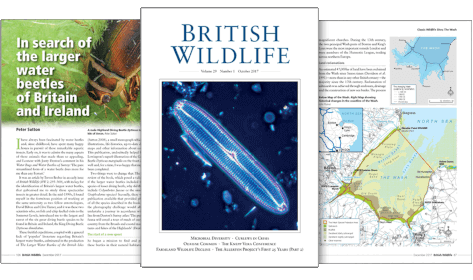
British Wildlife

8 issues per year 84 Seiten per Ausgabe Nur im Abonnement erhältlich

British Wildlife is the leading natural history magazine in the UK, providing essential reading for both enthusiast and professional naturalists and wildlife conservationists. Published eight times a year, British Wildlife bridges the gap between popular writing and scientific literature through a combination of long-form articles, regular columns and reports, book reviews and letters.

Abonnement ab £33 im Jahr

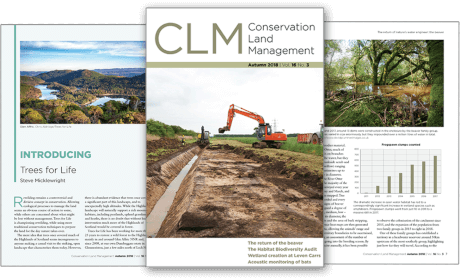
Conservation Land Management

4 Auflagen im Jahr 44 Seiten Nur im Abonnement erhältlich

Conservation Land Management (CLM) ist ein Mitgliedermagazin und erscheint viermal im Jahr. Das Magazin gilt allgemein als unverzichtbare Lektüre für alle Personen, die sich aktiv für das Landmanagement in Großbritannien einsetzen. CLM enthält Artikel in Langform, Veranstaltungslisten, Buchempfehlungen, neue Produktinformationen und Berichte über Konferenzen und Vorträge.

Subscriptions from £26 per year
Akademische und professionelle Bücher  Ecology  Ecosystem & Landscape Ecology

Fire in the South American Ecosystems

New
Series: Ecological Studies Volume: 250
By: Alessandra Fidelis(Editor), Vânia R Pivello(Editor)
441 pages, 54 colour & 4 b/w illustrations
Publisher: Springer Nature
Fire in the South American Ecosystems
Click to have a closer look
  • Fire in the South American Ecosystems ISBN: 9783031893711 Hardback Jul 2025 Not in stock: Usually dispatched within 1-2 weeks
    £150.00
    #267720
Price: £150.00
About this book Contents Customer reviews Biography Related titles

About this book

The incidence of anthropogenic fires in South America has increased lately, and fire effects on biodiversity and ecosystem services are of great concern. On the other hand, natural fires have been present on the continent for thousands of years, acting as an evolutionary driver of vegetation and fauna. Therefore, several ecosystems in South America are fire-prone due to their evolutionary history, while those that have not evolved under frequent fires are fire-sensitive. At the same time, as humans increase fire frequency in some environments, they try to banish fire from others, and such anthropogenic fire regimes have enormous consequences for biota, ecosystem services and the environment. Fire in the South American Ecosystems addresses the various South American ecosystems that benefit from the presence of fire, but also those that are harmed by fire. The effects of fire on plant and animal biodiversity of the main South American ecosystems will be presented and discussed, considering current trends in climate and land use change, bringing understanding about when and how fire should or should not be used to benefit nature and humans. Options for fire planning and management will be highlighted, especially considering the reduction of wildfire risk and the conservation of biodiversity and natural resources. This broad comprehension of the fire issue in South America will support wise decisions by environmental analysts, conservation managers and public policy makers.

Contents

- Introduction - Fire and the South American Ecosystems
- Fire as an evolutionary driver in South America
- Traditional Fire Uses by Indigenous Peoples and Local Communities in South America
- Fire in Subtropical and Temperate Grasslands
- Fire in the Cerrado
- Fire in the Llanos of the Orinoco River
- Fire ecology on megadiverse montane grasslands
- Fire in the Chaco region: ecological aspects and land management
- Fire in temperate forests and shrublands
- Fire in South American Wetlands
- Fire in Mediterranean Ecosystems of South America
- Fire in South American Tropical Forests: Examining the past to understand the present and predict the future
- Fire in the Anthropocene
- Challenges for a better fire management in South America

Customer Reviews

Biography

Alessandra Fidelis is a biologist, Associate Professor in the Department of Biodiversity at the Universidade Estadual Paulista, Brazil. Her research focuses on tropical grassland and savanna ecology, fire ecology, community ecology, biological invasion, and seed ecology. She coordinates a long-term fire experiment (since 2013) in open savannas of Central Brazil and has already coordinated several research projects related to fire effects on tropical grasslands and savannas. She is the vice-president of the International Association for Vegetation Science and editor of the Journal of Vegetation Science. She was recognised as one of the world's leading women in fire science in 2018 and is very active in the conservation of open ecosystems.

Vânia R. Pivello is a biologist, Full Professor in the Department of Ecology at the Universidade de São Paulo (USP), Brazil. She has vast experience in teaching and research in plant ecology, conservation biology, savanna ecology, fire ecology, and biological invasion. She has conducted and coordinated several scientific research projects at LEPaC/USP (Landscape Ecology and Conservation Laboratory/USP) and has provided consulting and technical support to governmental, non-governmental and private organisations on environmental issues. She is an expert advisor to several research funding agencies and scientific journals, and editor of the journal Perspectives in Ecology and Conservation. In 2018, she was recognised as one of the world's "women leaders in fire science".

New
Series: Ecological Studies Volume: 250
By: Alessandra Fidelis(Editor), Vânia R Pivello(Editor)
441 pages, 54 colour & 4 b/w illustrations
Publisher: Springer Nature
Current promotions
Great GiftsNew and Forthcoming BooksBritish Wildlife Magazine SubscriptionField Guide Sale 2025