Um genaue Preise zu sehen, wählen Sie bitte Ihr Lieferland.
 
 
United States
£ GBP
Alle Kategorien
Important Notice for US Customers

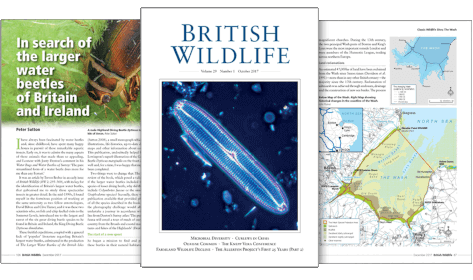
British Wildlife

8 issues per year 84 Seiten per Ausgabe Nur im Abonnement erhältlich

British Wildlife is the leading natural history magazine in the UK, providing essential reading for both enthusiast and professional naturalists and wildlife conservationists. Published eight times a year, British Wildlife bridges the gap between popular writing and scientific literature through a combination of long-form articles, regular columns and reports, book reviews and letters.

Abonnement ab £33 im Jahr

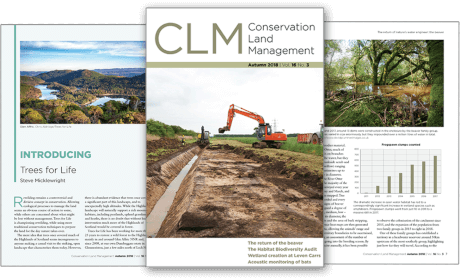
Conservation Land Management

4 Auflagen im Jahr 44 Seiten Nur im Abonnement erhältlich

Conservation Land Management (CLM) ist ein Mitgliedermagazin und erscheint viermal im Jahr. Das Magazin gilt allgemein als unverzichtbare Lektüre für alle Personen, die sich aktiv für das Landmanagement in Großbritannien einsetzen. CLM enthält Artikel in Langform, Veranstaltungslisten, Buchempfehlungen, neue Produktinformationen und Berichte über Konferenzen und Vorträge.

Subscriptions from £26 per year
Akademische und professionelle Bücher  Conservation & Biodiversity  Conservation & Biodiversity: General

Habitat The Fundamental Unit for Understanding and Conserving Nature

New
By: Roger LH Dennis(Author), Simone Fattorini(Author)
508 pages
Publisher: CABI Publishing
Habitat
Click to have a closer look
  • Habitat ISBN: 9781800627482 Hardback Nov 2025 Not in stock: Usually dispatched within 1 week
    £172.00
    #267697
Price: £172.00
About this book Contents Customer reviews Biography Related titles

About this book

Habitat is the fundamental unit for understanding species ecology and preserving biodiversity; it has always had a variety of meanings, often not explicitly defined. This important book focuses on the two main uses of the term and their importance for nature conservation.

The first, traditional usage (TH), is that of terrestrial, aquatic or aerial spatial units which can be denoted by the species they host, with associated trophic relationships and interdependencies. The second, termed resource-based habitat (RBH), focuses on any one species' habitat. These RBHs are rarely limited to one space but are defined by the intersection of appropriate resources and suitable conditions. Since the ability of individuals to exploit resources is influenced by their own unique combination of traits, the RBH is spatially and temporally variable.

The book explores how communities are structured, how species and individuals interact (niches, guilds, food webs, etc.), and how biodiversity changes over space and time. Typically, a location distinguished by specific attributes (TH; a meadow, a wood, a field, etc.) has few common species, but many rare ones and the book explores this long challenging conundrum. The TH usage has immense importance and implications for maintaining wildlife. Because of the variety of the ecological characteristics of different species, the study of them in distinctive spatial units (a lake, a moor, the seashore, the lower atmosphere, etc.) requires special methods in each case to determine their conservation status. The RBH is critical for understanding the factors necessary for the maintenance of 'focal' species, regarded as key or rare elements of ecosystems.

The book explores the different ways in which such species are maintained: i.e., their traits, defining their ecological and behavioural uniqueness, morphology, physiology, biochemistry, and the resources, and conditions, on which they depend. It also examines how, as specialists or generalists, species are placed in the trophic hierarchy, how they fit into their communities and influence the evolution (or demise) of other species. Ultimately, the book investigates how best to conserve biodiversity.

Contents

Chapter 1. The traditional habitat model: utility, affinities and failings
Chapter 2. Inside habitats: interactions in space and time
Chapter 3. Habitat changes over time
Chapter 4. Traditional habitat principles and a diversity of measures
Chapter 5. Basic principles of the resource-based habitat paradigm
Chapter 6. Bounds of the resource-based habitat: resource integration and movement
Chapter 7. The resource-based habitat in unstable landscapes
Chapter 8. The resource-based habitats in the Kingdoms of life)
Chapter 9. Primates and human evolution: expanding habitat demands
Chapter 10. The impact on habitats in the Anthropocene
Chapter 11. Conserving life: Biodiversity and the resource-based habitat

Appendix 1: Surveying natural populations
Appendix 2: Population dynamics
Appendix 3: Diversity measures
Appendix 4: Tree of life
Appendix 5: Geological events in the succession of species

Customer Reviews

Biography

Roger L.H. Dennis has spent 50 years researching butterfly ecology, biogeography and conservation, during which he has produced over 220 publications. His previous book, A Resource-Based Habitat View for Conservation, received the British Ecological Society's Book of the Year in 2012. A Fellow of the Linnean Society and the Royal Entomological Society, he is currently an Honorary Research Fellow at the NERC's Centre for Ecology and Hydrology, Wallingford, and an Honorary Professor at Staffordshire University and at Oxford Brookes University.

Simone Fattorini is included in the list of the Top Italian Scientists. He obtained a master's degree in Biological Science (summa cum laude, 1997) and a PhD in Animal Biology (2002) from Rome University "Sapienza". He teaches Ecology and Statistical Ecology at the University of L'Aquila, where he is currently a supervisor of undergraduate, graduate and PhD students. He is Associate Editor of Journal of Biogeography, Diversity, Journal of Insect Biodiversity, and Biogeographia.

New
By: Roger LH Dennis(Author), Simone Fattorini(Author)
508 pages
Publisher: CABI Publishing
Current promotions
Great GiftsNew and Forthcoming BooksBritish Wildlife Magazine SubscriptionField Guide Sale 2025