

Call us (08:30-16:00 UK)
01803 865913International
+44 1803 865913Need Help?
Help pages
Important Notice for US Customers
Due to changes at US Customs we will be only processing the shipping of orders through UPS. The purchase cost does not include any costs incurred from US Customs and the receiver will be liable for all import duties and taxes associated with their order. Should the order be returned undelivered, please note the refund will be processed minus the shipping costs.
Certain goods from specific countries are subject to higher tariffs and import restrictions. Ensure you check the regulations regarding the country of origin of your items to avoid unexpected charges or delays. Also ensure you select "business address" or "home address" when adding a new address to ensure your order is reported correctly
If you have any questions or need help with placing your order, please contact our Customer Services Team or select "Quotation" as the payment method online. Furthermore you can contact your local customs office for further information.
Wildlife Survey & Monitoring
- Aquatic Survey & Monitoring
- Professional Hand & Kick Nets
- Water Testing
- Waders & Aquatic Safety
- View All
- Amphibian & Reptile Survey
- Amphibian Survey & Monitoring
- Reptile Survey & Monitoring
- Scales, Balances & Holding Bags
- View All
Field Guides & Natural History
Academic & Professional Books
- Evolutionary Biology
- Evolution
- Human Evolution & Anthropology
- Cladistics, Phylogeny & Taxonomy
- View All
British Wildlife
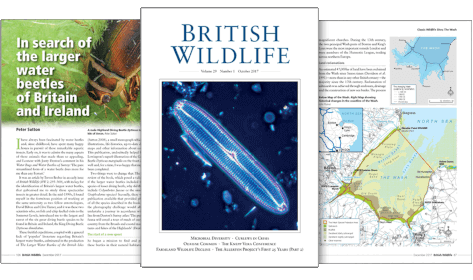
British Wildlife is the leading natural history magazine in the UK, providing essential reading for both enthusiast and professional naturalists and wildlife conservationists. Published eight times a year, British Wildlife bridges the gap between popular writing and scientific literature through a combination of long-form articles, regular columns and reports, book reviews and letters.
Conservation Land Management
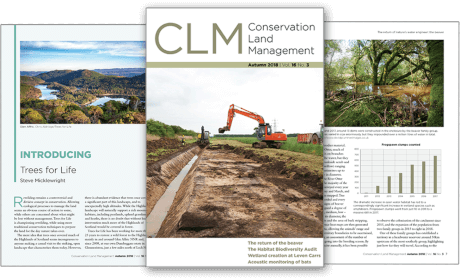
Conservation Land Management (CLM) is a quarterly magazine that is widely regarded as essential reading for all who are involved in land management for nature conservation, across the British Isles. CLM includes long-form articles, events listings, publication reviews, new product information and updates, reports of conferences and letters.
![Identification des Poissons par Leurs Otolithes en Imagerie 3D: Manche et Mer du Nord [Identification of Fishes by Their Otoliths in 3D: English Channel and North Sea]](http://mediacdn.nhbs.com/jackets/jackets_resizer_xlarge/26/265325.jpg?height=620 "Identification des Poissons par Leurs Otolithes en Imagerie 3D: Manche et Mer du Nord [Identification of Fishes by Their Otoliths in 3D: English Channel and North Sea]")
![Identification des Poissons par Leurs Otolithes en Imagerie 3D: Manche et Mer du Nord [Identification of Fishes by Their Otoliths in 3D: English Channel and North Sea]](http://mediacdn.nhbs.com/jackets/jackets_resizer_xlarge/26/265325.jpg)







![Poissons de l'Océan Indien Et de la Mer Rouge [Fishes of the Indian Ocean and Red Sea]](http://mediacdn.nhbs.com/jackets/jackets_resizer_medium/20/200808.jpg?height=150&width=94)
![Arbres, Arbustes et Lianes d'Afrique de l'Ouest [West African Trees, Shrubs and Lianas]](http://mediacdn.nhbs.com/jackets/jackets_resizer_medium/24/246252.jpg?height=150&width=100)

![Paysage, Biodiversité Fonctionnelle et Santé des Plantes [Landscape, Functional Biodiversity and Plant Health]](http://mediacdn.nhbs.com/jackets/jackets_resizer_medium/25/253537.jpg?height=150&width=100)
![Grenouilles, Crapauds & Cie: Parlez-Moi d'Anoures… [Frogs, Toads & Co.: Tell Me about Anurans...]](http://mediacdn.nhbs.com/jackets/jackets_resizer_medium/23/238491.jpg?height=150&width=131)
![Les Maladies Émergentes: Épidémiologie chez le Végétal, l'Animal et l'Homme [Emerging Diseases: Epidemiology in Plants, Animals and Humans]](http://mediacdn.nhbs.com/jackets/jackets_resizer_medium/23/237748.jpg?height=150&width=97)
![Oiseaux et Changement Global: Menace ou Aubaine? [Bird and Global Change: Threat of Windfall?]](http://mediacdn.nhbs.com/jackets/jackets_resizer_medium/22/224993.jpg?height=150&width=132)
![Les Termites dans le Monde [Termites of the World]](http://mediacdn.nhbs.com/jackets/jackets_resizer_medium/18/182815.jpg?height=150&width=85)
![Les Invertébrés Marins du Golfe de Gascogne à la Manche Orientale: Guide d'Identification des Èspeces Recoltées dans les Chalut [Marine Invertebrates of the Bay of Biscay at the Eastern Channel: Identification Guide for Trawl-Harvested Species]](http://mediacdn.nhbs.com/jackets/jackets_resizer_medium/18/183611.jpg?height=150&width=100)
![Les Orchidées Sauvages de Paris [The Wild Orchids of Paris]](http://mediacdn.nhbs.com/jackets/jackets_resizer_medium/17/179793.jpg?height=150&width=85)
![Les Insectes du Monde [Insects of the World] (2-Volume Set)](http://mediacdn.nhbs.com/jackets/jackets_resizer_medium/25/255244.jpg?height=150&width=235)
