Um genaue Preise zu sehen, wählen Sie bitte Ihr Lieferland.
 
 
United States
£ GBP
Alle Kategorien
Important Notice for US Customers

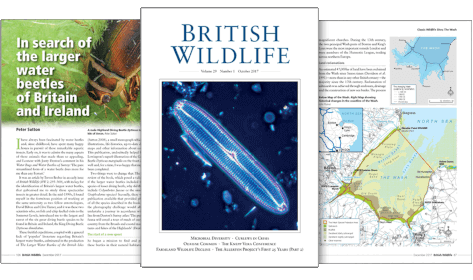
British Wildlife

8 issues per year 84 Seiten per Ausgabe Nur im Abonnement erhältlich

British Wildlife is the leading natural history magazine in the UK, providing essential reading for both enthusiast and professional naturalists and wildlife conservationists. Published eight times a year, British Wildlife bridges the gap between popular writing and scientific literature through a combination of long-form articles, regular columns and reports, book reviews and letters.

Abonnement ab £33 im Jahr

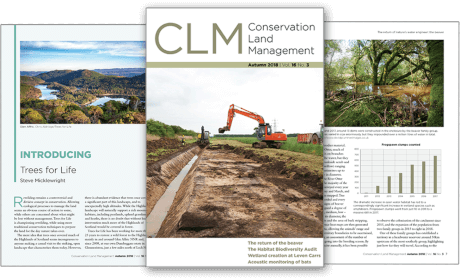
Conservation Land Management

4 Auflagen im Jahr 44 Seiten Nur im Abonnement erhältlich

Conservation Land Management (CLM) ist ein Mitgliedermagazin und erscheint viermal im Jahr. Das Magazin gilt allgemein als unverzichtbare Lektüre für alle Personen, die sich aktiv für das Landmanagement in Großbritannien einsetzen. CLM enthält Artikel in Langform, Veranstaltungslisten, Buchempfehlungen, neue Produktinformationen und Berichte über Konferenzen und Vorträge.

Subscriptions from £26 per year
Akademische und professionelle Bücher  Conservation & Biodiversity  Conservation & Biodiversity: General

Millipedes and Moon Tigers Science and Policy in an Age of Extinction

By: Stephen D Nash(Author)
176 pages
Millipedes and Moon Tigers
Click to have a closer look
  • Millipedes and Moon Tigers ISBN: 9780813926230 Hardback Apr 2007 Not in stock: Usually dispatched within 1-2 months
    £24.99
    #218797
Price: £24.99
About this book Customer reviews Biography Related titles

About this book

Millipedes and Moon Tigers explores those uneasy places where scientific research meets public policy-making – and the resulting human effect on our natural and historical landscapes. Steve Nash's eye gravitates toward those specific, contemporary stories whose relevance does not diminish with a turn of the calendar's page, for they represent larger, looming issues. The destruction wrought upon native ecosystems by invasive species such as snakehead fish; the drastic and, in many cases, mysterious reduction in songbird populations in recent decades; the blight of a century ago that wiped out four billion chestnut trees, which once made up a quarter of the Eastern forest...Nash does more than lament the passing of the continent as it once was. He reveals the factors that have led to endangerment and extinction – from environmental policies that are terribly outdated to technologies that are evolving more quickly than our attitudes – and presents possible solutions, in both the political and scientific arenas.

Nash follows an archaeobotanist on her research in the Near East to see what ancient agricultural practices in this now largely arid region can tell us about where the West may be heading. He writes of Civil War battlefields that, in the wake of new development, are being obliterated one by one – and, along with them, a wealth of lost archaeological opportunities. Turning to a more modern battlefield, he writes of "agroterror" – the intentional introduction of plant and animal diseases into agriculture and nature – and suggests what might be done to stop this new threat. Many of the essays explore the intersection of the environment and the most cutting-edge technology. Nash introduces us to the minnow-sized Glofish, America's first genetically engineered pet (the animal's name is actually trademarked). Further advances in our understanding of molecular genetics could even result, some believe, in the cloning of endangered species. All of this is exciting – and problematic. Nash reports on the controversies over genetically modified pines and poplars – "science fiction trees" – and how fears of their escape into wild forests has prompted some environments to go so far as to sabotage corporate laboratories.

The urgency Nash conveys is real: as one of his subjects observes, it is much easier to maintain an ecosystem than repair it. There is no escaping a feeling of apprehension over the destructive dynamics Nash uncovers. Nevertheless, the essays collected here stress the opportunity that is still there for policies to be established that serve humankind by better serving nature.

Customer Reviews

Biography

Steve Nash is Associate Professor of Journalism at the University of Richmond and the author of Blue Ridge 2020: An Owner's Manual, which won the 2001 Philip D. Reed Award for outstanding journalism on southern environmental issues.

By: Stephen D Nash(Author)
176 pages
Current promotions
January SaleNew and Forthcoming BooksBritish Wildlife Magazine SubscriptionField Guide Sale 2025