Um genaue Preise zu sehen, wählen Sie bitte Ihr Lieferland.
 
 
United States
£ GBP
Alle Kategorien
Important Notice for US Customers

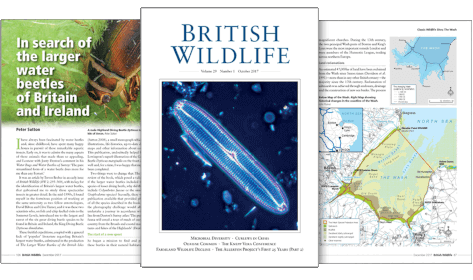
British Wildlife

8 issues per year 84 Seiten per Ausgabe Nur im Abonnement erhältlich

British Wildlife is the leading natural history magazine in the UK, providing essential reading for both enthusiast and professional naturalists and wildlife conservationists. Published eight times a year, British Wildlife bridges the gap between popular writing and scientific literature through a combination of long-form articles, regular columns and reports, book reviews and letters.
Abonnement ab £33 im Jahr

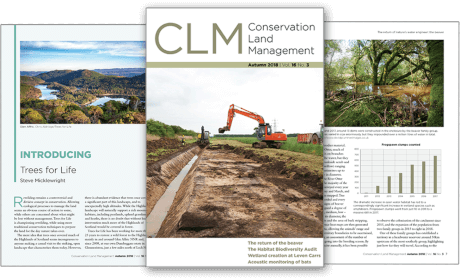
Conservation Land Management

4 Auflagen im Jahr 44 Seiten Nur im Abonnement erhältlich

Conservation Land Management (CLM) ist ein Mitgliedermagazin und erscheint viermal im Jahr. Das Magazin gilt allgemein als unverzichtbare Lektüre für alle Personen, die sich aktiv für das Landmanagement in Großbritannien einsetzen. CLM enthält Artikel in Langform, Veranstaltungslisten, Buchempfehlungen, neue Produktinformationen und Berichte über Konferenzen und Vorträge.

Subscriptions from £26 per year
Akademische und professionelle Bücher  Habitats & Ecosystems  Farmland Ecosystems

Rangeland Systems Processes, Management and Challenges

By: David D Briske(Editor)
661 pages, 69 colour & 32 b/w illustrations, 48 tables
Publisher: Springer Nature
Rangeland Systems
Click to have a closer look
  • Rangeland Systems ISBN: 9783319467078 Hardback Apr 2017 Not in stock: Usually dispatched within 1-2 weeks
    £22.99
    #241607
Price: £22.99
About this book Contents Customer reviews Biography Related titles

About this book

Rangeland Systems: Processes, Management and Challenges provides an unprecedented synthesis of the current status of scientific and management knowledge regarding global rangelands and the major challenges that confront them. It has been organized around three major themes. The first summarizes the conceptual advances that have occurred in the rangeland profession. The second addresses the implications of these conceptual advances to management and policy. The third assesses several major challenges confronting global rangelands in the 21st century.

Rangeland Systems: Processes, Management and Challenges will compliment applied range management textbooks by describing the conceptual foundation on which the rangeland profession is based. It has been written to be accessible to a broad audience, including ecosystem managers, educators, students and policy makers. The content is founded on the collective experience, knowledge and commitment of 80 authors who have worked in rangelands throughout the world. Their collective contributions indicate that a more comprehensive framework is necessary to address the complex challenges confronting global rangelands. Rangelands represent adaptive social-ecological systems, in which societal values, organizations and capacities are of equal importance to, and interact with, those of ecological processes. A more comprehensive framework for rangeland systems may enable management agencies, and educational, research and policy making organizations to more effectively assess complex problems and develop appropriate solutions.

Contents

1. Conceptual development toward a rangeland systems framework

Part: 1 Processes
2. Woody plant encroachment
3. Ecohydrology: processes and implications for rangelands
4. Soil and belowground processes
5. Structural heterogeneity as the basis for rangeland management
6. Non-equilibrium ecology and resilience theory
7. Ecological consequences of climate change on rangelands

Part: 2 Management
8. Rangelands as social-ecological systems
9. State and transition models: theory, applications, and challenges
10. Livestock production systems
11. Adaptive management of rangeland systems
12. Managing the livestock-wildlife interface on rangelands

Part: 3 Challenges
13. Invasive plant species and novel rangeland systems
14. Rangeland ecosystem services: nature's supply and humans' demand
15. Managing climate change risks in rangeland systems
16. Monitoring protocols: options, approaches, implementation, benefits
17. Rangeland systems in developing nations: conceptual advances and societal implications

Customer Reviews

Biography

David D. Briske is the T.M. O'Connor Professor in the Department of Ecosystem Science & Management at Texas A&M University, U.S.A. He earned a B.A. in Botany from North Dakota State University and a Ph.D. from Colorado State University. His scholarship and pedagogy emphasize the ecological function and management strategies of global rangelands. He has served as editor of the book Conservation Benefits of Rangeland Practices and the journal Rangeland Ecology & Management.

By: David D Briske(Editor)
661 pages, 69 colour & 32 b/w illustrations, 48 tables
Publisher: Springer Nature
Current promotions
Great GiftsNew and Forthcoming BooksBritish Wildlife Magazine SubscriptionField Guide Sale 2025