Um genaue Preise zu sehen, wählen Sie bitte Ihr Lieferland.
 
 
United States
£ GBP
Alle Kategorien
Important Notice for US Customers

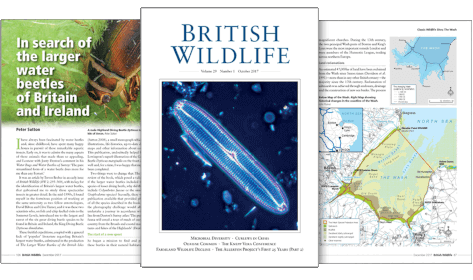
British Wildlife

8 issues per year 84 Seiten per Ausgabe Nur im Abonnement erhältlich

British Wildlife is the leading natural history magazine in the UK, providing essential reading for both enthusiast and professional naturalists and wildlife conservationists. Published eight times a year, British Wildlife bridges the gap between popular writing and scientific literature through a combination of long-form articles, regular columns and reports, book reviews and letters.

Abonnement ab £33 im Jahr

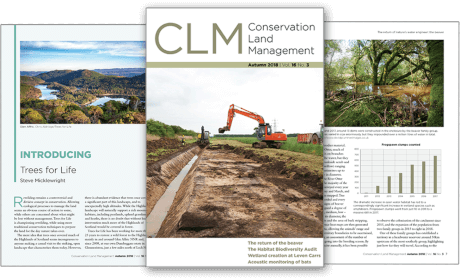
Conservation Land Management

4 Auflagen im Jahr 44 Seiten Nur im Abonnement erhältlich

Conservation Land Management (CLM) ist ein Mitgliedermagazin und erscheint viermal im Jahr. Das Magazin gilt allgemein als unverzichtbare Lektüre für alle Personen, die sich aktiv für das Landmanagement in Großbritannien einsetzen. CLM enthält Artikel in Langform, Veranstaltungslisten, Buchempfehlungen, neue Produktinformationen und Berichte über Konferenzen und Vorträge.

Subscriptions from £26 per year
Akademische und professionelle Bücher  Conservation & Biodiversity  Habitat Management & Care

Resilient Forest Management

By: Philip J Burton(Author)
400 pages, 128 illustrations, maps & images
Resilient Forest Management
Click to have a closer look
Select version
  • Resilient Forest Management ISBN: 9780198833000 Paperback May 2025 Not in stock: Usually dispatched within 6 days
    £40.00
    #267602
  • Resilient Forest Management ISBN: 9780198832997 Hardback May 2025 Not in stock: Usually dispatched within 6 days
    £132.00
    #267601
Selected version: £40.00
About this book Contents Customer reviews Biography Related titles

About this book

Global forest management is now grappling with ways to address the many dimensions of global change, including a warming climate and increasing forest disturbance from fires and pest outbreaks, along with changes in public values. However, the dominant forest management paradigms still assume a constant and predictable world in which command-and-control (i.e., treating long-lived forests much like short-lived agricultural crops) and single-value (i.e., timber) optimization still prevail.

This novel text argues for new approaches to forest management that focus on resilience and embracing adaptability to the changing socio-ecological environment as it unfolds. Resilience is the ability of a system to maintain its essential attributes (in the form of composition, structure, and/or function) in response to stress, disruption, or disturbance. Managing a system for resilience places an emphasis on persistence rather than growth, efficiency, or profitability, which can be fulfilled by enhancing the capacity to resist change (i.e., robustness) or by enhancing the capacity to incorporate change in desirable directions (i.e., flexibility), or a combination of the two. Resilient Forest Management develops many of the same resilience-enhancing strategies for protected areas, multi-purpose forests, and timber production lands, but with different degrees of emphasis. Featured prominently are practices that enhance diversity, connectivity in space and time, and adaptive management as informed by vulnerability analysis and broad stakeholder consultation. In so doing, Resilient Forest Management builds on foundational concepts of ecological forestry and our understanding of complex adaptive systems and takes sustainable forest management to the next level.

Resilient Forest Management will be suitable as a primary or supplementary text in forest policy and management. It will appeal to graduate-level students and researchers in the fields of forestry and conservation along with active policymakers in government, the forest industry, and environmental non-governmental organizations. While focused on forestry, parks managers, agriculturists, and urban planners too will find much useful insight and many creative solutions to sustainable development in a changing world.

Contents

Part I: Fundamentals
1. The Evolving Scope of Forest Management
2. Forest Values and Zoning
3. In Pursuit of Sustainability
4. Resilience Concepts

Part II: Promoting Resilience in the Management of Forest Ecosystems
5. Enhancing General Resilience in Forests
6. Climatic Influences and Forest Vulnerabilities
7. Fostering Climate Change Resilience
8. Resilience to Forest Disturbances

Part III: Synthesis and Direction
9. Restoring Forests for Resilience
10. Resilience Through Adaptive Management
11. What Resilient Forest Management Looks Like
12. Forest Stewardship Based on Socio-Ecological Principles

Customer Reviews

Biography

Philip J. Burton is an Emeritus Professor of Ecosystem Science and Management at the University of Northern British Columbia. He is the author or co-author of more than 120 journal papers and book chapters in scientific literature; he has co-written another book and co-edited two other books addressing ecosystem management issues. This book draws upon decades of basic and applied research experience, including employment with the Canadian Forest Service, Parks Canada, as a consultant to industry, and as a volunteer on local forest advisory committees.

By: Philip J Burton(Author)
400 pages, 128 illustrations, maps & images
Current promotions
Great GiftsNew and Forthcoming BooksBritish Wildlife Magazine SubscriptionField Guide Sale 2025