Um genaue Preise zu sehen, wählen Sie bitte Ihr Lieferland.
 
 
United States
£ GBP
Alle Kategorien
Important Notice for US Customers

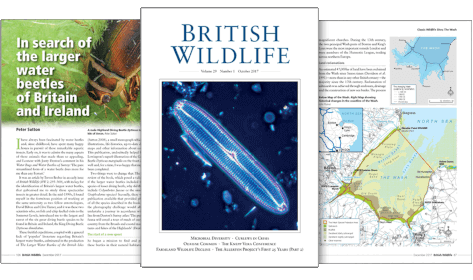
British Wildlife

8 issues per year 84 Seiten per Ausgabe Nur im Abonnement erhältlich

British Wildlife is the leading natural history magazine in the UK, providing essential reading for both enthusiast and professional naturalists and wildlife conservationists. Published eight times a year, British Wildlife bridges the gap between popular writing and scientific literature through a combination of long-form articles, regular columns and reports, book reviews and letters.

Abonnement ab £33 im Jahr

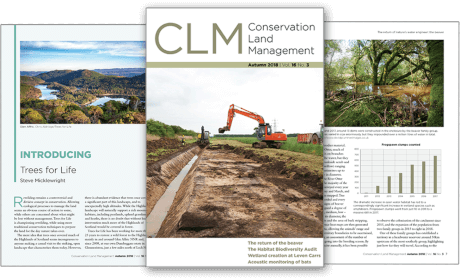
Conservation Land Management

4 Auflagen im Jahr 44 Seiten Nur im Abonnement erhältlich

Conservation Land Management (CLM) ist ein Mitgliedermagazin und erscheint viermal im Jahr. Das Magazin gilt allgemein als unverzichtbare Lektüre für alle Personen, die sich aktiv für das Landmanagement in Großbritannien einsetzen. CLM enthält Artikel in Langform, Veranstaltungslisten, Buchempfehlungen, neue Produktinformationen und Berichte über Konferenzen und Vorträge.

Subscriptions from £26 per year
Akademische und professionelle Bücher  Botany  Plants & Gardens

Science and the Garden The Scientific Basis of Horticultural Practice

Textbook
By: David S Ingram(Editor), Daphne Vince-Prue(Editor), Peter J Gregory(Editor)
376 pages, colour & b/w photos, colour & b/w illustrations, colour tables
Publisher: Wiley-Blackwell
Science and the Garden
Click to have a closer look
  • Science and the Garden ISBN: 9781118778432 Edition: 3 Paperback Dec 2015 Not in stock: Usually dispatched within 1 week
    £44.95
    #231524
Price: £44.95
About this book Contents Customer reviews Biography Related titles

About this book

Most conventional gardening books concentrate on how and when to carry out horticultural tasks such as pruning, seed sowing and taking cuttings. Science and the Garden, Third Edition is unique in explaining in straightforward terms some of the science that underlies these practices. It is principally a book of 'Why' Why are plants green? Why do some plants only flower in the autumn? Why do lateral buds begin to grow when the terminal bud is removed by pruning? Why are some plants successful as weeds? Why does climate variability and change mean change for gardeners? But it also goes on to deal with the 'How', providing rationale behind the practical advice.

The coverage is wide-ranging and comprehensive and includes: the diversity, structure, functioning and reproduction of garden plants; nomenclature and classification; genetics and plant breeding; soil properties and soil management; environmental factors affecting growth and development; methods of propagation; size and form; colour, scent and sound; climate; environmental change; protected cultivation; pest, disease and weed diversity and control; post-harvest management and storage; garden ecology and conservation; sustainable horticulture; gardens and human health and wellbeing; and gardens for science.

This expanded and fully updated Third Edition of Science and the Garden includes two completely new chapters on important topics:
- Climate and Other Environmental Changes
- Health, Wellbeing and Socio-cultural Benefits

Many of the other chapters have been completely re-written or extensively revised and expanded, often with new authors and/or illustrators, and the remainder have all been carefully updated and re-edited. Published in collaboration with the Royal Horticultural Society, reproduced in full colour throughout, carefully edited and beautifully produced, this new edition remains a key text for students of horticulture and will also appeal to amateur and professional gardeners wishing to know more about the fascinating science behind the plants and practices that are the everyday currency of gardening.

Contents

Preface to third edition, xiii
Preface to second edition, xiv
Preface to first edition, xv

1 Diversity in the plant world, 1
2 The plant body: structure and function, 14
3 Reproduction: Securing the future, 37
4 Naming plants, 45
5 Selecting and breeding plants, 55
6 Summary, 75
7 Soil cultivation and fertility, 86
8 The plant environment: Light and water, 102
9 Plants and seasons, 120
10 Growing plants from seed, 139
11 Vegetative propagation, 149
12 Size and form, 166
13 Colour, scent and sound in the garden, 175
14 Climate and weather, 191
15 Climate and other environmental changes, 206
16 Protected cultivation, 214
17 The diversity of the undesirables, 234
18 Controlling the undesirables, 248
19 Maturation, ripening and storage, 262
20 Garden ecology, 278
21 Garden wildlife and conservation, 292
22 Low-input and low-impact gardening, 299
23 Health, well-being and socio-cultural benefits, 307
24 Gardens for science, 320

Glossary, 329
Index, 355

Customer Reviews

Biography

Professor David Ingram, Formerly Regius Keeper, the Royal Botanic Garden, Edinburgh, RHS Professor of Horticulture and Master, St Catharine's College, Cambridge; now Honorary Professor in the Universities of Edinburgh (Science, Technology & Innovation Studies) and Lancaster (Environment Centre), UK.

Dr Daphne Vince-Prue, Formerly Reader in Botany, University of Reading, Scientific Advisor to the Agricultural Research Council and Head, Physiology and Chemistry Department, Glasshouse Crops Research Institute, UK.

Professor Peter Gregory, Formerly Director and Chief Executive, Scottish Crop Research Institute, Dundee and Chief Executive, East Malling Research; now Professor of Global Food Security, University of Reading, UK.

Textbook
By: David S Ingram(Editor), Daphne Vince-Prue(Editor), Peter J Gregory(Editor)
376 pages, colour & b/w photos, colour & b/w illustrations, colour tables
Publisher: Wiley-Blackwell
Media reviews

"A key book for those sitting their RHS examinations, but should also interest those gardeners interested in the science [...] I guarantee you will learn quite a few things you never knew."
– The Professional Gardener, October 2008

"This book has wide application due to its wide scope and lack of highly technical language. Color photos, diagrams, and text boxes are very helpful, as is an extensive glossary."
– Southeastern Naturalist, Volume 7, Issue 3

Current promotions
Great GiftsNew and Forthcoming BooksBritish Wildlife Magazine SubscriptionField Guide Sale 2025