To see accurate pricing, please choose your delivery country.
 
 
United States
£ GBP
All Shops
Important Notice for US Customers

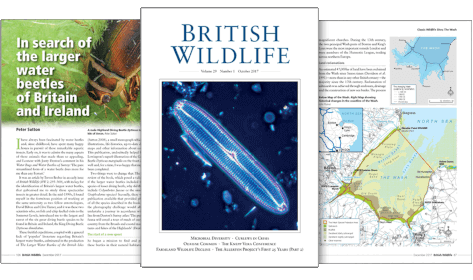
British Wildlife

8 issues per year 84 pages per issue Subscription only

British Wildlife is the leading natural history magazine in the UK, providing essential reading for both enthusiast and professional naturalists and wildlife conservationists. Published eight times a year, British Wildlife bridges the gap between popular writing and scientific literature through a combination of long-form articles, regular columns and reports, book reviews and letters.

Subscriptions from £33 per year

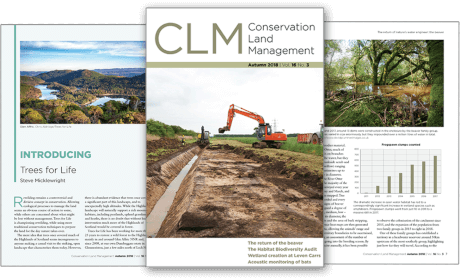
Conservation Land Management

4 issues per year 44 pages per issue Subscription only

Conservation Land Management (CLM) is a quarterly magazine that is widely regarded as essential reading for all who are involved in land management for nature conservation, across the British Isles. CLM includes long-form articles, events listings, publication reviews, new product information and updates, reports of conferences and letters.

Subscriptions from £26 per year
Academic & Professional Books  Insects & other Invertebrates  Invertebrate Biology & Ecology

Earthworms and Vermicomposting Species, Procedures and Crop Application

By: Sohan Singh Walia(Author), Tamanpreet Kaur(Author)
148 pages
Publisher: Springer Nature
Earthworms and Vermicomposting
Click to have a closer look
  • Earthworms and Vermicomposting ISBN: 9789819989522 Hardback Jan 2024 Not in stock: Usually dispatched within 1-2 weeks
    £110.00
    #266672
Price: £110.00
About this book Contents Customer reviews Biography Related titles

About this book

This book explains the lifecycle of earthworms, their biological features, the multiplication of worms, the species of earthworms that are suitable for vermicomposting, the different sources of vermicompost, nutrient recovery and different procedures for the making of vermicompost and the importance of application of vermicompost in cereal, fruit and vegetable crops.

The tremendous increase in population, urbanization, industrialization and agricultural production results in accumulation quantities of solid wastes. This has created serious problem in the environment. In order to dispose this waste safely it should be converted effectively. This is achieved by bio-composting and vermicomposting of farm, urban and agro-industrial waste. It is being increasing realized that composting is an environment friendly process, convert wide variety of wastes into valuable agricultural inputs. Compost is excellent source of humus and plant nutrients, on application of which improve soil biophysical properties and organic matter status of the soil. India generates about 350 million tonnes of agricultural waste every year. Agricultural wastes include crop residues, weeds, leaf litter, sawdust, forest waste, and livestock waste. Under appropriate conditions, worms eat agricultural waste and reduce the volume by 40 to 60%. Vermicompost produced by the activity of earthworms is rich in macro and micro-nutrients, vitamins, growth hormones, enzymes such as proteases, amylases, lipase, cellulase and chitinase and immobilized microflora.

This book will assist farmers, students and scholars to guide them about lifecycle of earthworms, biological features, multiplication of worms, species of earthworms that are suitable for vermicomposting and different procedures for making of vermicompost. This book will also benefit students of agriculture at graduate and post graduate level as students have a designated course on vermicomposting.


Contents

- Earthworms and vermicomposting
- Anatomy of earthworms
- Earthworms, their species and biological features
- Vermitechnology
- History and its applications
- Role of earthworms in vermicomposting
- Different sources of vermicompost
- Preparation of vermicompost
- Influence of vermicompost on soil health
- Harvesting of vermicompost
- By-product and value-added products
- Problems in handling vermicompost
- Importance of application of vermicompost in cereal, fruit and vegetable crops
- Beneficial role of vermicompost and nutrient content in vermicompost
- Conclusion

Customer Reviews

Biography

Dr Sohan Singh Walia obtained his M.Sc. and PhD degrees in Agronomy from Punjab Agricultural University, Ludhiana. He joined PAU as an Assistant Professor (Agronomy) in 1995, elevated to the position of Principal Agronomist in 2010. He started organic farming research as a pioneer work at PAU, Ludhiana as a PhD student (2001-04) and then worked on organic farming and integrated farming systems in All India Co-ordinated Research Project on Integrated Farming Systems and All India Network Project on Organic Farming. Dr Walia has to his credit more than 450 research and extension publications, nine books, ten teaching manuals, seven extension folders and 22 book chapters. He has handled 24 research projects and is currently handling five research projects. He was appreciated for outstanding work on integrated farming (2007-2017) and organic farming during QRT review (2012-2017). The AICRP on Integrated Farming System, Ludhiana Centre received the Best Centre Award (2014) from ICAR- Indian Institute of Farming Systems Research, Modipuram, Meerut.

Ms Tamanpreet Kaur works as a Senior Research Fellow under a project entitled "All India Co-ordinated Research Project on Integrated Farming Systems" at the School of Organic Farming, Punjab Agricultural University, Ludhiana. She obtained her M.Sc in Agriculture from Punjab Agricultural University, Ludhiana. Her area of interest is Integrated Farming Systems. She has many research papers, extension articles, book chapters and a booklet on integrated farming systems.


By: Sohan Singh Walia(Author), Tamanpreet Kaur(Author)
148 pages
Publisher: Springer Nature
Current promotions
Great GiftsNew and Forthcoming BooksBritish Wildlife Magazine SubscriptionField Guide Sale 2025