To see accurate pricing, please choose your delivery country.
 
 
United States
£ GBP
All Shops
Important Notice for US Customers

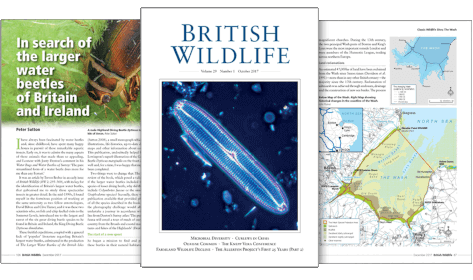
British Wildlife

8 issues per year 84 pages per issue Subscription only

British Wildlife is the leading natural history magazine in the UK, providing essential reading for both enthusiast and professional naturalists and wildlife conservationists. Published eight times a year, British Wildlife bridges the gap between popular writing and scientific literature through a combination of long-form articles, regular columns and reports, book reviews and letters.

Subscriptions from £33 per year

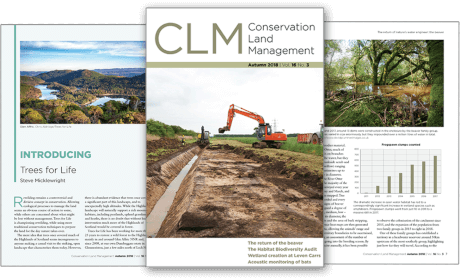
Conservation Land Management

4 issues per year 44 pages per issue Subscription only

Conservation Land Management (CLM) is a quarterly magazine that is widely regarded as essential reading for all who are involved in land management for nature conservation, across the British Isles. CLM includes long-form articles, events listings, publication reviews, new product information and updates, reports of conferences and letters.

Subscriptions from £26 per year
Academic & Professional Books  Insects & other Invertebrates  Arthropods (excl. insects)  Spiders, Scorpions, Ticks & Mites (Arachnida)

Behaviour and Ecology of Spiders Contributions from the Neotropical Region

By: Carmen Viera(Editor), Marcelo O Gonzaga(Editor)
437 pages, 54 colour & 37 b/w photos and illustrations, 56 tables
Publisher: Springer Nature
Behaviour and Ecology of Spiders
Click to have a closer look
  • Behaviour and Ecology of Spiders ISBN: 9783319657165 Hardback Nov 2017 Not in stock: Usually dispatched within 1-2 weeks
    £179.99
    #237111
Price: £179.99
About this book Contents Customer reviews Biography Related titles

About this book

Within the last few decades, arachnology in the Neotropical region has experienced a great development filling the knowledge gap in one of the most diverse regions of the world. Nevertheless, large geographical areas remain poorly sampled, especially within the Amazon, and new genera and species have been continuously discovered, even in urban areas. In congruence with the recent improvements in research, several aspects of the ecology, behaviour and natural history of spiders, such as interactions with other predators and parasitoids, social interactions, dispersal patterns, habitat requirements, mating behaviors, among others, are being carefully investigated. These recent contributions incorporate substantial information on the preexisting knowledge on these subjects every year. Our main objective with Behaviour and Ecology of Spiders is to present a summary on these new researches and on the currently knowledge on the main subjects involved in the general theme, emphasizing the contribution of the rich fauna of the Neotropical region to the research of behaviour and ecology of the spiders.

Contents

- Curves, Maps and Hotspots: The Diversity and Distribution of Araneomorph Spiders in the Neotropics   1-28
- Behavior and Biology of Mygalomorphae   29-54
- Neotropical Arachnological Collections: Basic Tools for the Development of Spider Research   55-84
- Habitat Selection and Dispersal   85-108
- Dispersal Strategies, Genetic Diversity, and Distribution of Two Wolf Spiders (Araneae, Lycosidae): Potential Bio-Indicators of Ecosystem Health of Coastal Dune Habitats of South America   109-135
- Webs: Diversity, Structure and Function   137-164
- Spider–Plant Interactions: An Ecological Approach   165-214
- Spiders as Plant Partners: Complementing Ant Services to Plants with Extrafloral Nectaries   215-226
- Foraging Strategies of Cursorial and Ambush Spiders   227-245
- Trophic Niches and Trophic Adaptations of Prey-Specialized Spiders from the Neotropics: A Guide   247-274
- Spiders Associated with Agroecosystems: Roles and Perspectives   275-302
- Sexual Selection in Neotropical Spiders: Examples from Selected Groups   303-350
- Parental Care and Sociality   351-381
- Plasticity and Cognition in Spiders   383-396
- Anti-Predator Strategies   397-415
- Host Behavioural Manipulation of Spiders by Ichneumonid Wasps   417-437

Customer Reviews

Biography

Carmen Viera is Professor and Director of Department of Animal Biology of Facultad de Ciencias, Universidad de la Republica and Director of the Laboratory of Behavioral Ecology of Instituto de Investigaciones Biologicas Clemente Estable, Uruguay founded by her in 2008. She is a researcher in the Sistema Nacional de Investigadores (SNI) Professor of Entomology of Facultad de Ciencias and Coordinator of Zoology in Post-graduation Program (PEDECIBA). She has experience in behavioural ecology and sociobiology.

Marcelo O. Gonzaga is a professor at Universidade Federal de Uberlandia, Minas Gerais, Brazil, since 2008. He earned his bachelor's degree at Universidade Federal de Minas Gerais (1996), and his master's and doctorate at Universidade Estadual de Campinas (1999, 2004). He had a post-doctoral fellowship in Universidade Estadual de Campinas (2006) and developed a project in the Program "Young Researches Awards" of FAPESP in Department of Ecology and Evolutionary Biology of Universidade Federal de Sao Carlos (2007-2008). He was the coordinator of the Post-graduation Program in Ecology and Conservation of Natural Resources of Universidade Federal de Uberlandia (2012-2014). He has experience in behavioural ecology, acting mainly in the following subjects: spider webs construction and variation, sociobiology, host behavioural manipulation by parasitoids, parental care in spiders.

By: Carmen Viera(Editor), Marcelo O Gonzaga(Editor)
437 pages, 54 colour & 37 b/w photos and illustrations, 56 tables
Publisher: Springer Nature
Current promotions
Great GiftsNew and Forthcoming BooksBritish Wildlife Magazine SubscriptionField Guide Sale 2025