To see accurate pricing, please choose your delivery country.
 
 
United States
£ GBP
All Shops
Important Notice for US Customers

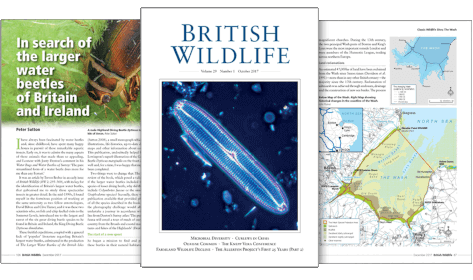
British Wildlife

8 issues per year 84 pages per issue Subscription only

British Wildlife is the leading natural history magazine in the UK, providing essential reading for both enthusiast and professional naturalists and wildlife conservationists. Published eight times a year, British Wildlife bridges the gap between popular writing and scientific literature through a combination of long-form articles, regular columns and reports, book reviews and letters.

Subscriptions from £33 per year

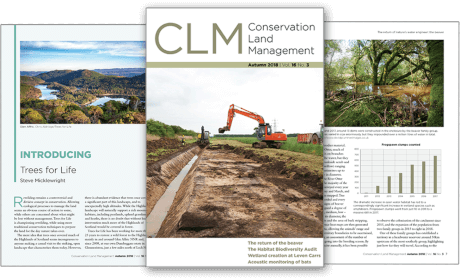
Conservation Land Management

4 issues per year 44 pages per issue Subscription only

Conservation Land Management (CLM) is a quarterly magazine that is widely regarded as essential reading for all who are involved in land management for nature conservation, across the British Isles. CLM includes long-form articles, events listings, publication reviews, new product information and updates, reports of conferences and letters.

Subscriptions from £26 per year
Academic & Professional Books  Botany  Non-Vascular Plants  Algae

Biodiversity of Seaweeds in the Egyptian Marine Waters The Mediterranean Sea, Red Sea and Suez Canal

By: Nihal Galal El-Din Thabet Shams El-Din(Author), Sarah Hamdy Rashedy(Author)
308 pages, 112 colour & 11 b/w illustrations
Publisher: Springer Nature
Biodiversity of Seaweeds in the Egyptian Marine Waters
Click to have a closer look
  • Biodiversity of Seaweeds in the Egyptian Marine Waters ISBN: 9783031333651 Hardback Aug 2023 Not in stock: Usually dispatched within 1-2 weeks
    £110.00
    #263443
Price: £110.00
About this book Contents Customer reviews Biography Related titles

About this book

The Arab Republic of Egypt enjoys a vital strategic location. Its northern border is the Mediterranean Sea, and its eastern border is the Red Sea, which gives it a special significance from the biodiversity point of view as a coastal zone, and as a sensitively diversified ecosystem. The shoreline of the Arab Republic of Egypt is about 3,000 km long. It is about 1,150 km long on the Mediterranean and about 1,850 km long on the Red Sea, which is connected by the Suez Canal, which is about 193.30 km in length. The three water masses are different ecologically and are experiencing a wide range of pressures due to eutrophication, coastal development, aquaculture, and climate change. These conditions resulted in several species of seaweeds that adapt to these pressures and expand their living boundaries while others may fade away. Accordingly, the study of seaweed biodiversity in Egyptian marine waters is of great concern globally and constitutes an important element of global change research.

Biodiversity of Seaweeds in the Egyptian Marine Waters summarizes our current understanding of the biodiversity of seaweeds in the Egyptian marine waters. It is a timely publication based wholly on primary data which were collected through extensive field studies conducted over the years covering the marine Egyptian waters and culminating the efforts of the Egyptian phycologists. The book contains high-quality images of some species in their existing habitats. This book gains critical importance from the fact that the Egyptian marine environment is witnessing rapid development, which will no doubt have a bearing on the coastal environment – and the baseline data on seaweed biodiversity would be useful to understand changes that may arise from physical changes in the environment as also pollution load and climate change.

Contents

Chapter 1. Biodiversity of Seaweeds in the Mediterranean Sea
Chapter 2. Biodiversity of Seaweeds in the Red Sea
Chapter 3. Suez Canal
Chapter 4. Recent Introduced Algal Species in the Egyptian Marine Waters

Customer Reviews

Biography

Dr Nihal Galal El-Din Thabet Shams El-Din, Professor in Hydrobiology Lab, National Institute of Oceanography and Fisheries, Alexandria, Egypt. Field of interest: Ecological studies on marine phytoplankton in the Mediterranean Sea, Red Sea, Suez Canal and Monitoring of phytoplankton in different habitats of Egyptian waters, especially the nursery ground of fish. Investigations on Harmful algae. Also, studies on macroalgae, including biodiversity, invasive species and taxonomical studies on native and introduced species. In addition, studies on the nutraceutical value of macroalgae, bioactive compounds, nanoparticles from macroalgae and their application in different domains such as industrial, pharmaceutical, and bioremediation. Also, studies on biodiesel production from macroalgae were performed.

Dr Sarah Hamdy Rashedy is currently working as a postdoctoral researcher of aquatic plants in the Hydrobiology Lab, Marine Environment Department, National Institute of Oceanography and Fisheries (NIOF), Hurghada, Egypt. Dr Rashedy received her M Sc. degree from South Valley University. Her master's thesis (2012-2015) was on eco-physiological studies on the phytoplankton along the north-western area of the Red Sea, Egypt. Then she was awarded a PhD from Suez Canal University. In her PhD thesis (2016-2019), she studied the spatial and temporal variations in nutritional composition, and antioxidant and antimicrobial activities of some seaweeds from the Red Sea, Egypt. Her major research interest is studying marine algae in terms of ecology, taxonomy, and application.in recent years, she has published a series of studies on the ecology of phytoplankton and seaweeds and in the field of biological treatment of wastewater by algae.

By: Nihal Galal El-Din Thabet Shams El-Din(Author), Sarah Hamdy Rashedy(Author)
308 pages, 112 colour & 11 b/w illustrations
Publisher: Springer Nature
Current promotions
January SaleNew and Forthcoming BooksBritish Wildlife Magazine SubscriptionField Guide Sale 2025