To see accurate pricing, please choose your delivery country.
 
 
United States
£ GBP
All Shops
Important Notice for US Customers

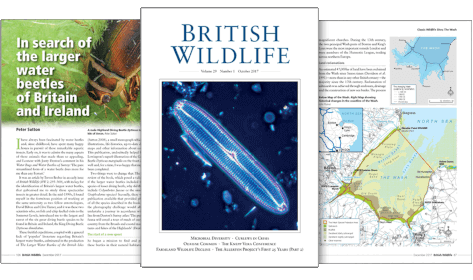
British Wildlife

8 issues per year 84 pages per issue Subscription only

British Wildlife is the leading natural history magazine in the UK, providing essential reading for both enthusiast and professional naturalists and wildlife conservationists. Published eight times a year, British Wildlife bridges the gap between popular writing and scientific literature through a combination of long-form articles, regular columns and reports, book reviews and letters.

Subscriptions from £33 per year

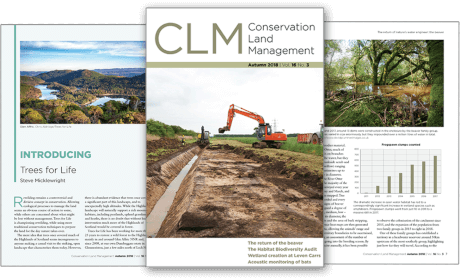
Conservation Land Management

4 issues per year 44 pages per issue Subscription only

Conservation Land Management (CLM) is a quarterly magazine that is widely regarded as essential reading for all who are involved in land management for nature conservation, across the British Isles. CLM includes long-form articles, events listings, publication reviews, new product information and updates, reports of conferences and letters.

Subscriptions from £26 per year
Academic & Professional Books  Environmental & Social Studies  Climate Change

Climate Change, Ocean Acidification and Sponges Impacts Across Multiple Levels of Organization

By: José Luis Carballo(Editor), James J Bell(Editor)
452 pages, 25 colour & 17 b/w illustrations, 23 tables
Publisher: Springer Nature
Climate Change, Ocean Acidification and Sponges
Click to have a closer look
  • Climate Change, Ocean Acidification and Sponges ISBN: 9783319590073 Hardback Nov 2017 Not in stock: Usually dispatched within 1-2 weeks
    £149.99
    #243113
Price: £149.99
About this book Contents Customer reviews Biography Related titles

About this book

While sponges represent a very simple group of organisms, which are represented by over 8000 species, there is considerable interest in the increasing role they may play in future marine ecosystems. While we still have a comparatively limited understanding of how sponges will respond to ocean warming and acidification there is evidence that some species may have the ability to acclimate or even adapt to these stressors. This comprehensive collection of articles describes our current understanding of the impacts of ocean acidification and warming on sponges across multiple levels of biological organisation, and from the geological past to the present. With expert contributions from across the world Climate Change, Ocean Acidification and Sponges represents the most up-to-date view on sponge responses to climate change. This book will be of interest to a wide audience of marine scientists and managers, who are grappling with how to manage, conserve and protect marine ecosystems.

Contents

Chapter 1. Climate change, ocean acidification and sponges: an introduction
Chapter 2. Lessons from the past: sponges in the geological record
Chapter 3. Sponges as proxies for past climate change events
Chapter 4. Gene expression and epigenetics and acclamatory mechanism in sponges
Chapter 5. Molecular and functional ecology of sponge and their microbial symbionts
Chapter 6. Temporal impacts of large-scale climatic variation on sponge assemblages
Chapter 7. Excavating sponges and the future of coral reefs
Chapter 8. Budgets, nutrient fluxes and ecological functions of coral reefs sponges in a warming planet
Chapter 9. Analysing the relationship between climate change and sponges disease outbreaks
Chapter 10. The deep glass sponge reefs
Chapter 11. Future research directions, and gaps in our understanding of climate change and ocean acidification impacts on sponges

Customer Reviews

Biography

Dr José Luis Carballo is a Senior Researcher and Professor of the postgraduate program in Marine Ecology at the Institute of Marine Science and Limnology at Universidad Nacional Autonoma de Mexico. (UNAM). He received his doctorate in Zoology in 1994 (Sevilla University) obtaining Cum Laude with the Thesis Sponges from the Strait of Gibraltar and after that obtained a postdoctoral Research Fellow on Research and Development. Currently is Senior Researcher in the UNAM, where he has published more than 100 scientific research papers, books, and invited major review chapters. He has also successfully supervised to completion more than 40 postgraduate (MS and PhD thesis) and Postdoctoral research fellows who research focused mainly in the study of taxonomy, biology an ecology of marine sponges. His current research interests focus mainly in coral reef sponges, and especially in boring sponges, on topics ranging from taxonomy, distribution, reproduction and dispersion. He is also interested in the general broad-scale variability in bioeroder communities and rates of erosion in Mexican Pacific coral reefs, and to understand how climate change and ocean acidification will influence bioerosion distribution and abundance of boring sponges.

Dr James J. Bell is an Associate Professor in marine biology and programme director from the School of Biological Sciences at Victoria University of Wellington in New Zealand. He received his undergraduate degree in marine biology in 1998 from Bangor University (1st Class hons), and his doctorate in 2001 from University College Cork (Ireland). Following his PhD, he held lectureship positions at Reading and Aberystwyth Universities (UK), and started at Victoria University in 2006. To date, Dr Bell has published over the 100 scientific articles in peer-reviewed journals and books, the majority of which are on sponge ecology. He has supervised over 50 honours, MSc and PhD students over hiss career, and has over 1800 citations. Dr Bell has extensive experience of temperate and tropical sponge ecology, and his current research interests include the impacts of climate change, ocean acidification and environmental degradation on sponges. His research interests also extend to understanding the functional roles of sponges and the factors influencing sponge biodiversity and abundance patterns.

By: José Luis Carballo(Editor), James J Bell(Editor)
452 pages, 25 colour & 17 b/w illustrations, 23 tables
Publisher: Springer Nature
Current promotions
January SaleNew and Forthcoming BooksBritish Wildlife Magazine SubscriptionField Guide Sale 2025