To see accurate pricing, please choose your delivery country.
 
 
United States
£ GBP
All Shops
Important Notice for US Customers

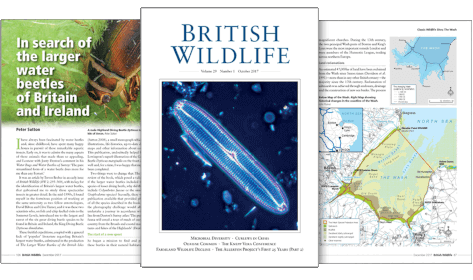
British Wildlife

8 issues per year 84 pages per issue Subscription only

British Wildlife is the leading natural history magazine in the UK, providing essential reading for both enthusiast and professional naturalists and wildlife conservationists. Published eight times a year, British Wildlife bridges the gap between popular writing and scientific literature through a combination of long-form articles, regular columns and reports, book reviews and letters.

Subscriptions from £33 per year

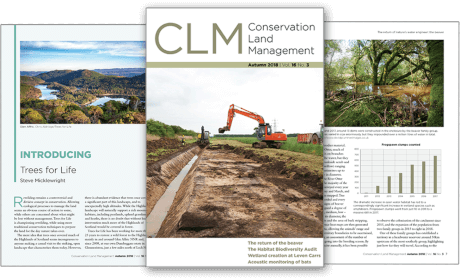
Conservation Land Management

4 issues per year 44 pages per issue Subscription only

Conservation Land Management (CLM) is a quarterly magazine that is widely regarded as essential reading for all who are involved in land management for nature conservation, across the British Isles. CLM includes long-form articles, events listings, publication reviews, new product information and updates, reports of conferences and letters.

Subscriptions from £26 per year
Academic & Professional Books  History & Other Humanities  History of Science & Nature

Erasmus Darwin's Gardens Medicine, Agriculture and the Sciences in the Eighteenth Century

By: Paul A Elliott(Author)
366 pages, 13 colour & 50 b/w illustrations
Publisher: Boydell Press
Erasmus Darwin's Gardens
Click to have a closer look
Select version
  • Erasmus Darwin's Gardens ISBN: 9781837652532 Paperback Feb 2025 Expected delivery 10th March - 13th March
    £32.99
    #270088 | Stock: 0
  • Erasmus Darwin's Gardens ISBN: 9781783276103 Hardback Jun 2021 Expected delivery 10th March - 13th March
    £50.00
    #270087 | Stock: 0
Selected version: £32.99
About this book Contents Customer reviews Biography Related titles

About this book

This first full study of Erasmus Darwin's gardening, horticulture and agriculture shows he was as keen a nature enthusiast as his grandson Charles.

Famous as the author of the Botanic Garden (1791) and grandfather of Charles Darwin (1809-1882), Erasmus Darwin (1731-1802) was a larger-than-life Enlightenment natural philosopher (scientist) and writer who practised as a doctor across the English Midlands for nearly half a century. A practical gardener and horticulturist, Darwin created a botanic garden near Lichfield – which galvanised his poetry – and kept other gardens, an orchard and small "farm" in Derby. Informed by his medical practice and botanical studies, Darwin saw many parallels between animals, plants and humans, which aroused hostility during the years of revolution, warfare and reaction, but helped him to write Zoonomia (1794/96) and Phytologia (1800) – his major studies of medicine, agriculture and gardening. Captivated by the changing landscapes and environments of town and country and supported by social networks such as those in Lichfield and Derby, Darwin avidly exchanged ideas about plants, animals and their diseases with family, patients, friends, such as the poet Anna Seward (1742-1809), farmers, fellow doctors, huntsmen and even the local mole catcher.

This is the first full study of Erasmus Darwin's gardening, horticulture and agriculture. It shows him as keen a nature enthusiast as his contemporary Rev. Gilbert White of Selbourne (1720-1793) or his grandson Charles, fascinated with everything from swarming insects and warring bees to domestic birds and dogs, pigs and livestock on his farm to fungi growing from horse dung in Derby tan yards. Ranging from his observations of plant physiology and anatomy to the use of plant "bandages" in his orchard and electrical machines to hasten seed germination, to explosive studies of vegetable "brains", nerves and sensations, the book demonstrates the ways in which Erasmus Darwin's landscape and garden experiences transformed his understanding of nature. They provided him with insights into medicine and the environmental causes of diseases, the classification of plants and animals, chemistry, evolution, potential new medicines and foodstuffs and the ecological interdependency of the natural economy. Like the amorous vegetables of the Loves of the Plants (1789), which fascinated, scandalised, and titillated late Georgian society, the many living creatures of Darwin's gardens and farm encountered in this book were for him real, dynamic, interacting and evolving beings who helped inspire and reaffirm his progressive social and political outlook.

Contents

Introduction

1. Lichfield and Derby gardens
2. Medicinal plants and their places
3. Agricultural improvement: enclosure and the application of science and technology
4. Vegetable physiology, technology and agriculture
5. Vegetable pathology and medicine
6. Amongst the animals
7. animal diseases
8. "Eating of the tree of knowledge": forestry, arboriculture and medicine
9. Trees in the economy of nature

Conclusion
Select Bibliography
Index

Customer Reviews

Biography

Paul Elliott is Professor of Modern History at the University of Derby.

By: Paul A Elliott(Author)
366 pages, 13 colour & 50 b/w illustrations
Publisher: Boydell Press
Media reviews

"[An] important addition to Erasmus Darwin scholarship."
Eighteenth-Century Intelligencer

"Elliott's deeply researched and stimulating book sets a high standard for future scholarship on Darwin."
H-NET

Current promotions
New and Forthcoming BooksBritish Wildlife Magazine SubscriptionField Guide Sale 2025