To see accurate pricing, please choose your delivery country.
 
 
United States
£ GBP
All Shops
Important Notice for US Customers

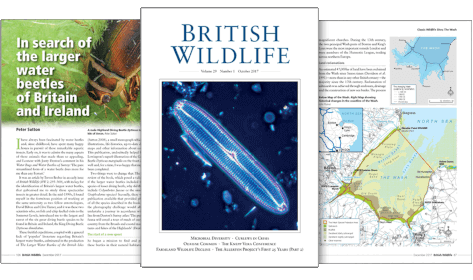
British Wildlife

8 issues per year 84 pages per issue Subscription only

British Wildlife is the leading natural history magazine in the UK, providing essential reading for both enthusiast and professional naturalists and wildlife conservationists. Published eight times a year, British Wildlife bridges the gap between popular writing and scientific literature through a combination of long-form articles, regular columns and reports, book reviews and letters.

Subscriptions from £33 per year

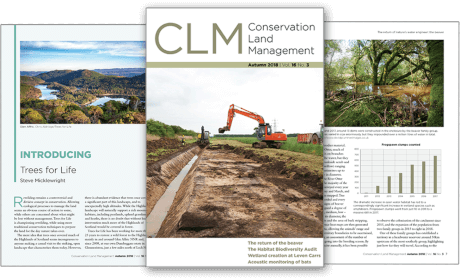
Conservation Land Management

4 issues per year 44 pages per issue Subscription only

Conservation Land Management (CLM) is a quarterly magazine that is widely regarded as essential reading for all who are involved in land management for nature conservation, across the British Isles. CLM includes long-form articles, events listings, publication reviews, new product information and updates, reports of conferences and letters.

Subscriptions from £26 per year
Academic & Professional Books  History & Other Humanities  Archaeology

Multispecies Archaeology

By: Suzanne E Pilaar Birch(Editor)
376 pages, 46 b/w photos, 28 b/w illustrations, 17 tables
Publisher: Routledge
Multispecies Archaeology
Click to have a closer look
  • Multispecies Archaeology ISBN: 9781138898981 Hardback Feb 2018 Not in stock: Usually dispatched within 1 week
    £230.00
    #241279
Price: £230.00
About this book Contents Customer reviews Biography Related titles

About this book

Multispecies Archaeology explores the issue of ecological and cultural novelty in the archaeological record from a multispecies perspective. Human exceptionalism and our place in nature have long been topics of academic consideration and archaeology has been synonymous with an axclusively human past, to the detriment of gaining a more nuanced understanding of one that is shared.

Encompassing more than just our relationships with animals, Multispecies Archaeology considers what we can learn about the human past without humans as the focus of the question. The volume digs deep into our understanding of interaction with plants, fungi, microbes, and even the fundamental building blocks of life, DNA. Multispecies Archaeology examines what it means to be human – and non-human – from a variety of perspectives, providing a new lens through which to view the past.

Challenging not only the subject or object of archaeology but also broader disciplinary identities, the volume is a landmark in this new and evolving area of scholarly interest.

Contents

List of Contributors
Acknowledgements
Introduction

Part I: Living in the Anthropocene
1. Calabrian Hounds and Roasted Ivory (or, Swerving from Anthropocentrism)
      Noah Heringman
2. The End of the ‘Neolithic’? At the emergence of the Anthropocene
      Christopher Witmore
3. Rehearsing the Anthropocene in microcosm: the palaeoenvironmental impacts of the Pacific rat (Rattus exulans) and other non-human species during island Neolithization
      Thomas P. Leppard
4. Trans-Holocene Human Impacts on California Mussels (Mytilus californianus): Historical Ecological Management Implications from the Northern Channel Islands
      Breana Campbell, Todd J. Braje, and Stephen G. Whitaker
5. Drift
      Þóra Pétursdóttir

Part II: Multispecies Ecology of the Built Environment
6. Symbiotic Architectures
      Gavin Lucas
7. The Eco-Ecumene and Multispecies History: The Case of Abandoned Protestant Cemeteries in Poland
      Ewa Domanska
8. Ecologies of Rock and Art in Northern New Mexico
      Benjamin Alberti and Severin Fowles
9. Oysters and Mound-Islands of Crystal River along the Central Gulf Coast of Florida
      Victor D. Thompson and Thomas J. Pluckhahn
10. Multi-species Dynamics and the Ecology of Urban Spaces in Roman Antiquity
      Michael MacKinnon
11. Mammalian Community Assembly in Ancient Villages and Towns in the Jordan Valley of Israel
      Nimrod Marom and Lior Weissbrod

Part III: Agrarian Commitments: Towards an archaeology of symbiosis
12. Animals and the Neolithic: cui bono?
      Terry O’Connor
13. Making space from the position of duty of care: Early Bronze Age human - sheep entanglements in Norway.
      Kristin Armstrong Oma
14. The History of the Human Microbiome: Insights from Archaeology and Ancient DNA
      Laura S. Weyrich
15. An archaeological telling of multispecies co-inhabitation: comments on the origins of agriculture and domestication narrative in southwest Asia
      Brian Boyd

Part IV: The Ecology of Movement
16. Legs, feet and hooves: the seasonal roundup in Iceland
      Oscar Aldred
17. The Rhythm of Life: Exploring the role of daily and seasonal rhythms in the development of human-nonhuman relationships in the British Early Mesolithic
      Nick J. Overton
18. Seasonal mobility and multispecies interactions in the Mesolithic northeastern Adriatic
      Suzanne E. Pilaar Birch
19. The role of ostrich in shaping the landscape use patterns of humans and hyenas on the southern coast of South Africa during the late Pleistocene
      Jamie Hodgkins, Petrus le Roux, Curtis W. Marean, Kirsty Penkman, Molly Crisp, Erich Fisher, and Julia Lee-Thorp
20. Prey species movements and migrations in ecocultural landscapes: reconstructing late Pleistocene herbivore seasonal spatial behaviors
      Kate Britton

Index

Customer Reviews

Biography

Suzanne E. Pilaar Birch is Assistant Professor at the University of Georgia with a joint appointment in the departments of Anthropology and Geography. She combines zooarchaeology and biogeochemistry to investigate changes in diet, environment, mobility, and settlement systems spanning the late Pleistocene and early Holocene.

By: Suzanne E Pilaar Birch(Editor)
376 pages, 46 b/w photos, 28 b/w illustrations, 17 tables
Publisher: Routledge
Current promotions
January SaleNew and Forthcoming BooksBritish Wildlife Magazine SubscriptionField Guide Sale 2025