Um genaue Preise zu sehen, wählen Sie bitte Ihr Lieferland.
 
 
United Kingdom
£ GBP
Alle Kategorien
Free standard shipping on UK orders over £50 | Christmas delivery times

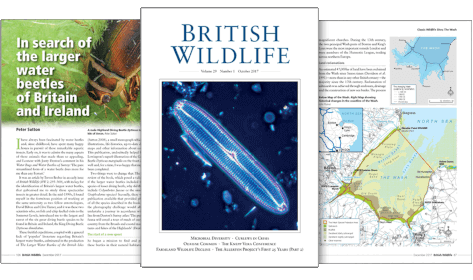
British Wildlife

8 issues per year 84 Seiten per Ausgabe Nur im Abonnement erhältlich

British Wildlife is the leading natural history magazine in the UK, providing essential reading for both enthusiast and professional naturalists and wildlife conservationists. Published eight times a year, British Wildlife bridges the gap between popular writing and scientific literature through a combination of long-form articles, regular columns and reports, book reviews and letters.

Abonnement ab £33 im Jahr

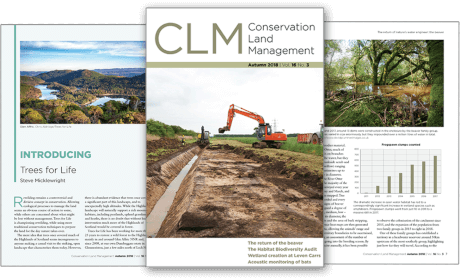
Conservation Land Management

4 Auflagen im Jahr 44 Seiten Nur im Abonnement erhältlich

Conservation Land Management (CLM) ist ein Mitgliedermagazin und erscheint viermal im Jahr. Das Magazin gilt allgemein als unverzichtbare Lektüre für alle Personen, die sich aktiv für das Landmanagement in Großbritannien einsetzen. CLM enthält Artikel in Langform, Veranstaltungslisten, Buchempfehlungen, neue Produktinformationen und Berichte über Konferenzen und Vorträge.

Subscriptions from £26 per year
Akademische und professionelle Bücher  Earth System Sciences  Geosphere  Regional & Local Geology

Natural Stone Resources for Historical Monuments

By: R Prikryl(Editor), A Torok(Editor)
256 pages, colour & b/w illustrations, maps
Natural Stone Resources for Historical Monuments
Click to have a closer look
  • Natural Stone Resources for Historical Monuments ISBN: 9781862392915 Hardback Mar 2010 Not in stock: Usually dispatched within 1-2 weeks
    £106.00
    #206350
Price: £106.00
About this book Contents Customer reviews Related titles

About this book

Natural stone is considered to be a versatile, durable and aesthetically pleasing building material. From the beginning of civilization, important structures and monuments have been built from, or based on, natural stone. Until the end of the nineteenth century, the use of local stone resources was mostly in balance with the local environment. Strict environmental legislation has resulted in the closing of many long-standing quarries in industrialized countries, which has led to a shortage of traditional stone varieties.

This has caused problems for restoration practice. Cheap, imported stone from less industrialized countries has become more widely available in recent years. Some of the issues related to built stone conservation and restoration covered by Natural Stone Resources for Historical Monuments are: the establishment of inventories of possible replacement stones; understanding the decay mechanism and use of preventive conservation methods for slowing down decay processes; evaluation of the properties of natural stone; and assessing the risks of using replacement stones of different qualities.

Most of the papers in Natural Stone Resources for Historical Monuments were presented during the special sessions held during the General Assemblies of the European Geosciences Union held in Vienna (Austria) annually during 2006-2008.

Contents

Preface • PRIKRYL, R. & TÖRÖK, Á. Natural stones for monuments: their availability for restoration and
Evaluation • SIEDEL, H. Alveolar weathering of Cretaceous building sandstones on monuments in Saxony,
Germany • FRONTEAU, G., SCHNEIDER-THOMACHOT, C., CHOPIN, E., BARBIN, V., MOUZE, D. &
PASCAL, A. Black-crust growth and interaction with underlying limestone microfacies • ANGELI, M., HÉBERT, R., MENÉNDEZ, B., DAVID, C. & BIGAS, J.-P. Influence of temperature and salt concentration on the salt weathering of a sedimentary stone with sodium sulphate • YU, S. & OGUCHI, C. T. Is sodium sulphate invariably effective in destroying any type of rock? • OGUCHI, C. T. & YUASA, H. Simultaneous wetting/drying, freeze/thaw and salt crystallization experiments of three types of Oya tuff • GILLHUBER, S., LEHRBERGER, G. & GÖSKE, J. Fire damage of trachyte: investigations of the Tepla´ monastery building stones • PEREIRA, D., PEINADO, M., YENES, M., MONTERRUBIO, S., NESPEREIRA, J. & BLANCO, J. A. Serpentinites from Cabo Ortegal (Galicia, Spain): a search for correct use as ornamental stones • MCCABE, S., SMITH, B. J.&WARKE, P. A. A legacy of mistreatment: conceptualizing the decay of medieval sandstones in NE Ireland • GOMEZ-HERAS, M., SMITH, B. J. & VILES, H. A. Oxford stone revisited: causes and consequences of diversity in building limestone used in the historic centre of Oxford, England • BECK, K. & AL-MUKHTAR, M. Evaluation of the compatibility of building limestones from salt crystallization experiments • NIJLAND, T. G., VAN HEES, R. P. J.& BOLONDI, L. Evaluation of three Italian tuffs (Neapolitan Yellow Tuff, Tufo Romano and Tufo Etrusco) as compatible replacement stone for Ro¨mer tuff in Dutch built cultural heritage • ANDRIANI, G. F. & WALSH, N. Petrophysical and mechanical properties of soft and porous building rocks used in Apulian monuments (south Italy) • UNTERWURZACHER, M., OBOJES, U., HOFER, R. & MIRWALD, P. W. Petrophysical properties
of selected Quaternary building stones in western Austria • FIGUEIREDO, C., FOLHA, R., MAURÍCIO, A., ALVES, C. & AIRES-BARROS, L. Contribution to the technological characterization of two widely used Portuguese dimension stones: the ‘Semi-rijo’ and ‘Moca Creme’ stones • LAHO, M., FRANZEN, C., HOLZER, R. & MIRWALD, P. W. Pore and hygric properties of porous limestones: a case study from Bratislava, Slovakia •
ASTNÁ, A., JEHLICKA, J. & PRIKRYL, R. Raman spectra of reduced carbonaceous matter as a tool for determining the provenance of marbles: examples of ‘graphitic’ marbles from Czech quarries • COOKE, L. The 19th century Corsi collection of decorative stones: a resource for the 21st century? • FRANGIPANE, A. Working for an electronic database of historical stone resources in Friuli-Venezia Giulia (Italy) • KAMPFOVÁ, H. & PRIKRYL, R. Electronic database of historical natural stones of the Czech Republic: structuring field and laboratory data • ALLOCCA, F., CALCATERRA, D., CALICCHIO, G., CAPPELLETTI, P., COLELLA, A.,
LANGELLA, A. & DE’ GENNARO, M. Ornamental stones in the cultural heritage of Campania region (southern Italy): the Vitulano marbles • Index

Customer Reviews

By: R Prikryl(Editor), A Torok(Editor)
256 pages, colour & b/w illustrations, maps
Media reviews

"This book ends with a comprehensive index, which allows easy navigation through the contents. Each paper ends with numerous references, which will allow the reader to move above and beyond what is reported here to related areas of research. The well-written papers, in crisp easy-flowing language, are amply supported by numerous figures. It is a pity that some of the photographs are either too small or not sufficiently clear to suitably support the written text.

As a snapshot in time of research on natural stone used in historical monuments, this book is well worth reading by geologists and other scientists who study materials used in historical buildings and the mechanisms of their deterioration. Professionals seeking new sources of building stone, and stone for replacement purposes, should also find this volume useful"

- JoAnn Cassar, QJEGH Vol. 45
 

Current promotions
Great GiftsNew and Forthcoming BooksBritish Wildlife Magazine SubscriptionField Guide Sale 2025