Um genaue Preise zu sehen, wählen Sie bitte Ihr Lieferland.
 
 
United States
£ GBP
Alle Kategorien
Important Notice for US Customers

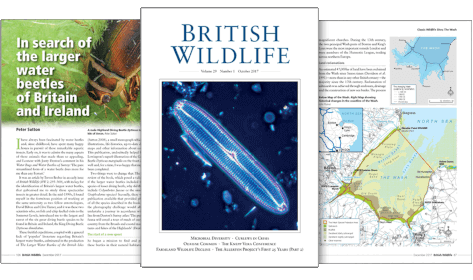
British Wildlife

8 issues per year 84 Seiten per Ausgabe Nur im Abonnement erhältlich

British Wildlife is the leading natural history magazine in the UK, providing essential reading for both enthusiast and professional naturalists and wildlife conservationists. Published eight times a year, British Wildlife bridges the gap between popular writing and scientific literature through a combination of long-form articles, regular columns and reports, book reviews and letters.

Abonnement ab £33 im Jahr

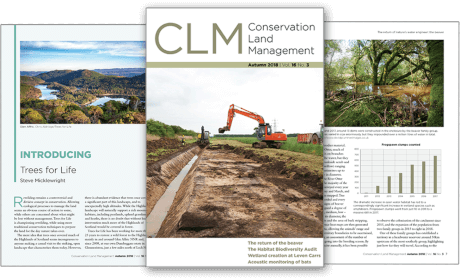
Conservation Land Management

4 Auflagen im Jahr 44 Seiten Nur im Abonnement erhältlich

Conservation Land Management (CLM) ist ein Mitgliedermagazin und erscheint viermal im Jahr. Das Magazin gilt allgemein als unverzichtbare Lektüre für alle Personen, die sich aktiv für das Landmanagement in Großbritannien einsetzen. CLM enthält Artikel in Langform, Veranstaltungslisten, Buchempfehlungen, neue Produktinformationen und Berichte über Konferenzen und Vorträge.

Subscriptions from £26 per year
Feldführer und Naturgeschichte  Insects & other Invertebrates  Insects  Flies (Diptera)

RES Handbook, British Dolichopodidae (Diptera)

Field / Identification Guide Identification Key Coming Soon
By: Martin Drake(Author)
360 pages, b/w line drawings
RES Handbook, British Dolichopodidae (Diptera)
Click to have a closer look
  • RES Handbook, British Dolichopodidae (Diptera) ISBN: 9781800628335 Hardback 29 Dec 2025 Available for pre-order
    £125.00
    #267701
Price: £125.00
About this book Contents Customer reviews Biography Related titles

About this book

This handbook covers British species of the family Dolichopodidae, popularly called long-legged flies. These are often attractive both visually and in their behaviour, so the larger species will be familiar to most naturalists. The sexes are often strongly dimorphic, males having their legs and wings modified for signalling during sometimes complex courtship. Both the larvae and adults are predators, with the exception of one genus whose larvae are miners within monocotyledons.

Most species are associated with wetlands from the seashore to montane pools, while a small number have more xerophilic tendencies and others are associated with rot-holes or wood-boring beetles. Dolichopodids can play an important role in nature conservation assessment of sites as their habitat affinities, rarity status and distributions are fairly well known.

This book focuses on the British fauna of about 327 species in 47 genera placed in 12 subfamilies. One species so far found only in Ireland is also included. The limits of several subfamilies are poorly defined, and phylogenetic relationships based on morphological and molecular data are also not always in agreement, so the placement in this book of some genera differs from previous British checklists. In particular, some genera are assigned to the Peloropeodinae, which has not been accepted previously in the British literature. Owing to their secondary sexual characteristics, males are easier to identify than females so separate keys are provided for nearly all genera. Some males can be separated reliably only by using genitalia characters which are therefore often included in the keys and are illustrated for most species. In a few cases no reliable differences have been found for females.

Line drawings illustrate many of the characters mentioned in the couplets, and photographs show representative species of all genera. Most keys are derived de novo rather than updating those already existing. Species accounts briefly describe the most important characters to confirm the identification arrived at using the key, distinctions from similar species that may occur in Britain, the distribution in Britain, and their habitat associations.

Contents

1. Recognising the family
2. Keys and species accounts
3. Morphology of adults
4. Checklist of Dolichopodidae of the British Isles
5. References
6. Key to Genera of British Dolichopodidae

Customer Reviews

Biography

Martin Drake has a long interest in flies. After an early start as an entomologist with the Freshwater Biological Association, following a PhD on the ecology of midges, much of his career has been spent in insect conservation with the government conservation agencies, and then running his own consultancy in the same field. He has published many papers on invertebrates, but with an emphasis on flies and their natural history. He was a founding member of the Dipterists Forum, which he served in several capacities. Running the dolichopodid recording scheme for many years highlighted the need for an updated identification guide culminating in the present wor,k which has provided an outlet for an amateur taxonomist.

Field / Identification Guide Identification Key Coming Soon
By: Martin Drake(Author)
360 pages, b/w line drawings
Current promotions
Great GiftsNew and Forthcoming BooksBritish Wildlife Magazine SubscriptionField Guide Sale 2025