To see accurate pricing, please choose your delivery country.
 
 
United States
£ GBP
All Shops
Important Notice for US Customers

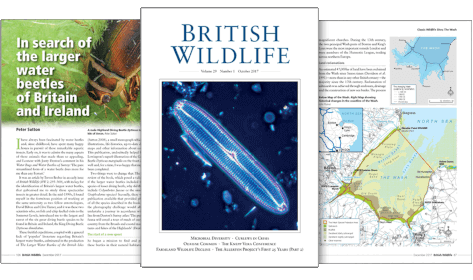
British Wildlife

8 issues per year 84 pages per issue Subscription only

British Wildlife is the leading natural history magazine in the UK, providing essential reading for both enthusiast and professional naturalists and wildlife conservationists. Published eight times a year, British Wildlife bridges the gap between popular writing and scientific literature through a combination of long-form articles, regular columns and reports, book reviews and letters.

Subscriptions from £33 per year

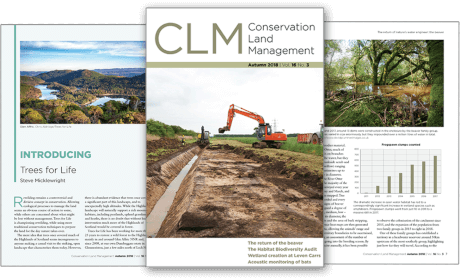
Conservation Land Management

4 issues per year 44 pages per issue Subscription only

Conservation Land Management (CLM) is a quarterly magazine that is widely regarded as essential reading for all who are involved in land management for nature conservation, across the British Isles. CLM includes long-form articles, events listings, publication reviews, new product information and updates, reports of conferences and letters.

Subscriptions from £26 per year
Academic & Professional Books  Earth System Sciences  Atmosphere  Meteorology & Weather

The Weather Observer's Handbook

Handbook / Manual
By: Stephen Burt(Author)
522 pages
The Weather Observer's Handbook
Click to have a closer look
Select version
  • The Weather Observer's Handbook ISBN: 9781009260589 Edition: 2 Paperback Apr 2024 Not in stock: Usually dispatched within 1-2 weeks
    £39.99
    #265777
  • The Weather Observer's Handbook ISBN: 9781009260541 Edition: 2 Hardback Apr 2024 Not in stock: Usually dispatched within 1-2 weeks
    £90.00
    #265776
Selected version: £39.99
About this book Contents Customer reviews Biography Related titles

About this book

This handbook provides a comprehensive, practical, and independent guide to all aspects of making weather observations. The second edition has been fully updated throughout with new material, new instruments and technologies, and the latest reference and research materials. Traditional and modern weather instruments are covered, including how best to choose and to site a weather station, how to get the best out of your equipment, how to store and analyse your records and how to share your observations. The book's emphasis is on modern electronic instruments and automatic weather stations. It provides advice on replacing 'traditional' mercury-based thermometers and barometers with modern digital sensors, following implementation of the UN Minamata Convention outlawing mercury in the environment. The Weather Observer's Handbook will again prove to be an invaluable resource for both amateur observers choosing their first weather instruments and professional observers looking for a comprehensive and up-to-date guide.

Contents

Part I. The Basics:
1. Why measure the weather?
2. Choosing a weather station
3. Buying a weather station

Part II. Measuring the Weather:
4. Site and exposure – the basics
5. Measuring the temperature of the air
6. Measuring precipitation
7. Measuring atmospheric pressure
8. Measuring humidity
9. Measuring wind speed and direction
10. Measuring grass and earth temperatures
11. Measuring sunshine and solar radiation
12. Observing hours and time standards
13. Aws data flows, display and storage
14. Non-instrumental weather observing
15. Calibration
16. Metadata – what is it, and why is it important?

Part III. Making the Most of Your Observations:
17. Collecting and storing data
18. Making the data avalanche work for you
19. Sharing your observations
20. Summary and getting started

Appendix 1: Metrology and meteorology: an instrument theory primer
Appendix 2: Recommended products
Appendix 3: Useful sources
Appendix 4: Mercury-based legacy thermometers and barometers
Appendix 5: Useful functions
Appendix 6: Unit conversions

References
Further reading
Index

Customer Reviews

Biography

Dr Stephen Burt commenced his professional career in meteorology within the UK Met Office in 1977, followed by a series of private-sector marketing roles within the computer industry before returning to academia, eventually retiring from the Department of Meteorology at the University of Reading in 2018 (where he remains a Visiting Fellow). His meteorological research interests span instruments, observation techniques and methods, climatological data rescue, case studies of notable weather events, and long weather records and their sites; in all, he has authored or joint-authored some fifty peer-reviewed journal papers to date, and four other books. Stephen is a Fellow of the UK's Royal Meteorological Society and a member of both the American Meteorological Society and the Irish Meteorological Society. He is also an accomplished photographer with several hundred published photographs to his name.

Handbook / Manual
By: Stephen Burt(Author)
522 pages
Media reviews

Reviews of the first edition:

"This is a very impressive work! [...] At last there is a comprehensive book on the tricky issue of accurately measuring the weather. This timely publication is a must for anyone in the market for a weather station, libraries, and weather observers of all stripes, both amateur and professional."
– Christopher C. Burt, Wunderground, Inc. and author of Extreme Weather: A Guide and Record Book

"Sophisticated equipment for weather observing is now within reach of more people than ever. Yet a poorly sited station or a wrongly interpreted report can do more harm than good. With this marvelous book, Stephen Burt has given us a very practical and helpful guide to installing and using one's own reporting station, enhanced with perspective drawn from the centuries-long history of meteorological instrumentation. The Weather Observer's Handbook is an ideal companion to the practice of monitoring the atmosphere."
– Robert Henson, author of The Rough Guide to Weather and The Rough Guide to Climate Change

"We have many amateur members and schools in our Society and I'm often asked if I can recommend a good book to help them in their observing exploits: well now I can [...] If you have an interest in observing the weather then this book is as essential as your observing equipment."
– Paul Hardaker, Chief Executive, Royal Meteorological Society

"I like this book very much. I am a lifelong weather observer and user of weather data both as an amateur and a career professional – spanning the years from manual-only to globally-networked automated observing systems. This book answers so many of the questions I have had over the decades and the many questions I continue to field – from fresh beginners, to experienced amateurs and on to a wide range of professionals. At last I have a single book that I can point people to. It is comprehensive and scientifically rigorous – yet very readable. Thank you, Stephen – well done."
– Nolan Doesken, Colorado State Climatologist, former President of the American Association of State Climatologists, and founder of the Community Collaborative Rain, Hail and Snow network

"[...] the book's great strength is that it draws on the author's wealth of experience and expertise in making amateur measurements over several decades, and is liberally illustrated with photographs and data from his own weather station [...] his enthusiasm for the subject [...] clearly comes across in the book. The author puts amateur weather enthusiasts at the head of his list of target audiences, and this is undoubtedly the group [...] who will find this very readable book a goldmine of information."
– Geoff Jenkins, Weather (journal of the Royal Meteorological Society)

"This hugely impressive tome will be of enormous benefit."
The Weather Magazine

"Stephen Burt is an observer, not of the night sky, but of all aspects of the weather. His book covers equipment choice, including gauges for measuring things like rainfall and humidity. Choosing the right site is also covered, as is how to record and measure data. The 'one minute summary' at the end of each chapter is particularly useful [...]"
Sky at Night Magazine

"It would be difficult to find a more comprehensive book on the subject [...] for anyone thinking of investing in new instrumentation, or updating his or her existing instrumentation, this book is an essential prerequisite."
International Journal of Meteorology

"[...] the amount of detail means there is information relevant for all levels including experienced professionals [...] An obvious purchase for academic institutions with any weather-related departments, it is also exactly the sort of book which a good public library should hold."
– Val Hamilton, Reference Reviews

Current promotions
Great GiftsNew and Forthcoming BooksBritish Wildlife Magazine SubscriptionField Guide Sale 2025