Um genaue Preise zu sehen, wählen Sie bitte Ihr Lieferland.
 
 
United States
£ GBP
Alle Kategorien
Important Notice for US Customers

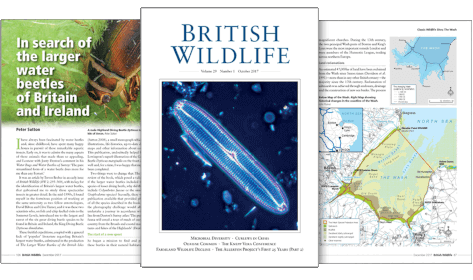
British Wildlife

8 issues per year 84 Seiten per Ausgabe Nur im Abonnement erhältlich

British Wildlife is the leading natural history magazine in the UK, providing essential reading for both enthusiast and professional naturalists and wildlife conservationists. Published eight times a year, British Wildlife bridges the gap between popular writing and scientific literature through a combination of long-form articles, regular columns and reports, book reviews and letters.

Abonnement ab £33 im Jahr

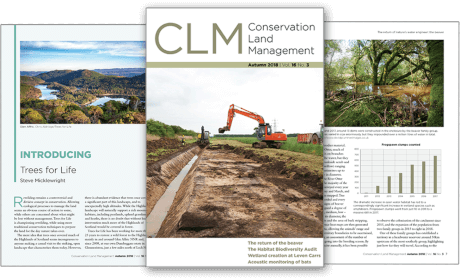
Conservation Land Management

4 Auflagen im Jahr 44 Seiten Nur im Abonnement erhältlich

Conservation Land Management (CLM) ist ein Mitgliedermagazin und erscheint viermal im Jahr. Das Magazin gilt allgemein als unverzichtbare Lektüre für alle Personen, die sich aktiv für das Landmanagement in Großbritannien einsetzen. CLM enthält Artikel in Langform, Veranstaltungslisten, Buchempfehlungen, neue Produktinformationen und Berichte über Konferenzen und Vorträge.

Subscriptions from £26 per year
Akademische und professionelle Bücher  Habitats & Ecosystems  Wetlands

Wetlands Ecology Eco-Biological Uniqueness of a Ramsar Site (East Kolkata Wetlands, India)

By: Susanta Kumar Chakraborty(Author), Poulomi Sanyal(Author), Ratnadeep Ray(Author)
692 pages, 122 colour & 3 b/w illustrations
Publisher: Springer Nature
Wetlands Ecology
Click to have a closer look
Select version
  • Wetlands Ecology ISBN: 9783031092558 Paperback Mar 2024 Not in stock: Usually dispatched within 1-2 weeks
    £140.00
    #268860
  • Wetlands Ecology ISBN: 9783031092527 Hardback Mar 2023 Not in stock: Usually dispatched within 1-2 weeks
    £140.00
    #259652
Selected version: £140.00
About this book Contents Customer reviews Biography Related titles

About this book

This book discusses current knowledge and challenges with the ecological management and conservation of wetlands, with a focus on the East Kolkata Wetlands of India. This area is referred to as a Ramsar Site, a designation given to areas with special protection statuses since it is the largest natural waste recycling system in the world. The site faces many threats to its biodiversity and ecosystem functioning due to anthropogenic activity in the region, and therefore an assessment of the ecosystem services, bio-ecological uniqueness, and issues stemming from climate change and human impacts is needed to develop protection strategies for the future ecological functioning and sustainability of the wetlands. The authors use GIS and remote sensing techniques to assess and monitor harmful industrial and environmental impacts on the wetlands and to inform mitigation and conservation strategies in the face of ongoing threats such as pollution, habitat destruction and bioinvasion. The book also highlights various social and economic aspects tied to the functioning and management of the wetlands, along with ecological, biological, and physio-chemical considerations. The study will be of use to students and researchers in aquatic ecology, biodiversity, and environmental sustainability and conservation, as well as to environmental planners, engineers, and policymakers.

Contents

Chapter 1. Introduction
Chapter 2. Historical perspectives of the wetlands with special reference to geomorphic evolution of East Kolkata Wetlands
Chapter 3. Underlying ecological principles for the functioning of Wetland Ecosystems
Chapter 4. Basics of Remote Sensing Techniques applicable in the aquatic freshwater system: Classificatory Approaches of East Kolkata Wetlands
Chapter 5. Biodiversity of East Kolkata wetlands: Concept of biodiversity
Chapter 6. Ecosystem services and values of Wetlands (East Kolkata Wetlands)
Chapter 7. Seasonal Dynamics of Physico-Chemical Parameters of Soil and Water
Chapter 8. Threats and pollution of wetlands: Special reference to East Kolkata Wetland (E.K.W)
Chapter 9. Biomonitoring and Bioremediation
Chapter 10. Sustainable conservation strategy (Waste Water Recycling)
Chapter 11. Conclusion

Customer Reviews

Biography

Dr Susanta Kumar Chakraborty is a Professor of Zoology at Vidyasagar University and he received his M.Phil. in Environmental Science and PhD in Marine Science from Calcutta University. His research centres on Coastal Ecology, Mangrove and Fresh Water Wetlands, Rivers and Estuaries, emphasising biodiversity and ecosystem dynamics. He has also worked on the integration of rural biotechnologies for environmental management, eco-restoration, and livelihood generation. He has received a number of awards in recognition of his research commitments. Dr Chakraborty has taught for over three decades, mostly at the postgraduate level, covering different aspects of Zoology in general and Ecology/Environmental Science in particular, and has successfully supervised thirty PhD students, published around 150 research papers, written books, and has completed more than a dozen research projects including consultancy work on environmental impact assessment in several countries. Dr Chakraborty has also served at other universities as a member of selection committees and academic bodies, as well as an expert member in several government departments like U.G.C. and I.C.A.R., and he is a life member of a number of scientific bodies in India and serves on the editorial board of a number of journals.

Dr Poulami Sanyal is a Research Scientist at West Bengal Pollution Control Board, India.

Dr Ratnadeep Ray is an Assistant Professor of remote sensing and GIS in Earth Sciences at JIS University, Kolkata, India.

By: Susanta Kumar Chakraborty(Author), Poulomi Sanyal(Author), Ratnadeep Ray(Author)
692 pages, 122 colour & 3 b/w illustrations
Publisher: Springer Nature
Current promotions
Great GiftsNew and Forthcoming BooksBritish Wildlife Magazine SubscriptionField Guide Sale 2025