To see accurate pricing, please choose your delivery country.
 
 
United States
£ GBP
All Shops
Important Notice for US Customers

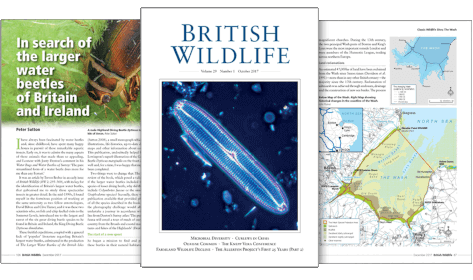
British Wildlife

8 issues per year 84 pages per issue Subscription only

British Wildlife is the leading natural history magazine in the UK, providing essential reading for both enthusiast and professional naturalists and wildlife conservationists. Published eight times a year, British Wildlife bridges the gap between popular writing and scientific literature through a combination of long-form articles, regular columns and reports, book reviews and letters.

Subscriptions from £33 per year

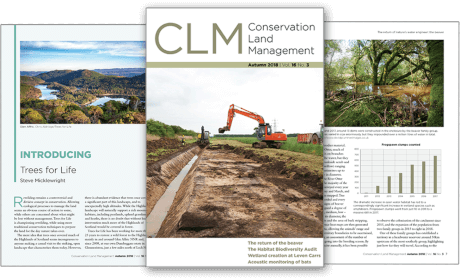
Conservation Land Management

4 issues per year 44 pages per issue Subscription only

Conservation Land Management (CLM) is a quarterly magazine that is widely regarded as essential reading for all who are involved in land management for nature conservation, across the British Isles. CLM includes long-form articles, events listings, publication reviews, new product information and updates, reports of conferences and letters.

Subscriptions from £26 per year
Academic & Professional Books  Environmental & Social Studies  Climate Change

How To Think About Climate Change Insights from Economics for the Perplexed but Open-Minded Citizen

By: Riccardo Rebonato(Author)
360 pages
How To Think About Climate Change
Click to have a closer look
  • How To Think About Climate Change ISBN: 9781009405003 Hardback Jan 2024 Not in stock: Usually dispatched within 1-2 weeks
    £30.00
    #265174
Price: £30.00
About this book Contents Customer reviews Biography Related titles

About this book

Caught in the crossfire between climate deniers and catastrophists, the intelligent layperson is understandably bewildered when faced with the complexity of climate change. How To Think About Climate Change shows that economics provides not just a suitable, but an indispensable perspective to understand the root causes of the climate-change problem: scarcity of resources, externalities, and free riding. Riccardo Rebonato argues that there are no silver bullets or easy solutions. However, he shows that the new-generation economics models offer a radically different insight about our best course of action from what most early models recommended – in particular, they suggest that fast and large-scale climate action can now be justified as the most cost-effective strategy without requiring the 'infinite altruism' of earlier models. Given the conceptual tools provided in this book, readers can decide whether they agree with these conclusions – and, if they do, what the most effective courses of action are.

Contents

1. Introduction
2. The facts on the ground
3. Deep changes
4. How economists think about climate change
5. How economists look at choice
6. How utility theory works
7. From choice to utility
8. What are integrated assessment models?
9. How much should we care about future generations?
10. Growth
11. Population
12. So, what should we do?
13. Taking the dirty stuff out
14. The role of nuclear energy
15. Constraints
16. The plumbing
17. Unfinished business

Customer Reviews

Biography

Riccardo Rebonato is a Professor of Finance at EDHEC and Scientific Director at the EDHEC Risk Climate Institute. He worked as a researcher at the nuclear research reactor at the Institut Laue Langevin, at Brookhaven National Laboratory and at Oxford University and has authored 11 books and 50 articles on finance, risk management and political economics. He is a current Board member of the Nine Dots Prize with Cambridge University Press and a former Board member of ISDA and GARP.

By: Riccardo Rebonato(Author)
360 pages
Media reviews

"Riccardo Rebonato has done it again! Notwithstanding its humble title, his latest book is filled with rich insights from the interface of economics and climate science, for both the concerned citizen and the seasoned expert. It's all there: the economics and the climate science, the facts and the models, the costs and the benefits. Rebonato offers uniquely-informed economic insights on mitigation, adaptation, new technologies, and open questions."
– Francis X. Diebold, Professor of Economics, Finance and Statistics, University of Pennsylvania

"Anthropogenic climate change is a market failure, and its solution will require close collaboration between physicists and economists. Professor Rebonato's unique background as a trained physicist and a world-renowned finance expert shines through in this wonderful book, making it one of the most authoritative treatments of this subject possible."
– Marcos Lopez de Prado, Global Head of Quantitative R&D at the Abu Dhabi Investment Authority, and MIT Connection Science Fellow

"Riccardo Rebonato is a well-known practitioner, author, and economist. He is celebrated for his insightful contributions to financial engineering, economic modeling, and climate change discourse, habitually offering fresh perspectives on complex global challenges. How To Think About Climate Change empowers readers to confront the climate crisis with renewed understanding and purpose. Rebonato's book is essential for anyone seeking an enlightened and actionable perspective on one of the most pressing issues of our time."
– Alexander Lipton, ADIA Lab

Current promotions
Great GiftsNew and Forthcoming BooksBritish Wildlife Magazine SubscriptionField Guide Sale 2025