To see accurate pricing, please choose your delivery country.
 
 
United States
£ GBP
All Shops
Important Notice for US Customers

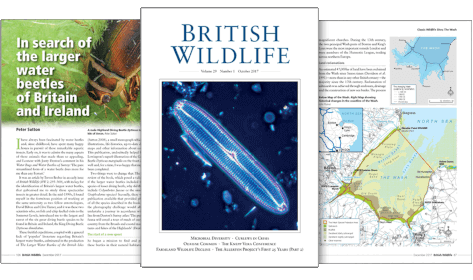
British Wildlife

8 issues per year 84 pages per issue Subscription only

British Wildlife is the leading natural history magazine in the UK, providing essential reading for both enthusiast and professional naturalists and wildlife conservationists. Published eight times a year, British Wildlife bridges the gap between popular writing and scientific literature through a combination of long-form articles, regular columns and reports, book reviews and letters.

Subscriptions from £33 per year

Conservation Land Management

4 issues per year 44 pages per issue Subscription only

Conservation Land Management (CLM) is a quarterly magazine that is widely regarded as essential reading for all who are involved in land management for nature conservation, across the British Isles. CLM includes long-form articles, events listings, publication reviews, new product information and updates, reports of conferences and letters.

Subscriptions from £26 per year
Academic & Professional Books  Reference  Data Analysis & Modelling  Bioinformatics

Plant Bioinformatics Decoding the Phyta

By: Khalid Rehman Hakeem(Editor), Adeel Malik(Editor), Fazilet Vardar-Sukan(Editor), Münir Öztürk(Editor)
459 pages, 49 colour & 1 b/w illustrations
Publisher: Springer Nature
Plant Bioinformatics
Click to have a closer look
  • Plant Bioinformatics ISBN: 9783319671550 Hardback Nov 2017 Not in stock: Usually dispatched within 1-2 weeks
    £159.99
    #244699
Price: £159.99
About this book Contents Customer reviews Related titles

About this book

Plant Bioinformatics: Decoding the Phyta: (i) introduces fundamental and applied bioinformatics research in the field of plant life sciences; (ii) enlightens the potential users towards the recent advances in the development and application of novel computational methods available for the analysis and integration of plant -omics data; (iii) highlights relevant databases, softwares, tools and web resources developed till date to make ease of access for researchers working to decipher plant responses towards stresses; and (iv) presents a critical cross-talks on the available high-throughput data in plant research. Therefore, in addition to being a reference for the professional researchers, it is also of great interest to students and their professors.

Considering immense significance of plants for all lives on Earth, the major focus of research in plant biology has been to: (a) select plants that best fit the purposes of human, (b) develop crop plants superior in quality, quantity and farming practices when compared to natural (wild) plants, and (c) explore strategies to help plants to adapt biotic and abiotic/environmental stress factors. Accordingly the development of novel techniques and their applications have increased significantly in recent years. In particular, large amount of biological data have emerged from multi-omics approaches aimed at addressing numerous aspects of the plant systems under biotic or abiotic stresses. However, even though the field is evolving at a rapid pace, information on the cross-talks and/or critical digestion of research outcomes in the context of plant bioinformatics is scarce. Plant Bioinformatics: Decoding the Phyta is aimed to bridge this gap.

Contents

1. Introduction to fundamental and applied bioinformatics research in plant life sciences
Concept, development and application of novel computational methods for the analysis and integration of -omics data
3. Impact of high-throughput techniques on plant translational research
4. Functional genomics approaches in plant research
5. Bioinformatical versus experimental analyses of small RNAs in plants
6. Systems analyses of plant functions
7. Phylogenetic analyses and whole genome duplication (WGD) events
8. Application of bioinformatics in agriculture, plant breeding and, improved complex traits (e.g. yield and quality)
9. Application of bioinformatics in developing resistance against insects and harsh environments
10. Discovery of molecular markers such as single sequence repeats (SSRs) involved in gene mapping, molecular breeding and genetic diversity
11. Significance of bioinformatics in the new crop diseases-emergence
12. From genomics to the improved crop phenotype
13. Deciphering the effects of microbiome on plants using computational methods
14. Bioinformatics resources for plants
15. Recent Technological advances in plant bioinformatics
16. `Big Data' challenges and future trends in plant bioinformatics research

Customer Reviews

By: Khalid Rehman Hakeem(Editor), Adeel Malik(Editor), Fazilet Vardar-Sukan(Editor), Münir Öztürk(Editor)
459 pages, 49 colour & 1 b/w illustrations
Publisher: Springer Nature
Current promotions
Great GiftsNew and Forthcoming BooksBritish Wildlife Magazine SubscriptionField Guide Sale 2025