To see accurate pricing, please choose your delivery country.
 
 
United States
£ GBP
All Shops
Important Notice for US Customers

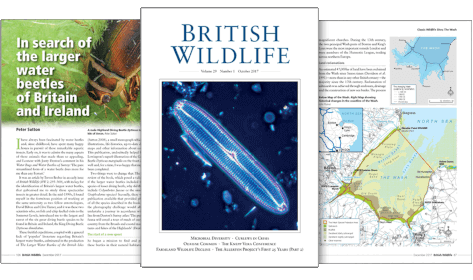
British Wildlife

8 issues per year 84 pages per issue Subscription only

British Wildlife is the leading natural history magazine in the UK, providing essential reading for both enthusiast and professional naturalists and wildlife conservationists. Published eight times a year, British Wildlife bridges the gap between popular writing and scientific literature through a combination of long-form articles, regular columns and reports, book reviews and letters.

Subscriptions from £33 per year

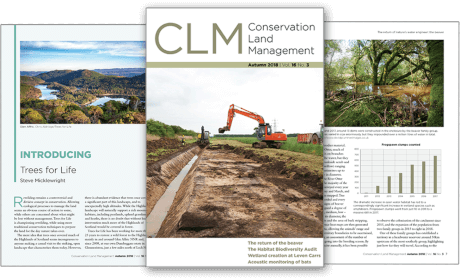
Conservation Land Management

4 issues per year 44 pages per issue Subscription only

Conservation Land Management (CLM) is a quarterly magazine that is widely regarded as essential reading for all who are involved in land management for nature conservation, across the British Isles. CLM includes long-form articles, events listings, publication reviews, new product information and updates, reports of conferences and letters.

Subscriptions from £26 per year
Academic & Professional Books  Organismal to Molecular Biology  Microbiology

Deep Life The Hunt for the Hidden Biology of Earth, Mars, and Beyond

Popular Science
By: Tullis C Onstott(Author)
486 pages, 32 b/w photos, 19 b/w illustrations
NHBS
Deep Life is a detailed eyewitness account of our discovery of Earth's subsurface biosphere.
Deep Life
Click to have a closer look
Select version
Average customer review
  • Deep Life ISBN: 9780691202822 Paperback Jul 2020 Not in stock: Usually dispatched within 1 week
    £19.99
    #249722
  • Deep Life ISBN: 9780691096445 Hardback Nov 2016 In stock
    £29.99
    #234467
Selected version: £19.99
About this book Contents Customer reviews Biography Related titles Recommended titles

About this book

Deep Life takes readers to uncharted regions deep beneath Earth's crust in search of life in extreme environments and reveals how astonishing new discoveries by geomicrobiologists are helping the quest to find life in the solar system.

Tullis Onstott, named one of the 100 most influential people in America by Time magazine, provides an insider's look at the pioneering fieldwork that is shining vital new light on Earth's hidden biology – a thriving subterranean biosphere that scientists once thought to be impossible. Come along on epic descents two miles underground into South African gold mines to experience the challenges that Onstott and his team had to overcome. Join them in their search for microbes in the ancient seabed below the desert floor in the American Southwest, and travel deep beneath the frozen wastelands of the Arctic tundra to discover life as it could exist on Mars.

Blending cutting-edge science with thrilling scientific adventure, Deep Life features rare and unusual encounters with exotic life forms, including a bacterium living off radiation and a hermaphroditic troglodytic worm that has changed our understanding of how complex subsurface life can really be. This unforgettable book takes you to the absolute limits of life – the biotic fringe – where today's scientists hope to discover the very origins of life itself.

Contents

Foreword   ix
Acknowledgments   xiii
Abbreviations   xv
Introduction   1

1 Triassic Park   12
2 The Treasure of Cerro Negro   56
3 Bikers, Bombs, and the Death-o-Meter   103
4 Microbes in Meteorites!   126
5 Life in Deepest, Darkest Africa   143
6 Hunting for Water and Carbon   172
7 The Subterranauts   198
8 A Lot of Breaks and One Lucky Strike   234
9 Life beneath the Ice   265
10 The Worm from Hell   333

Epilogue   357
Appendix A: Chronology of the Exploration of Subsurface Life   365
Appendix B: Chronology of the Meeting of the U.S. DOE’s SSP Meetings   377
Notes   381
References   463
Index   473

Customer Reviews (1)

  • A detailed eyewitness account of our discovery of Earth's subsurface biosphere
    By Leon (NHBS Catalogue Editor) 9 Sep 2025 Written for Paperback


    One of the more exciting developments in biology in recent decades is the full-blown realisation that there is an enormous biosphere underneath our feet that rivals the surface world in biomass. With the recent publication of Karen G. Lloyd's Intraterrestrials, I decided this was a great opportunity to finally read Deep Life that I bought over seven years ago. In it, the late Tullis C. Onstott gives an in-depth account of research into the subsurface biosphere over the 23 years from 1986 to 2009, with his own entry into this field happening in 1992. It is equal parts geomicrobiology and science history, told as a chronological narrative of the research he was involved in.

    Let me delve into the geomicrobiology first, as that is really why I wanted to read this book. As was true of early research on ancient DNA, the concern of contamination was a major stumbling block and an important hurdle to clear for this field to really take off. The first few chapters thus spill quite some ink walking you through the so-called quality assurance and quality control protocols they developed. After convincing critics and themselves that the microbes they were finding were indigenous to the subsurface and not introduced during retrieval and handling, the book can pivot to describing these weird and wonderful extremophiles. One question that occupies Onstott and his colleagues throughout this book is where these microbes get their energy from, as it cannot be from photosynthesis. Over time, evidence starts stacking up in favour of radiolysis. This is the process whereby ionising radiation produced by decaying radioactive material cleaves the bonds of nearby molecules. This could produce some of the hydrogen, oxygen, sulfate, and other nutrients these microbes feed on.

    Equally remarkable is that these microbes live life in the slow lane, dividing once every few centuries or much less, potentially resulting in lifespans of a million years or more. This is where you start approaching life's edge, with some of the microbes they are retrieving chronically starved and much reduced in size, or in stasis with metabolisms ground to a halt. Movement similarly happens slowly as infiltrating groundwater moves through rock pores on geological time scales.

    One thing to keep in mind, which Onstott does not make explicit as they search for microbial life in the ultra-deep gold mines in South Africa, is that this research often relies on indirect evidence. The water they gather when the miners breach water-bearing geological fractures is checked for genetic material using an approach known as metagenomics. The advantage is that you do not have to grow microbes in culture, meaning that many species that were previously missed or hard to grow in the lab have now been identified. The disadvantage is that you do not have to grow microbes in culture, meaning that we know very little about them beyond their identity: we have effectively found their calling card, but most have never been observed under the microscope.

    A final notable aspect is what these microbes are capable of collectively. Some of the work Onstott initially did under the banner of the US Department of Energy focuses on bioremediation of e.g. radioactive and chemical waste. In South Africa, there similarly is the hope to use microbes to clean up the toxic legacy of a century of heavy-metal mining. And then there is the astrobiology angle. NASA hopes to learn from our attempts at exploring Earth's subsurface biosphere for finding life elsewhere in the universe. The last chapter discusses how some microbes might be responsible for cave formation, with limestone being corroded from below by sulfuric acid that is a byproduct of sulfur-oxidising bacteria.

    At 486 pages, Deep Life is a big book, and the gotcha is that you have to wade through a lot of background material. The above insights are not explicitly summarised and presented to you, but surface in bits and pieces as you follow Onstott on his research journey, with the book written as a blow-by-blow, year-by-year eyewitness account. He goes into great detail on the practical obstacles and research questions he and his collaborators wrestle with and how they find solutions, or fail to. I hope you like engineering details on drilling and mining, because there is plenty of both here! He talks at length about his colleagues, the conferences and workshops he attends, the organisations he works for, the companies he works with, and the places he works in. Though not intended as a history of the discipline, elements of this are woven throughout with two appendices giving chronologies. There are numerous abbreviations for chemicals, methodologies, research programmes, and organisations sprinkled throughout the text, and you will want to bookmark the 3-page list at the beginning. Additional details on methods, people, and places are provided in 81 pages of endnotes, with individual notes sometimes running to two pages.

    In short, Deep Life provides an insider's perspective of this kind of research, showing you how the sausage is made. Conceivably, some readers might get frustrated and wonder where the editor was. I am a pretty tolerant and patient reader and instead found myself fascinated by some of the engineering details. Notably, Onstott is unapologetically candid about his own ignorance. Given he was trained as a geologist, getting to grips with microbiology and genetics was a long and hard intellectual journey, and he openly writes about the moments where he felt clueless. If I have to criticise him, it is for a certain naivety I noticed. Much of this research rides on the coattails of extractive industries which are in the costly business of venturing underground. It does feel a little incongruent when in Nunavut, he wistfully observes that "it was reassuring that parts of the planet still existed that had not been completely overrun by the resource extractors" (p. 311) when he is literally working in a mining concession. I do not think this makes such research morally "wrong", but do not expect much in the way of Onstott reckoning with how the two are entwined.

    Overall, though I found Deep Life< interesting, it will likely test the patience of some readers. This is less a book about geomicrobiology and more a book about *doing* geomicrobiology. Onstott is a knowledgeable guide who was clearly deeply embedded in the research community while helping to advance this field by leaps and bounds, but the intense focus on the daily realities of such research threatens to smother the otherwise fascinating subject matter. With Deep Life charting research up to 2009, I am next turning to Intraterrestrials to fill me in on more recent developments.
    Was this helpful to you? Yes No

Biography

Tullis C. Onstott (1955–2021) was a professor of geosciences at Princeton University. He lived in Stockton, New Jersey.

Popular Science
By: Tullis C Onstott(Author)
486 pages, 32 b/w photos, 19 b/w illustrations
NHBS
Deep Life is a detailed eyewitness account of our discovery of Earth's subsurface biosphere.
Media reviews

"Onstott so beautifully conveys his excitement that laypeople and scientists alike will find [Deep Life] a worthwhile read."
Publishers Weekly

"Deep Life tackles one of the most mysterious, sexiest questions in science today: Is there life beyond Earth? [...] Onstott's argument is both profound – we can't understand life on other planets without understanding life on our own – and surprising, pleasing any amateur extraterrestrial beep hunter."
– Sarah Sloat, Inverse

"Extreme environments beneath Earth's surface could well be the crucible where life was forged, and studying the weird creatures that live in such locales could well shed light on how life could endure in Mars' deep crust or Europa's hidden ocean. Geoscientist Tullis C. Onstott brings you along on the hunt."
– Alan Boyle, GeekWire

"Life can thrive in the most inhospitable places. And finding out just how inhospitable has been the life's work of Tullis Onstott [...] While rooted in the earth, the study may also help in the quest to find life in the solar system and beyond. This amazing journey takes us from deep in a South African gold mine, to the ancient seabed below a desert floor to travel deep beneath the frozen Arctic tundra."
Cosmos Magazine

"Tullis Onstott has been at the forefront of the exploration of [the Earth's] subterranean mysteries. If you had to compare him to an iconic figure, I don't think you'd go far wrong seeing him as a microbiologist Indiana Jones, clambering through dimly lit mining tunnels far below the surface, sampling tubes in hand [...] Along the way, he addresses some of the deepest questions – if you'll excuse the pun – in modern biology [...] [This book] offers great insights for science historians or students in the discipline."
– Lewis Dartnell, Times Higher Education

"Deep Life is both gripping and powerful in its immediacy, so much so that no matter your background, if you have any concern for the future of this planet and its place in the universe, it is well worth spending some time considering the bearing that Onstott's propositions and implications might have on your own future."
– Lois C. Henderson, Bookpleasures.com

"Onstott takes us on a journey to discover and understand the limits of life beneath the surface of our planet [...] The author, a brilliant geomicrobiologist, shares his passion for this relatively new field of research. It is difficult to ignore the infectious enthusiasm that permeates the narrative."
– Lisa Kaaki, Arab News

"Onstott is truly a bold front-runner in deep subsurface microbiology and a great role model for anyone in geology who aspires to become a successful geomicrobiologist. Reading this book makes me feel lucky to have witnessed some of these explorations firsthand. I am also amazed by their vivid descriptions, which sometimes read like science fiction."
– Chuanlun Zhang, Tongji University

"The discovery of deep biosphere is a fascinating chapter in the history of astrobiology, and Onstott was at the bottom of it all – literally, when he and his team were searching for life in the deepest mines on Earth. This detailed and well-written book explains the importance of the subsurface biosphere and why those of us interested in the search for life on Mars are so interested in life deep underground."
– Chris McKay, NASA Ames Research Center

"Deep Life is an engaging historical account of the discovery and exploration of Earth's newest known biome, the deep subsurface. Onstott vividly chronicles the emergence of this new field by transporting the reader to the drill rigs, mines, and laboratories where fundamental discoveries that have changed our understanding of the nature of life itself and its relationship to our planet – and possibly others – were made."
– Duane Moser, Desert Research Institute

"Onstott takes readers on a journey of discovery, weaving his personal reflections on his exploits in the field with just the right amount of science. He shows how field science is challenging, exciting, and full of adventure."
– Gordon Southam, University of Queensland

Current promotions
Great GiftsNew and Forthcoming BooksBritish Wildlife Magazine SubscriptionField Guide Sale 2025